
When One Voice Fills the Room
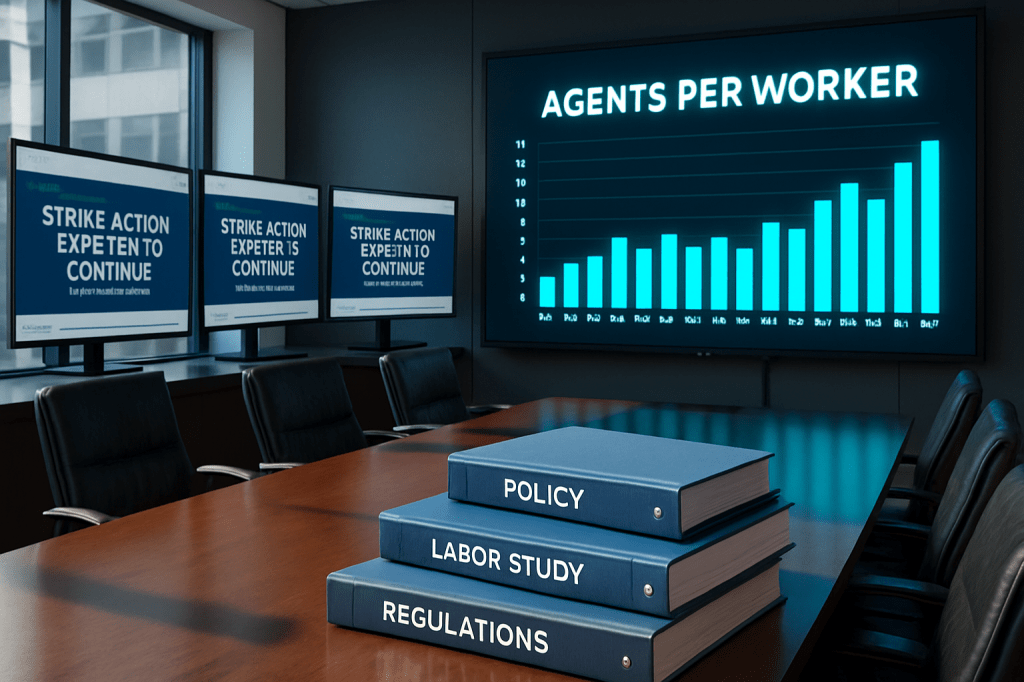
By midmorning yesterday, my tabs looked like a glitch. Different mastheads, same cadence. Every outlet that usually argues over the future of labor had synchronized into a single note: more reflections on Nvidia’s GTC spectacle and, specifically, Jensen Huang’s vision of “AI agents per worker.” Fortune echoed it. Comment threads stitched it into a banner. Meanwhile, the rest of the day’s calendar offered only webinars and event listings—the digital equivalent of polite chatter in the hallway while a keynote overruns the schedule.
This wasn’t a slow news day. It was a crowded one. And that difference matters. When a single company’s framing monopolizes the conversation, it doesn’t just win the headline race; it drafts the vocabulary of the next quarter’s board decks and HR memos. That’s the story worth telling: not what was said on stage—that’s already been replayed—but what happens to work when the day’s discourse compresses into one narrative and everything else yields the floor.
The power to name the ratio
“Agents per worker” sounds tidy because it is. Ratios invite budgets. They turn a sprawling idea—software that does work alongside you—into a line item that CFOs can chart and managers can target. Two decades ago, “laptops per employee” made endpoint computing a cost model rather than a debate. “SaaS seats per headcount” did the same for software. A ratio like this doesn’t just describe a future; it proposes a management technique and, in doing so, suggests a performance metric. How many agents are you orchestrating? Why not more?
That is the subtlety of a monoculture news day: the frame becomes the default. If yesterday’s briefings and think pieces all tug on the same thread, today’s staff meetings will, too. Procurement teams will be asked to explore bundles that map cleanly to a ratio; HR will be asked to chart roles against an implicit expectation that each person supervises a fleet of nonhuman teammates; compliance will be asked how to audit the outputs of a thing that isn’t an employee but does work like one. A single line, amplified widely, can reshape not just technology adoption but the contours of a job description.
The missing counterpoint
What didn’t surface yesterday is as revealing as what did. There was no marquee policy development to counterweight the vendor vision. No major labor study to recalibrate the forecast. No significant legal ruling to define what accountability looks like when an “agent” commits an error that cascades into a workplace injury, a biased screening, or a broken contract. The editorial oxygen was consumed by amplification and commentary on that keynote line—and that means the guardrails didn’t get their turn at the microphone.
That asymmetry has a cost. Unions and worker advocacy groups lose a day of share-of-voice just when a new management construct is hardening in executives’ minds. Regulators miss the moment to pose the boring but essential questions about recordkeeping, audit trails, and recourse. And the public, already attuned to the spectacle of demos, receives less coverage of the seams where real jobs fray: handoffs between human judgment and agent autonomy, liability splits when things go wrong, or the practicalities of retraining at the speed vendors promise transformation.
From tools to teammates to throughput
There’s a deeper shift tucked inside the agent-per-worker motif. We’ve moved from “AI as tool” to “AI as teammate” to something cooler and more operational: throughput. The narrative invites organizations to re-imagine a worker’s span of control as a span of orchestration. If you buy into that, you don’t just deploy assistants; you reassign accountability. Supervising output becomes as important as generating it. Middle management mutates into traffic control. Process design—what gets automated, what gets escalated—becomes the new craft.
Under that model, job security decouples from domain expertise and reattaches to configuration and oversight. The person who understands how to combine prompts, review queues, and exception handling takes precedence over the person who used to do the task end to end. That’s not inherently dystopian, but it is disruptive in a very specific way: it rewards being good at systems while compressing the value of singular skill. On a day when the storyline is unified, that nuance risks getting flattened into slogans about productivity.
Bundling the future of work
There is also an obvious commercial plotline. A ratio prefigures a bundle. If workplaces start counting agents, they will shop for kits: the hardware behind the models, the platforms to deploy them, the orchestration layers to connect them, and the dashboards to prove they’re working. In a world where one vendor narrative dominates the day, that bundle quickly looks like a default stack. Interoperability, portability, and open standards recede into the footnotes. The supplier who sets the metric angles to sell the measurement tool.
That has implications for bargaining power inside companies as much as between them. Finance will see a way to swap payroll growth for operating expense tied to software and compute. Departments will find their autonomy narrowing as agent choices standardize across the enterprise. And individual workers will encounter a familiar ultimatum in a new shape: adapt to the platform’s way of working, or be labeled inefficient not because your output fell, but because your orchestration ratio didn’t climb.
The sound of everyone agreeing
It’s tempting to chalk up yesterday’s sameness to logistics. Big conferences draw coverage; sensible PR teams avoid launching competing stories; editors prioritize what readers click. All true. But in markets that move on narrative as much as on benchmarks, a day like this does more than round out the news cycle. It sets the default assumption for a quarter. When you look back at inflection points in workplace technology, you can often trace them to the moment a phrase jumped from keynote to committee meeting. We may have watched such a jump in real time.
Oddly, the most interesting signals yesterday sat in the corners: the event listings, the webinars, the minor posts with niche audiences. That’s where practice takes shape while the spotlight sits elsewhere. Managers trade checklists. Consultants assemble playbooks. Early adopters quietly fail and adjust. If you want to understand how “agents per worker” becomes more than a catchphrase, watch the people booking those sessions. They will turn rhetoric into routines—defining review thresholds, codifying escalation, discovering which roles bloat under the weight of oversight and which actually shrink.
Read the vacuum
So yes, the biggest single story in AI and employment yesterday was the same story you’ve already heard: Nvidia’s vision, echoed and refracted. But the absence of a strong counter-story is itself a headline. It means the framing will harden faster. It means pilots will proliferate with fewer public debates about what should and shouldn’t be automated. It means job postings will begin to smuggle expectations—“experience orchestrating autonomous agents”—into roles that, last month, demanded none of it.
On “AI Replaced Me,” we try not to mistake volume for truth. Yesterday’s chorus was loud. The task now is to listen for the quiet parts it drowned out, because that is where the future of work actually gets written: not on a stage, but in the tension between a neat ratio and the messy business of keeping people, processes, and accountability aligned when software starts to count as a colleague.
