
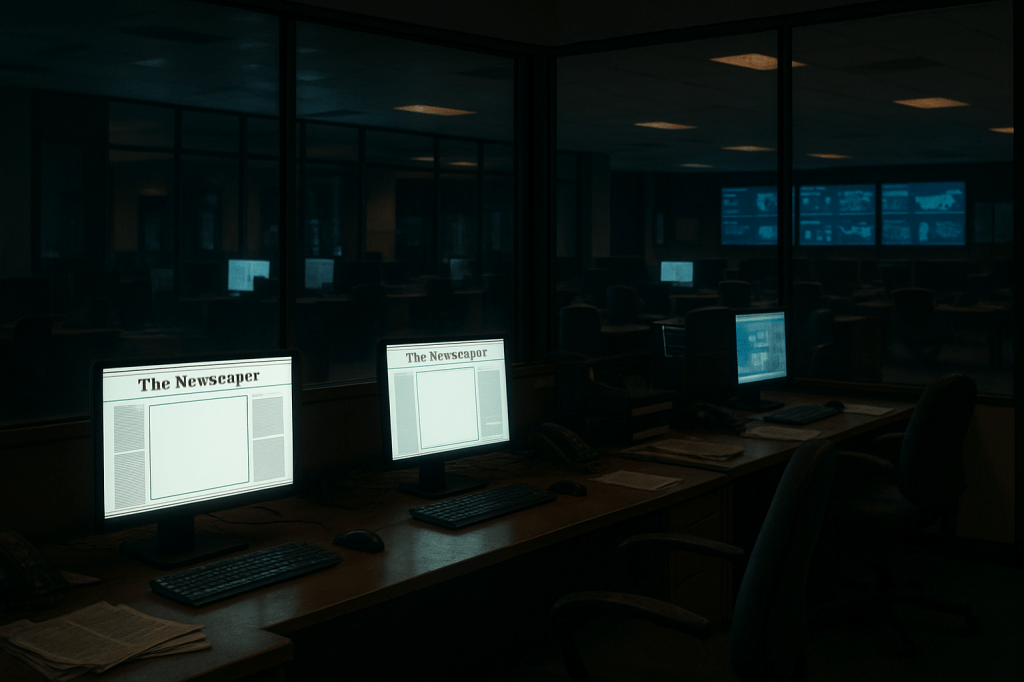
The Biggest Story Was the Silence
Yesterday, the AI-and-work beat didn’t deliver a banner headline. Across the Washington Post’s business and tech pages, the AP’s weekend file, the Guardian’s AI section, and the usual trade stalwarts, the story that usually finds us simply didn’t appear. On Saturday, March 21, 2026, the public narrative of how AI is reshaping employment took a day off—and that absence is its own signal.
Weekend news has a rhythm. Event listings crowd out long reads; editors hold investigations for weekday attention; policy drops aim for peak traffic, not a Saturday scroll. But the quiet wasn’t just scheduling. It reflected a transition already underway: AI at work is slipping from spectacle into substrate. The standout pieces landed earlier in the month—a senator’s letter urging BLS and the Census Bureau to measure AI’s effects on jobs, Gallup’s survey tracking workplace usage, and a run of analysis essays setting frames for what comes next. By Saturday, the agenda-setting items had dispersed into the background. The machinery kept running; the narrative pipeline did not.
This is what happens when disruption becomes infrastructure. You don’t get daily exposés about spreadsheets, even though they silently reorganize how an office functions. Likewise, the most consequential shifts in AI and employment tend to materialize in the places news doesn’t linger: a contact center piloting new routing models on the weekend shift; a mid-market firm quietly standardizing AI assistants across its back office; a school district tweaking its procurement language to allow model-assisted grading under a different budget line. They aren’t splashy, but they change whose time is valued, which tasks are bundled into which roles, and who trains whom to keep the lights on.
That earlier letter to the statistical agencies matters precisely because it acknowledges this drift from dramatic to granular. If we don’t instrument the economy to see task-level substitution and augmentation, we’re left chasing anecdotes. Weekly headlines can tell you who’s anxious and who’s optimistic; official time-use series, occupational reclassification, and longitudinal wage data tell you who actually did less of one thing and more of another. When Saturday delivers nothing, it’s a reminder that our measurement systems still trail our intuitions.
The weekend lull also exposes a tension between the editorial economy and the labor economy. The former wants a peg—a company announcing a restructuring “because AI,” a regulator brandishing a rule, a union drawing a red line. The latter advances by accretion: model access widens, defaults change in software people already use, frontline managers shift KPIs to reflect what tools can now do. Policy frameworks tend to drop on Thursdays and Fridays; feature pieces arrive midweek; but the reallocation of tasks happens continuously, indifferent to the calendar.
So the absence of a marquee story is not a reprieve. It’s a diagnostics problem. The next phase of AI’s impact on employment will be less about sudden decapitations of job categories and more about the seepage of capability into workflows, affecting hours before titles, margins before headlines. You see it in usage surveys that point to a steady climb of on-the-job experimentation; you hear it in bargaining tables where “consult the model” becomes a clause rather than a press release. By the time a weekend-worthy story emerges, the baseline will already have shifted.
For a publication that tracks disruption, this is the uncomfortable truth: on some days, the biggest story is the one we can’t quote because it never coalesced into a single article. Yesterday was one of those days. The beat went quiet, and the work of replacement carried on—in dashboards, in handoffs, in expectations baked into software updates no one thought to announce. We’ll keep following the visible clashes. But when the front page blinks, pay attention to the infrastructure being built in the dark. That’s where your next job description is being written.
