
When the Big Story Doesn’t Show Up
Yesterday I went looking for the thunderclap—the headline-sized jolt that says, “Here is where the jobs moved.” Instead, there was a quiet. After scanning the majors, no single, well-sourced AI-and-employment splash stood out for Monday, March 23, 2026. No mass layoff tied to a model. No grand unveiling of a machine that redraws a profession in one afternoon. The absence felt like a void at first, until it didn’t. Because this is the moment the plot turns: the big story about AI and work is no longer a single event. It’s the slow, relentless migration of decision rights from humans to systems, carried by a thousand small approvals that never make the front page.
The Day the Headline Became Background
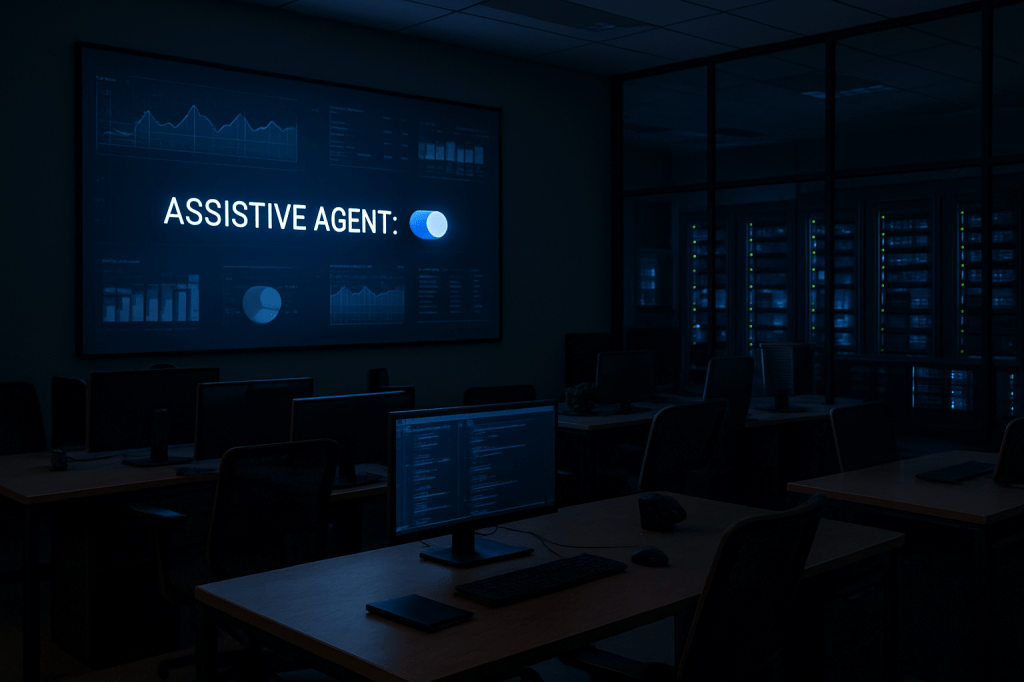
This is what normalization sounds like. A procurement manager greenlights 400 seats of an “assistive agent” and calls it a pilot. A hospital flips on auto-drafted notes for one department, just to see. A logistics firm routes exception handling through a model and frames it as standardization. None of those choices looks decisive. They don’t read as a sweeping declaration of “AI replaced us.” But stitched together, they move the line that separates what people do from what the system does. We used to measure disruption in dramatic exits; now it’s accretion. The work doesn’t vanish with a headline. It slides sideways into software while job descriptions keep their old names a little longer than they should.
The Economics of a Thousand Small Switches
When automation lives in one big machine, change looks like a plant closure. When it’s distributed across tools, change looks like better Tuesdays. Each team wins back minutes. Each manager squeezes a hiring plan by one head. Each budget review nudges more cost into “platform” and less into “people.” None of this sparks a sensation, but the arithmetic is unforgiving. A recurring 8 percent efficiency gain, applied in pockets and renewed with every software release, outruns a single 30 percent shock in one department. The market responds accordingly. Companies report margin improvements under the bland cover of “process optimization” and “software leverage,” while recruiters quietly rewrite job postings to emphasize oversight, curation, and exception arbitration over creation and routine execution.
The New Shape of Work Is Asymmetric
Readers of this site already know where the pressure lands first: the bottom rungs and the edges of process. What’s clearer this week is how the shape is settling. Juniors aren’t “replaced” so much as preempted; the job they would have had is now a workflow where a model drafts and a mid-level human signs off. Teams shrink at the base and widen at the top, with experienced operators becoming editors, auditors, and integrators. The moral is cold but direct: the easiest tasks go first, not because they’re unimportant, but because they’re most legible to a machine. This reorganizes incentive structures inside companies. Mentorship becomes a cost center if there are fewer true apprentices. Career ladders turn into ledges.
Why Silence Is the Signal
The lack of a dominant headline is not indecision from the industry. It’s the opposite. Vendors have learned to arrive as infrastructure rather than confrontation. Buyers have learned to wrap labor effects inside “tooling upgrades” that don’t trip panic or press. Unions and policymakers are left chasing vapor trails because the change is delivered as configuration, not decree. Compliance teams can point to human-in-the-loop flows, while the loop gets thinner each quarter. Finance departments get their savings through attrition and role redesign instead of conspicuous cuts. If you’re waiting for a smoking gun, you’ll miss the fog that changes everything.
Three Clocks That No Longer Tick Together
Capability moves fastest: every few weeks, a model gets better at understanding messy inputs and producing audited outputs. Deployment moves slower: it takes months to thread that capability through authentication, logging, approvals, and customer promises. Reporting moves slowest: by the time the impact shows up in filings or labor statistics, the decisions that caused it are a year old. Yesterday’s non-story lives in those gaps. Public discourse looks for the capability clock and expects employment consequences to sync. They don’t. This is why the news cycle feels out of step with what you’re seeing in your own org chart.
The Quiet Rewriting of Risk
Silence also masks a shift in what counts as risk. In 2023, the hazard was “model makes things up.” In 2026, the hazard is “organization trusts the model too much to maintain redundant skill.” When a workflow is rebased on an assistant, the muscle memory fades. A team that could once survive a system outage by falling back to manual is now culturally and practically dependent on prompts, templates, and checks that don’t exist offline. The risk manager’s job flips: instead of preventing the model from acting, they must preserve enough human competence to catch it when it fails. That’s a governance problem with a half-life; it decays if you don’t constantly replenish it.
How to Read the Week Without a Headline
When the big story declines to present itself, you read the margins. Watch how vendors describe “coverage” of tasks instead of announcing new domains. Track internal language: words like “assist,” “triage,” and “review” quietly widen their scope. Listen to how hiring managers justify not backfilling a departure and how they rationalize raising the bar for entry-level roles. Follow the footnotes in earnings calls where “efficiency from automation” becomes a reliable phrase rather than a one-off boast. The signals aren’t flashy, but they rhyme.
What It Means If You’re the Work
If your output is already touched by a model, assume the next step is that your input will be structured for one. The work migrates toward interfaces: designing prompts that are actually specifications, reviewing outputs that are actually audits, and stitching tools that are actually management. The advantage moves to people who can turn messy intent into machine legibility, then turn machine output back into judgment a customer trusts. That’s not a platitude about “learn AI.” It’s a concrete shift in where value shows up and how it’s measured. Titles stay the same; the verbs change.
The Takeaway
Yesterday’s biggest story about AI and employment is that there wasn’t a biggest story. That’s not a lull; it’s a phase change. The drama has drained out of the headlines because it has soaked into the infrastructure. Displacement is arriving as defaults, not declarations. For workers, the danger is delay—waiting for a marquee moment to tell you the ground moved. For leaders, the risk is mistaking noise for cover and underinvesting in the hard parts: redesigning workflows, rebuilding ladders, and preserving enough human skill to keep the system honest. If you insist on a line to hold onto, take this one: the future isn’t coming as a press release. It’s shipping as a settings page.
