Google Tries to Script the Future of Work—and Invites Washington to Workshop the Ending
In a city that lives on talking points, Google showed up yesterday with something sturdier than a memo. The company didn’t just pitch a vision of “AI jobs.” It staged a scene: a DC convening where agency heads, executives, and advocates could argue over the shape of the labor market while Google rolled out programs that speak the policy language of the moment—apprenticeships, regional manufacturing, rural health care—and numbers designed to stick in a lawmaker’s head.
The offer on the table
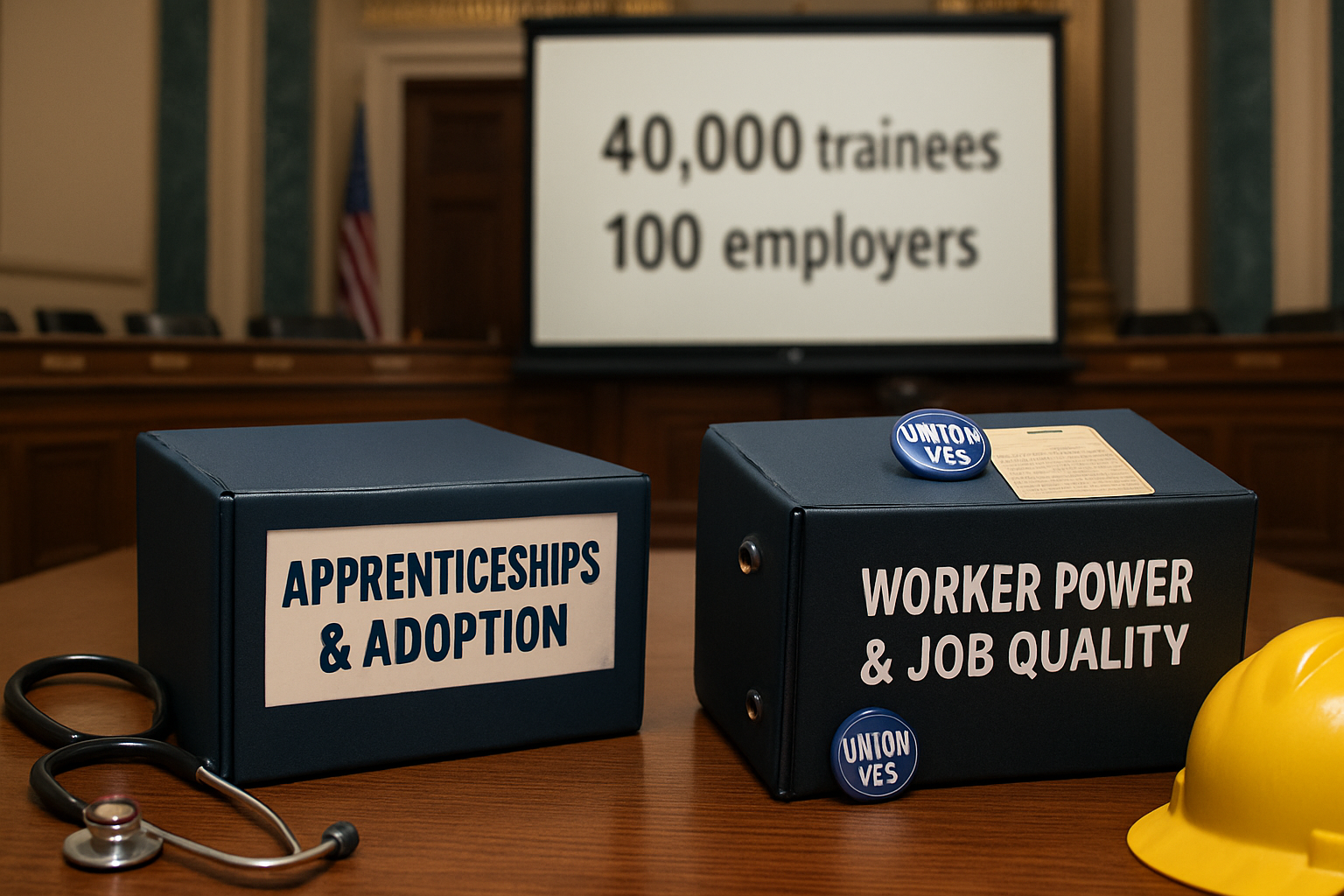
Three commitments anchored the day. First, a health care push with the Johnson & Johnson Foundation to hand rural providers AI that shaves paperwork time in short-staffed clinics. Second, a coalition with Jobs for the Future to assemble one hundred employers into new AI-fluent apprenticeships, the rare workforce pathway DC can agree is both fast and credible. Third, with the Manufacturing Institute, training forty thousand workers in AI skills and expanding apprenticeship infrastructure to fifteen additional regions—an unmistakable nod to the country’s reindustrialization project.
These are not economy-scale numbers, but they are agenda-scale numbers. They are big enough to populate press releases and appropriations hearings, small enough to spin up quickly, and aimed squarely at sectors with political salience: the hospital that can’t fill the night shift, the factory relearning how to hire, the regional coalition trying to become more than a slide in an economic development deck. This is diffusion strategy as theater: create pilots that look like policy outcomes, then ask government to meet them halfway.
Framing the choice
Google’s chief economist, Fabien Curto Millet, put the company’s thesis in one line: “AI is not something that is happening to us. It is something that we get to shape.” That isn’t just rhetoric. It’s a claim about the locus of control—and a bid to define what, exactly, counts as shaping. Alongside the programs, Google endorsed a slate of bipartisan bills to measure AI’s economic effects, expand public–private training, and nudge “worker‑empowering” adoption. Measurement up front is not neutral; whoever designs the scorecard influences which outcomes look like success. If Washington funds dashboards that track productivity and vacancies but underweight job quality, scheduling stability, or wage progression, policy will reward “adoption” even when value accrues unevenly.
There’s also a quieter ambition here: standardize the vocabulary. Call it “workforce preparedness,” not displacement; “apprenticeships,” not job ladders; “AI for Main Street,” not enterprise capture. If the bipartisan center rallies around this lexicon, the corridor for permissible regulation narrows, and the subsidies, audits, and tax credits that follow will privilege implementations that fit the frame. In other words, set the baseline, and the rest becomes a negotiation over coefficients.
The counterclaim: power before pedagogy
Organized labor arrived with a different center of gravity. AFL‑CIO spokesperson Steve Smith argued that any “worker‑centered AI strategy” starts with the ability to unionize; otherwise, deployment happens “at the whim of a CEO.” That is a clean split with Google’s training-first posture. Training answers who can operate the tools. Unions answer who decides when to deploy them, how to share the gains, and what guardrails survive the next earnings call. Labor’s interest in state-level action is telling: states can move faster on rules for algorithmic monitoring, impact assessments before automation, and enforceable standards around data use and scheduling—areas where federal consensus is hard and the costs show up locally.
This is the live argument beneath yesterday’s optics. Is the AI transition mostly a skills allocation puzzle, solved by creating more on-ramps? Or is it a governance problem, solved by shifting bargaining power and setting hard lines around surveillance, workload, and pay? If you believe the first, you measure competencies and fund diffusion. If you believe the second, you measure control and legislate it.
Why yesterday mattered
Plenty of companies talk about responsible AI. Fewer arrive in Washington with a concrete package that can be lifted into budgets and bill text. By pairing a DC summit with tangible program targets—forty thousand trainees, one hundred companies—Google didn’t just preview a blueprint; it tested a coalition. And by responding in the same news cycle, labor forced the debate onto its preferred axis: not whether workers can learn the tools, but whether they have standing to shape how the tools are used.
The novelty isn’t the existence of training programs; it’s the attempt to fuse them with a measurement regime and bipartisan legislation so that “preparing for AI” becomes the default policy response. That would channel money toward adoption and skills—valuable, yes—but could also normalize deployments that erode autonomy if guardrails lag. The stakes are straightforward: in five years, we will either be counting apprenticeships and congratulating ourselves on time‑to‑productivity, or we will also be auditing how AI changes scheduling, pay bands, and supervision—and enforcing consequences when it goes wrong.
What to watch next
The proof will live in the seams. Do the rural health pilots measure time saved against new forms of digital oversight? Do the apprenticeships convert into stable roles with wage progression, or into a rotating bench of contingent talent? Does the one‑hundred‑company coalition reach small employers where adoption is hardest, or mostly badge recognizable brands? And in Congress, do the measurement and training bills incorporate job‑quality metrics and worker voice by design, or do those arrive later, after deployment norms have set?
Yesterday’s story made one thing clear: the contest over AI and employment is no longer abstract. One side is building institutions to accelerate diffusion with a veneer of worker empowerment; the other is racing to harden rights before the defaults ossify. Whoever wins gets to define what “good AI jobs” even means—and, by extension, who captures the value of the next productivity boom.