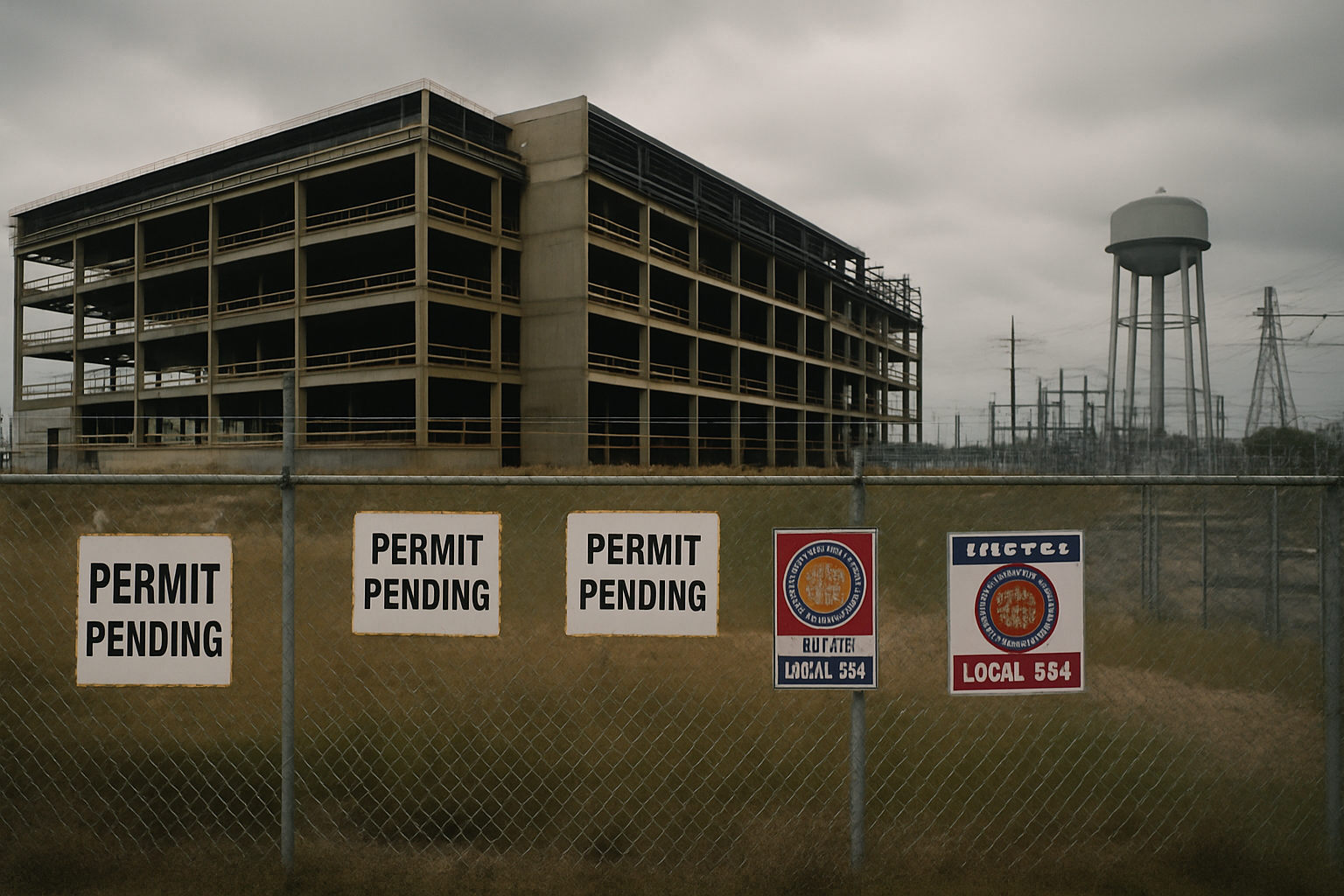
Labor Puts Its Hand on the Off Switch
Yesterday, the jobs debate around AI stopped being a conference panel and became a confrontation. On a D.C. stage, Senator Bernie Sanders stood shoulder to shoulder with the heads of America’s biggest unions and said the quiet part out loud: this isn’t a seminar about skills; it’s a fight over who gets to decide how technology reorganizes work. The coalition named names, cast tech’s leading figures as would-be oligarchs, and introduced a set of demands designed not to “prepare” workers for displacement but to prevent or reshape it. For an industry that has long treated deployment as destiny, this was a reminder that destiny can be regulated.
From abstractions to paychecks
For years, the AI conversation has hidden behind tidy vocabulary—tasks, augmentation, reskilling. The union leaders ripped off that protective casing. They talked about drivers, not datasets: truckers, bus operators, taxi and ride-hail drivers whose wages live and die by whether a safety driver sits in the front seat. They talked about who captures productivity, not whether the model gets 2% better on a benchmark. By invoking individual CEOs, they transformed automation from a story about neutral progress into a distributive decision about income, bargaining power, and the boundary between human judgment and machine control.
The new choke point: compute as a public utility
The most radical move wasn’t rhetorical; it was architectural. Calling for a moratorium on new AI data centers is a direct grab at the throttle of scale. Compute is to modern AI what track was to rail and right-of-way was to telecom. If you can pause expansions of the physical substrate—power-hungry, water-thirsty facilities that anchor model training and inference—you don’t just buy time; you set terms. Permits become policy levers. Environmental reviews become labor negotiations by other means. Local siting fights turn into national arguments over who shares in the gains when a jurisdiction hands over land, power, and tax abatements to spin up more GPUs.
This reframes AI growth from a purely software phenomenon into an industrial-policy question that touches utilities, grids, and municipal budgets. It also introduces a new style of bargaining: no longer just wages at the plant, but conditions on the construction of the plant that will define which jobs exist at all.
Robotaxis meet the human veto
The demand to keep safety drivers in robotaxis is similarly precise. It preserves a wage line item at the very point where autonomy seeks to erase it. This isn’t nostalgia for steering wheels; it’s an insistence that the path from prototype to profit must route through human employment. If the rule holds, the unit economics of autonomy bend back toward labor, and statewide deployments become contingent on the presence of a worker who can claim overtime, benefits, and a union card. In other words, a technical threshold becomes a labor threshold.
The settlement offer: time, not training
When UAW’s Shawn Fain ties this moment to a 32-hour week, he’s floating a price for automation’s dividends: we’ll accept machines that do more if people do less for the same pay. It drags the conversation out of the HR department and into the calendar. Unlike the familiar script—displacement now, retraining later—the shorter workweek treats productivity gains as something to distribute today, through time rather than tuition. It’s a structural hedge against “learn to code” promises that arrive years after the pink slip.
Inevitability with conditions
There was no denial that AI is advancing. The genius of the coalition’s stance is to concede momentum while contesting its terms. By centering transportation—where sensors meet streets and regulatory authority is tangible—they’ve chosen terrain where public safety, local politics, and labor law intersect. That intersection is fertile ground for hybrid agreements: staffing guarantees inside automated control rooms, profit-sharing tied to model performance, permitting rules that require labor-peace accords, and minimum human roles codified into system design.
The fight migrates: from code to concrete
Expect the conflict to drift from research labs into planning commissions and statehouses. Data center moratoria will pull in utilities and water boards. Robotaxi rules will pit DOTs and city councils against venture-backed burn rates. If Congress takes the bait, we’ll see hearings that stop asking whether AI is safe and start asking who captures its surplus and what human oversight is nonnegotiable. Insurance markets, municipal bond desks, and data center REITs will price this in long before the headlines catch up.
Why this matters to anyone who still works
April 16 didn’t answer whether AI replaces or augments. It changed who gets to pose the question. By converting compute, permits, and deployment timelines into bargaining chips, labor has located the levers that actually move the adoption curve. Tech can still ship, but it may no longer dictate. The new normal is negotiation at the point of infrastructure, where the story of AI ceases to be about clever models and becomes a civic choice about the future of paid work.