Security Is Now the Bottleneck, Not the Budget
Yesterday in Minneapolis, amid the usual declarations about faster models and bigger clusters, the Linux Foundation dropped a quieter bombshell: the brake on AI adoption has shifted from money to maturity. Their 2026 State of Tech Talent Report, unveiled at the Open Source Summit North America, calls it an “AI security readiness crisis.” Translation: most organizations are done debating if they’ll use AI. They’re stuck figuring out how to run it without tripping alarms.
That pivot is measurable. Two years ago, just 17% of organizations pointed to security as their top obstacle. Now it’s 48%. Nearly every company surveyed—97%—is committed to implementing AI, yet more than half report shortfalls in AI security and risk management and in AI operations and monitoring. Forty-three percent say security concerns are directly blocking AI’s promised value, edging out cost, general skill gaps, and creaky legacy systems. AI didn’t stall; operational discipline did.
The Hiring Story You Weren’t Expecting
This crisis isn’t shrinking teams; it’s redrawing them. Against the drumbeat of layoff headlines, organizations report a +26% net hiring effect for 2025 and project +31% for 2026 in AI-touched tech roles. Even entry-level IT, supposedly doomed by automation, is projected to rise 8%. The acceleration is sharpest in software development, technical management, IT operations, and QA/testing—places where AI gets woven into production, audited, and kept upright when something strange happens at 2 a.m.
The labor market signal is unambiguous: employers no longer want only “AI builders.” They’re staffing up “secure-AI operators”—engineers and managers who can harden pipelines, govern data flows, monitor model behavior, validate outputs, and keep a ledger of who changed what, when, and why. This is headcount moving from experimentation to accountability, from a handful of researchers to the teams that make software a dependable business system.
Upskilling Is Winning the Economics
The report’s most pragmatic finding is where organizations are getting this talent: they’re not buying it, they’re building it. Fifty-seven percent say upskilling existing staff is their primary response to AI talent gaps. The math explains why. Compared with outside hiring, internal training is credited with a 7.9× advantage on business context, 7.7× on retention, 7.3× on team cohesion, and a 5× edge on total cost. It’s easier to teach an ops engineer prompt-injection defenses than to teach a new hire your entire incident playbook and org chart.
There’s a deeper strategic angle here. AI security, unlike traditional perimeter defense, straddles data governance, application behavior, and human workflows. The people who already know where your data lives, which dashboards actually get read, and how compliance works on bad days are the ones who can turn a security checklist into a living control system. That tacit knowledge is the moat, and training is a way to widen it.
Operations Is the New R&D
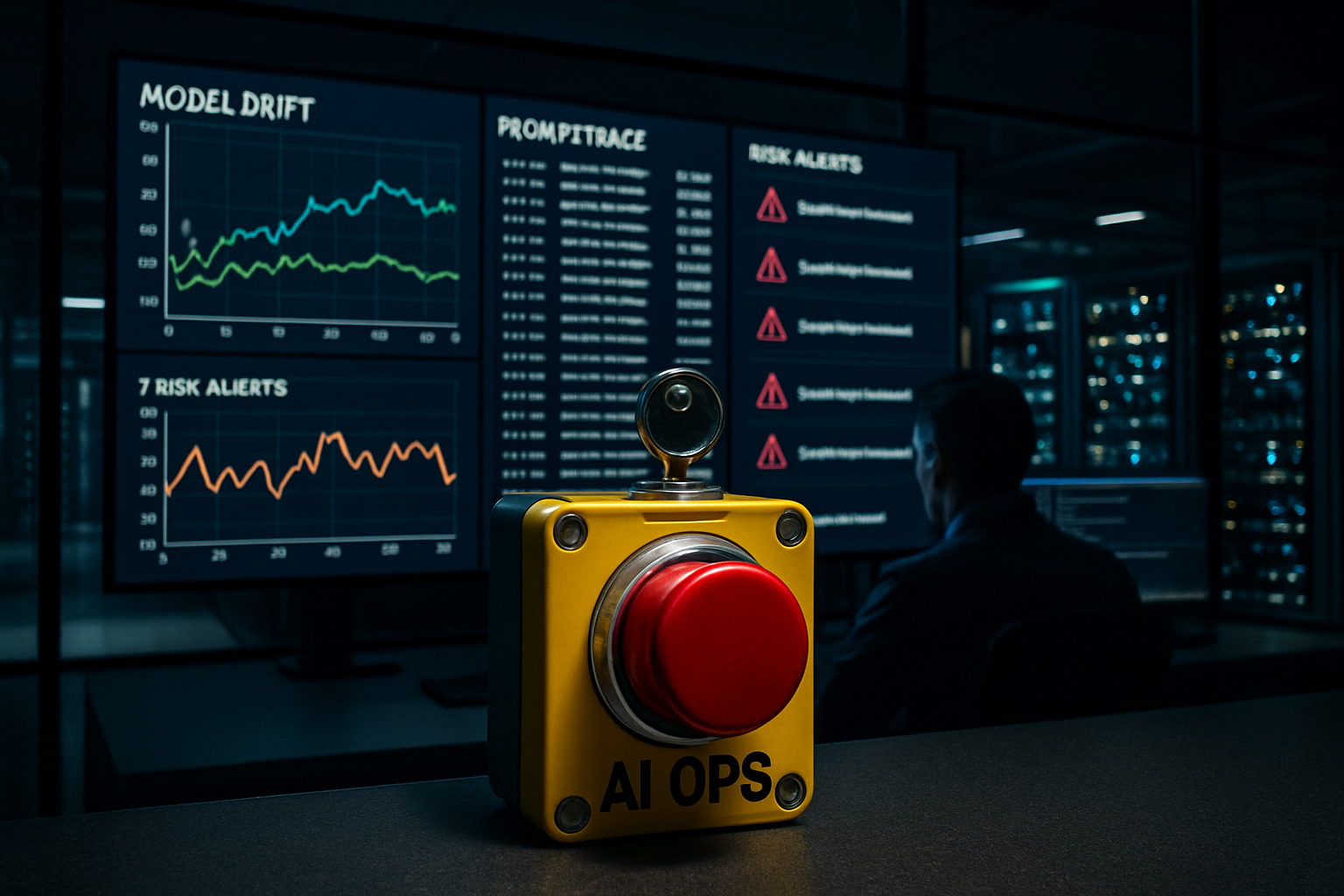
The capability gaps tell you where the jobs are going. Shortfalls cluster around AI security and risk management, AI operations and monitoring, cost optimization, and infrastructure expertise. These aren’t research problems; they’re production problems. They demand observability for models and data, red-teaming that looks like your adversaries not your slide decks, policy enforcement that survives a product pivot, and cost controls that don’t quietly incentivize shadow deployments. This is SRE for probabilistic systems: measuring drift, tracing prompts, restricting tools, and treating model updates with the same ceremony you’d give a database migration in a regulated environment.
As organizations thread AI into billing, customer support, compliance review, and code generation, the attack surface changes character. It’s less about a single catastrophic breach and more about a thousand small failure modes—leaky prompts, hallucinated actions, skewed decision trails—that only disciplined operations can catch. The report’s numbers make that reality legible: security is now the gating factor for value realization.
What This Means If You Build or Run Systems
Job descriptions are already mutating. DevOps and SRE roles now include model telemetry, prompt and tool governance, and kill switches that work under real load. Security teams are adding red-team exercises for AI features and supply-chain checks for model artifacts. QA is evolving from pass/fail to statistical assurance, with test plans that observe distributions, not just thresholds. Managers are on the hook for showing that AI changes reduce toil without creating audit debt. The standout candidates won’t be those who can merely fine-tune; they’ll be the ones who can explain, in your environment, how the fine-tuned model will fail—and what will contain the blast radius.
Read the Footnotes, Keep the Signal
Yes, this is a vendor-sponsored snapshot: a Linux Foundation press release summarizing a survey of 400 global IT hiring and training leaders conducted with KodeKloud, LF Research, and Linux Foundation Education. Samples and timing always shape results. But the deltas are too large to ignore: security surging from 17% to 48% as the top barrier, net hiring swinging positive, and upskilling beating external hiring by wide margins on cost and cohesion. Even with caveats, that’s a labor market contour, not a blip.
The Quiet Reordering
Yesterday’s most important jobs story wasn’t another forecast of displacement. It was a reprioritization: the center of gravity for AI talent is moving into security and operations. Organizations that invest in cross-skilling today will capture value faster than rivals trying to poach their way to readiness. And for workers, the safest bet is no longer being the person who builds the smartest model—it’s becoming the person who can keep a merely good model safe, observable, and accountable inside a messy, regulated, cost-sensitive business. That’s where the hiring is, and that’s where the leverage sits.
Source: Linux Foundation, 2026 State of Tech Talent Report, announced May 18, 2026 at Open Source Summit North America.