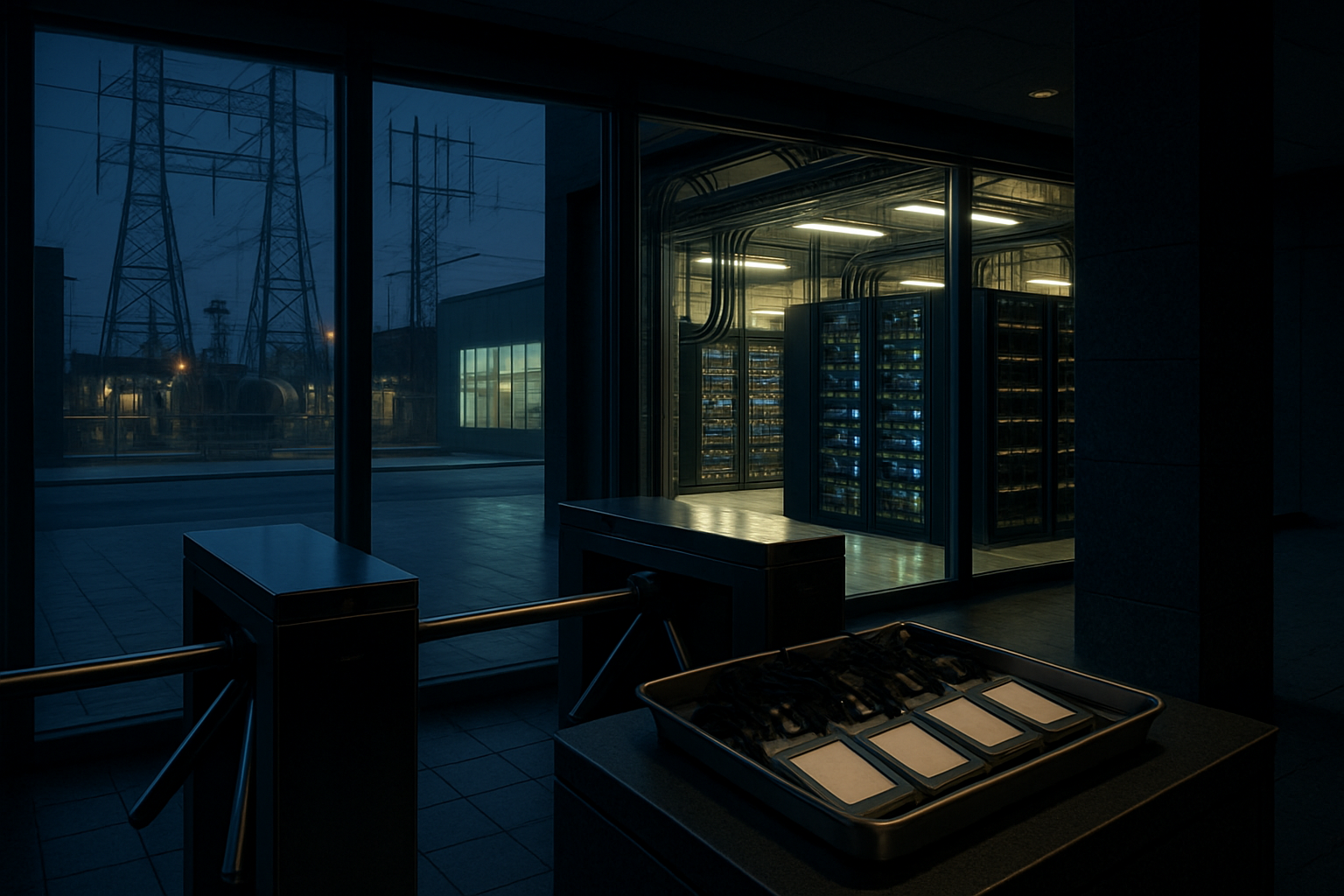
Meta’s New Employer: The Data Center
At 4 a.m. in a dozen time zones, Slack channels fell quiet in familiar ways. Calendars froze. Some badges stopped opening doors. By sunrise, the shape of Meta’s next act was already visible: about 8,000 people gone—roughly one in ten—thousands of planned roles erased before they ever existed, and thousands more told to pack up their projects and report to something called “AI pods.” You don’t run an experiment at that hour; you execute a decision that’s already been made.
The company’s explanation was blunt enough to qualify as strategy: compute or people. Capital expenditure for 2026 is now guided to a stratospheric $125–$145 billion, and Mark Zuckerberg framed the two dominant costs as “compute infrastructure” and “people‑oriented things.” Yesterday, Meta put a price on that sentence. Integrity teams, cybersecurity, and content design were among the groups cut. In the United States, the departing were offered 16 weeks of base pay plus two weeks per year of service—an old‑economy severance template set against a very new‑economy line item: the bill for frontier AI.
In the background, the company erased approximately 6,000 open requisitions and redirected around 7,000 incumbents into AI workflows, with reporting indicating a broader draft of another tenth of the company into Applied AI Engineering and “agent” programs. The word draft is doing more work than usual here. This isn’t just “hiring for AI.” It is a forced migration of organizational attention—away from functions built for the last decade’s problems and toward a future where the most important colleagues are clusters.
From salaries to silicon
The strike‑price on the trade is astonishing. Even generous estimates suggest the savings from headcount cuts amount to a few billion dollars in annual expense. That’s a rounding error against $145 billion pointed at land, power, networking, accelerators, and the software glue that turns them into capability. If you want to understand the shift, stop thinking of compute as a cost center and start thinking of it as the workforce. The data center is where Meta’s next million “employees” will live—not on LinkedIn, but as tokens per second.
In that light, yesterday’s shock looks less like a correction and more like a re-rating of what work is inside a platform company. The resources once spent coaxing human systems into coherence—design, policy, moderation—are being redeployed to engineer systems that make fewer humans necessary in the loop. You can feel the bet: models will be good enough that preemptive safety and post‑hoc cleanup can be minimized, or at least handled by a much smaller cadre armed with better tooling. It’s a high‑wire act. Trim too much of the human scaffolding and the platform tilts; fail to scale the machine side fast enough and you carry the cost without the competence.
Reorganizing around agents
The new org chart is written in verbs, not nouns. “Pods” suggest swarms dispatched to problems: retrieval pipelines here, long‑context orchestration there, tool‑use over in enterprise integrations, character agents stitching together support, commerce, and creation. The company is no longer primarily building features that people use; it’s building entities that do work. The developers, product managers, and researchers who remain are being asked to become choreographers of capacity: prompt engineers as process designers, infra as HR for models, policy as constraints encoded upstream rather than enforced downstream. It’s a workplace where the most valuable meetings might be between schedulers and schedulers.
This retooling hit hardest in roles that mediated human behavior—integrity, content design, parts of cybersecurity. That’s not an accident. If you believe your agents can author, route, and police their own flows, the organization that previously brokered attention and enforced norms looks oversized. If you’re wrong, you’ll find out in public.
The training set is you
Separate reporting on the same day described intensified workplace monitoring: keystrokes, activity, the kind of telemetry that used to be a red flag for a micromanaging manager and is now a feedstock. Employees were reportedly told they could not opt out; more than 1,500 signed a petition. It’s an awkward synthesis, but a revealing one. Meta is turning its own workforce into a living dataset—observed, labelled by outcome, mined for workflows that can be distilled into prompts, tools, and agents. In the short run, that raises morale and privacy concerns. In the long run, it makes the company better at bottling what its best people do and selling it as capability. Labor becomes both teacher and training material for its replacement.
Investors are underwriting an industrial revolution with quarterly earnings
Markets are trying to price a decade‑long capex cycle on a quarterly scoreboard. The math doesn’t reconcile neatly. You spend like a utility, you return like software—that’s the promise. If the promise holds, the share of costs attached to human headcount keeps shrinking relative to the capital stock of compute. If it doesn’t, the layoffs don’t look like a one‑time clean‑up; they become the periodic interest payments on an overbuilt future.
This is why yesterday matters beyond one ticker. The precedent is explicit: when model ambition collides with the P&L, white‑collar roles lose, and they don’t come back at a one‑to‑one rate. Some of those dollars resurface as highly compensated AI engineers and systems reliability experts. Most of them congeal into chips, fiber, substations, and land. It is a labor market rotation from people to plant and equipment—except the plant is racks of accelerators and the equipment schedules tokens.
Externalities are the strategy tax you don’t see on a balance sheet
Cutting integrity and content design while ramping autonomous agents creates risk vectors that only show up later: moderation lag, emergent misuse, subtle degradations in product quality that compound. Energy and land use will become political problems well before they are engineering problems. Regulators will ask which parts of the work remain human‑accountable. And inside the company, diffusion of responsibility—the beauty and the danger of agentic systems—will test governance designed for teams, not swarms.
The lesson for the rest of us
For years, “AI strategy” meant a slide with model performance and a hiring plan. Now it means a conversion plan: which processes become agents, which data you can lawfully turn into training fuel, which human functions you’re willing to pare back to finance compute, and how you’ll prove the ROI before the patience of markets or employees runs out. If you can’t answer those questions, you’re not competing with Meta; you’re competing with your own cost of capital.
Yesterday, Meta didn’t just cut jobs. It redrew the boundary of what counts as the workforce. One million invisible colleagues are clocking in across its data centers, paid not in equity refreshers but in megawatts and memory bandwidth. The message to Big Tech is crisp: if your role can’t be expressed as a contribution to model quality, deployment efficiency, or agentic leverage, it risks being expressed as capex instead. And once that accounting change happens, the future of work is no longer negotiated on a salary band. It’s negotiated at the substation.