California Didn’t Publish Another AI Manifesto. It Handed Out a To‑Do List.
By the time the podium was folded and the cameras moved on, California had done something unusual in AI policy: it replaced vibes with verbs. Governor Gavin Newsom’s Executive Order N‑6‑26 reads less like a declaration and more like a production schedule, a set of deadlines that tries to convert abstract worry about automation into operating instructions for the state’s machinery of work. For a place that hosts the lion’s share of private AI power, that choice matters. California isn’t just talking about disruption; it’s detailing who must detect it, who must cushion it, and who should share the upside, by when.
The Pivot from Principles to Plumbing
Back in March, the state tightened “trusted AI” procurement—ethics checklists, civil‑rights safeguards, certifications. Yesterday’s order shifts from how government buys models to how people survive and benefit as those models hit the workplace. The tone is managerial: 90 days for a research review and an early‑warning blueprint; 180 days for redesigning a layoff law built for factory closures, not algorithmic reorgs; October 15 for a training refocus and a practical playbook for local boards. The cadence is the point. AI moves in sprints; regulation usually lumbers. California is trying to run at the tempo of the technology without pretending it can see the finish line.
A Labor Radar, Not a Rearview Mirror
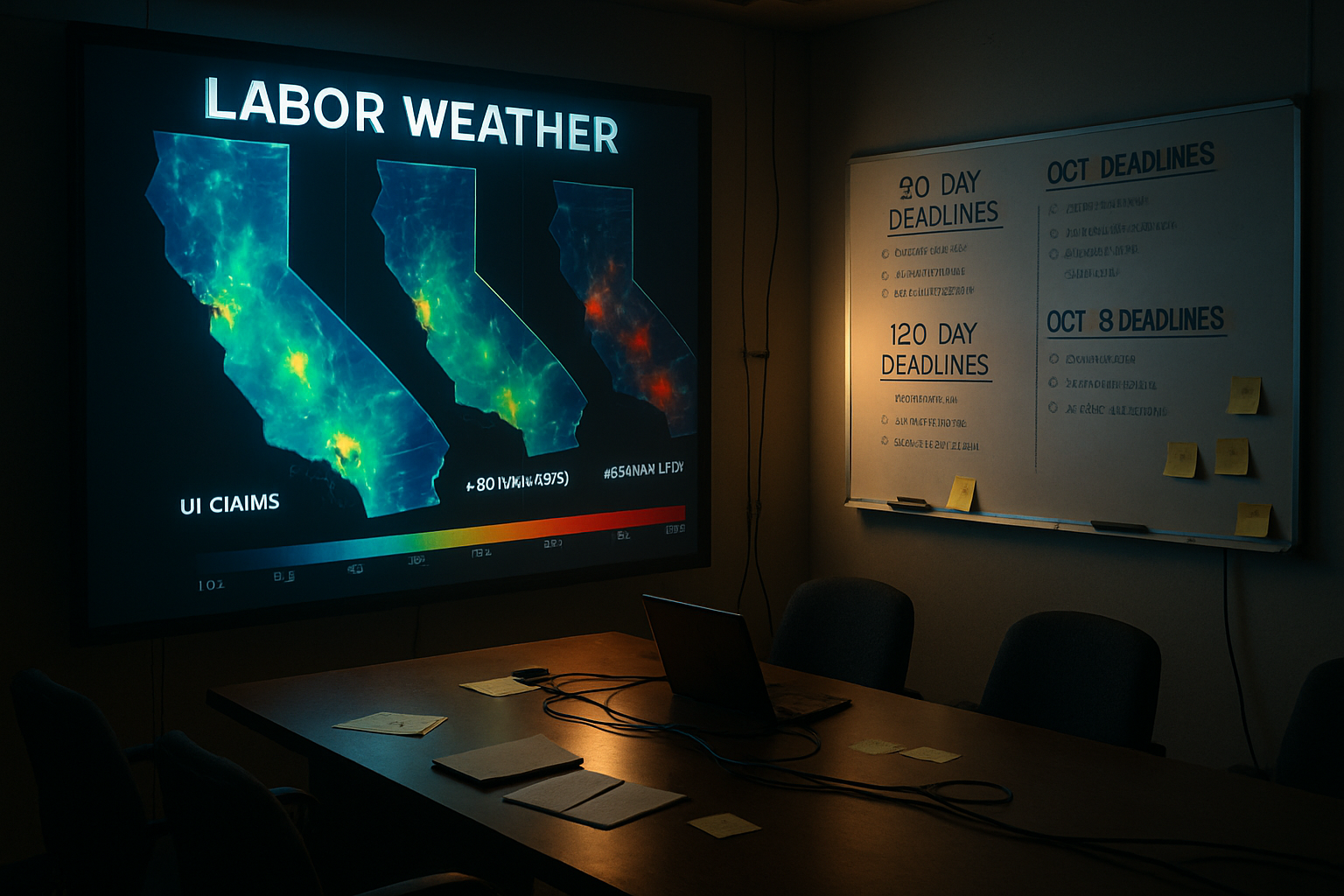
The most novel piece is deceptively simple: a public dashboard from the Employment Development Department that surfaces AI’s footprint in jobs data. Instead of waiting for headlines about mass layoffs, the state wants to nowcast disruption from unemployment insurance filings, vacancy patterns, and—if necessary—direct input from leading AI labs. That last clause hints at a rare experiment: getting the builders to help measure their own externalities in close to real time. If it works, the dashboard becomes a kind of labor weather service, flagging sectoral squalls before they turn into storms.
But measurement is political. Attributing a job loss to AI versus a soft quarter or a merger is messy, and UI records weren’t designed as causal instruments. Watch for the methods: task‑level exposure indices tied to occupation codes, parsing of WARN notices for mentions of automation, cross‑checks against job posting shifts. Also watch for where the data lands. If this dashboard is just a pretty chart, nothing changes; if it’s a trigger for rapid re‑training dollars, community outreach, and employer engagement, it becomes an early‑intervention engine rather than a retrospective report.
Turning WARN Into a Sensor Network
California’s WARN Act was built for a twentieth‑century layoff where a plant gate closed and a shift vanished. AI displacement is sneakier: hiring freezes, role consolidation, software quietly eating tasks without a headline‑grabbing event. The order tells the Labor and Workforce Development Agency to modernize WARN so it acts as an actual sensor for technology‑driven job loss. That could mean lower thresholds for notice when automation replaces functions, clearer definitions for “technology‑related” separations, and enforcement teeth for distributed layoffs that hopscotch under reporting limits. If California pulls this off, it will redefine what counts as a layoff in a world where your replacement arrives as an API call.
Safety Nets With Teeth, Not Pamphlets
There’s a realism in the document’s attention to policy plumbing: severance rules, equity compensation, work‑sharing, and the tangle of programs that either catch you when you fall or bury you in forms. The order asks for a review that doesn’t just map the safety net but widens its mesh and actually drives enrollment. It nods to Work Share—letting hours and pay drop temporarily instead of cutting people loose entirely—and to connecting dislocated workers with federally backed programs like Workforce Pell and with service opportunities for the long‑term unemployed. The risk here is performative complexity; the opportunity is a safety net that behaves like a product with onboarding, not a maze.
Who Gets the Upside
While the headlines will cluster around layoffs, the subtext is ownership. California is instructing its business organs—GO‑Biz and the Office of the Small Business Advocate—to push “opportunity AI” into small firms and to examine worker‑ownership pathways, including employee‑owned conversions. This is a bet that productivity gains shouldn’t arrive solely as headcount reductions or executive equity windfalls. It’s also a bet that the diffusion of capability matters as much as its frontiers. If corner restaurants, clinics, and repair shops can wield AI as competent back‑office staff, the effects on wages and survival rates at the long tail could exceed the marginal gains inside the tech giants that build the models.
Pointing the Firehose at the Public
Buried in the order is a quiet provocation: the Government Operations Agency must propose ways to realign incentives so AI development advances the public good, potentially by directing a slice of AI company revenues to pro‑social deployments and by securing access to compute for research in the public interest. In a field obsessed with scaling laws, compute is sovereignty. If California reserves compute capacity for safety research, education, and workforce tools, it creates a public channel in a market otherwise ruled by private prioritization. The revenue idea is even thornier. Is this a windfall‑like mechanism, a social licensing model, or a partnership tithe? However it’s designed, the signal is unmistakable: the state wants a hose connected from private capability to public outcomes, not just public contracts for private services.
Collective Bargaining’s New Chapter
Another understated shift: the order asks for a reading of how unions are negotiating the incursion of AI and how training dollars should tilt toward “AI‑exposed” and “AI‑adjacent” roles. That phrasing admits what frontline workers already know—some jobs won’t survive intact, but many nearby tasks will expand. The real test is whether bargaining moves beyond vague “consultation” clauses to concrete provisions on data rights, model deployment boundaries, and upskilling guarantees tied to actual roles, not generic “digital literacy.” If California can surface working templates here, expect them to propagate across contracts the way health benefits standards once did.
California’s Leverage—and Its Risk
The state is explicit about its swagger. With 33 of the world’s top 50 private AI companies inside its borders, it can try to make labor readiness a standard feature of the ecosystem. The March procurement order, the new workforce order, and the ongoing transparency push form a layered stack: safety in how government uses AI, signals and cushions for the broader economy, and an on‑ramp for small businesses and workers to capture value, not just fend off losses. The risk, of course, is execution. Dashboards that don’t feed decisions, WARN updates that don’t bite, training that dissolves into seminars without placement—these are familiar failure modes. And if California overreaches clumsily, companies have options, both geographically and politically.
The Next Few Months Are the Tell
By late August, we’ll see whether the research review surfaces a pragmatic set of early indicators and whether the EDD’s dashboard ships as a living instrument or a static report. By October 15, we’ll know if the “AI playbook” gives local boards something a case manager can actually use when a bookkeeper shows up with a pink slip and a mortgage. By mid‑November, we’ll see whether WARN modernization and safety‑net proposals reckon with algorithmic downsizing rather than theatrically restating the old rules. These dates aren’t just deliverables; they’re a test of whether a state can learn on a clock that looks more like product development than legislative theater.
The Deeper Bet
Strip away the press lines and you’re left with a simple proposition: build civic infrastructure for the age of general‑purpose automation. Not a one‑time program, but an early‑warning system, a response playbook, and a set of pipes that carry resources to people when the floor shifts under their feet. If California can make that infrastructure real—and keep it updated as models mutate—it will have authored something exportable to any economy where code is taking on tasks faster than institutions can rewrite themselves.
For readers of this newsletter, the subtext lands close to home. “AI Replaced Me” has long chronicled the drift from anecdote to trend. Yesterday, California tried to catch the trend mid‑curve and bend it. Not with poetry, but with due dates.