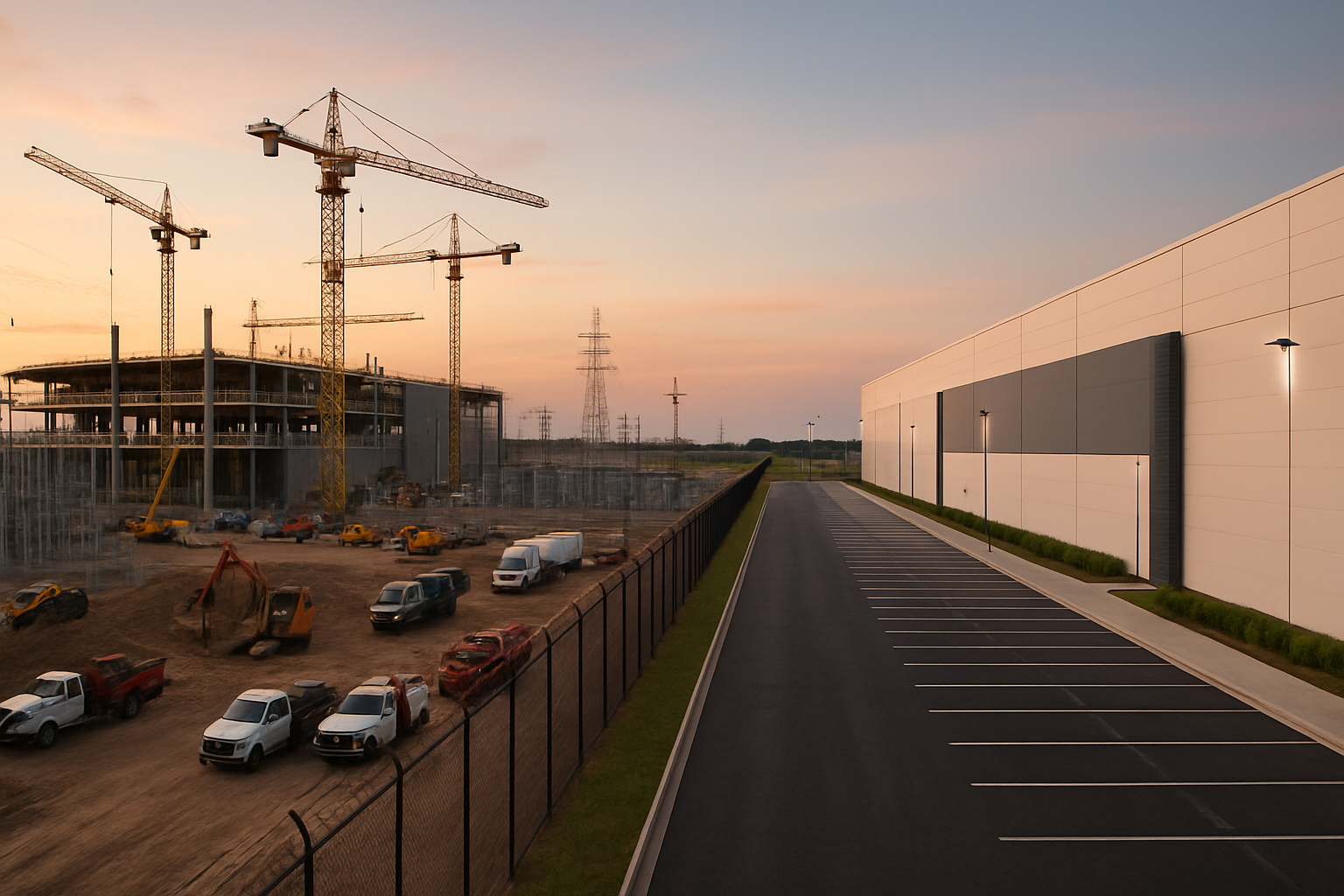
The cranes are hiring. The offices are not.
Before sunrise in places that never expected to matter to Silicon Valley—exurbs, prairie towns, and warehouse districts—the day begins with hard hats, not hoodies. Lines of electricians and HVAC techs badge into projects wrapped in nondisclosure agreements and blank fencing. Inside, future intelligence takes a very physical form: concrete pads, battery rooms, switchgear the size of studios, and chillers that breathe like freight trains. It is here, among cable trays and raised floors, that yesterday’s most important AI-and-jobs story unfolded—not in a boardroom downsizing slide but on a jobsite where the labor market is suddenly hot.
CBS News MoneyWatch captured the split-screen economy we’ve all been feeling but not yet naming: AI is subtracting some white‑collar roles while adding blue‑collar ones—at least for a while. The numbers frame the scale. McKinsey says U.S. data‑center spending could reach as high as $7 trillion by 2030, a figure that reads like a typo until you drive by the substations being doubled. Apollo estimates roughly 4,000 data centers already exist in the U.S., with about 3,000 more announced or under construction. That’s not a sector; that’s a national build.
Short booms leave long shadows
The work is real, immediate, and skilled. Electricians who understand medium‑voltage, techs who can nurse an ailing chiller back into spec, fiber splicers with surgeon hands—these are the heroes of the moment. The paychecks are better than the average construction gig and steadier than the last housing cycle. Towns feel it in breakfast rushes and motel vacancy signs; Brookings‑linked research cited in the piece notes the spillovers are loudest when the crews are in town. The problem is that crews, by design, leave.
Data centers are factories for computation, and factories in the twenty‑first century are instruments, not workshops. Once the ribbon is cut, the headcount collapses into a small, specialized operations team. Economists in the CBS story put it plainly: these facilities are capital‑intensive, not labor‑intensive. There are durable jobs—data‑center technicians, facilities engineers, reliability specialists—and they pay well, with a median around $88,000 on Glassdoor and steady openings at Microsoft, IBM, Amazon, and Google. But a hyperscale campus that consumes a neighborhood’s worth of power does not employ a neighborhood’s worth of people. The staffing reality is an engineering virtue and a political headache.
The hidden math of the boomlet
What we’re seeing is capital deepening on fast‑forward. AI demand pulls on GPUs, which pulls on power, which pulls on land, water, cooling, and fiber. Each pull mobilizes trades and vendors, from transformer manufacturers to epoxy-floor contractors. It looks like a jobs engine because, for 18 to 36 months, it is. But the steady state is a different equation. Every incremental megawatt is a marginal cost to finance and cool, not a dozen new hires to onboard. The boom’s employment profile is a spike with a long, low tail.
This asymmetry explains the growing friction. Communities are being asked to offer generous tax packages and scarce grid capacity to facilities that, permanently, may staff a few dozen people. Environmental groups see the water and power draw; ratepayers see the substation upgrades; school boards see abatements that outlast the crane operators. Even supporters are asking a fair question: if the jobs are transient, what is the lasting return?
How to bank something permanent from a temporary wave
The answer is to treat the construction surge as a bridge, not a destination. Regions landing data‑center deals should negotiate like they understand the curve: front‑loaded jobs, lean operations. Tie incentives to apprenticeships in mission‑critical trades, with pathways into permanent technician roles on the back end. Require vendor diversity that seeds local firms into the data‑center supply chain beyond the build phase—think maintenance contracts, parts depots, and testing labs. Peg abatements to measurable outcomes that survive the ribbon‑cut: uptime commitments to essential services, grid investments that add capacity for everyone, water‑reuse systems that become community infrastructure, and training cohorts that place graduates into long‑term roles.
There is also a risk management play that rarely makes it into the press releases. If model efficiency improves faster than expected or capital costs bite harder, some announced projects will slip or shrink. Workers trained only for the narrowest slice of hyperscale construction can be stranded by a procurement decision made three time zones away. Cross‑training across electrical, controls, and mechanical systems makes those workers employable in hospitals, transit, and microgrids, not just in the next AI campus. The point is optionality, not ideology.
The story we tell ourselves about AI jobs needs rewiring
For years, the shorthand has been that AI comes for the spreadsheet, not the socket wrench. This week’s reporting complicates that. AI is a software shock that arrives wearing steel‑toed boots, and those boots move on once the racks light up. It’s not a contradiction; it’s the supply chain revealing itself. Intelligence at scale is physical first, virtual later.
So yes, the cranes are hiring. And yes, the offices are not. In between sits policy. If communities capture the skills, the infrastructure, and the vendor base while the scaffolding is up, they’ll keep value when it comes down. If not, they’ll be left with a bigger substation, a smaller payroll, and a story about a boom that passed through town on its way to someone else’s balance sheet.
Credit where due: CBS News MoneyWatch put numbers and names to the split. The rest is on us to read the curve correctly—and to build for the steady state, not just the photo op.