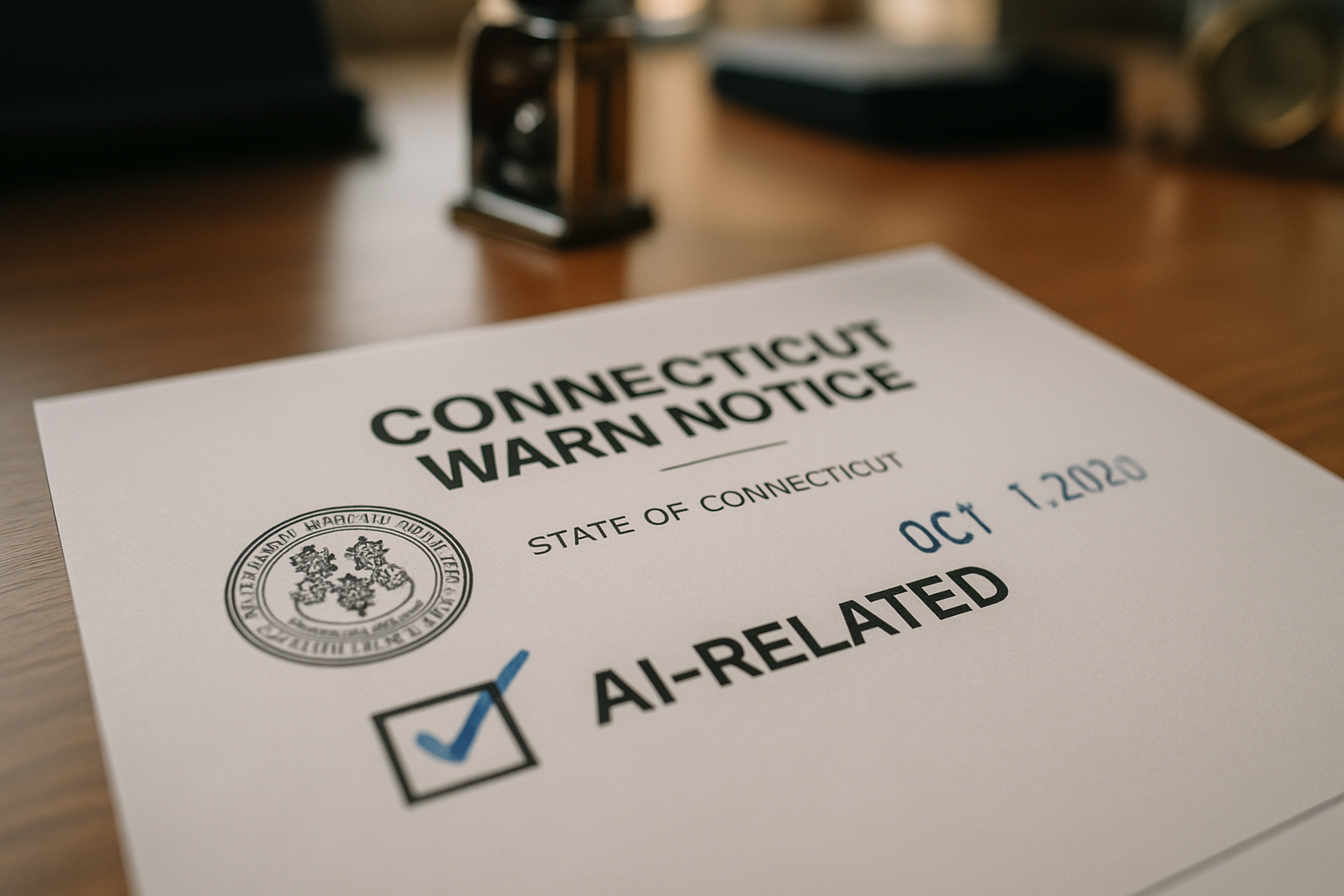
Connecticut Just Put a Checkbox on the AI Layoff Debate
For months, executives have been asked a deceptively simple question: Were those job cuts really because of AI? Yesterday, Connecticut turned that question into a form field. With the ink barely dry on Senate Bill 5, the state quietly rewired the way layoffs are documented. Starting October 1, 2026, any employer filing a WARN notice for a plant closing or mass layoff in Connecticut must also say whether the reduction is related to the employer’s use of artificial intelligence—or some other technological change. No more gobbledygook about “efficiencies” and “realignments.” A state file will now carry a yes-or-no answer.
This is not a rhetorical flourish. It’s a structural change to how we account for technological displacement. The debate has been stuck in a haze of projections and press releases; now, the state’s labor registry becomes a living ledger of AI-linked job loss. When researchers, unions, local officials, and plaintiffs’ attorneys query the recorded reasons for separations, they won’t be combing through euphemisms. They’ll be looking at an official record that ties real people’s livelihoods to specific categories of technological change. That’s a different kind of data—governing data, not PR data—and it will move policy faster than another viral memo from the future-of-work crowd.
The day the euphemisms ran out
The novelty isn’t only the label. It’s the forced internal reckoning. If you have to tell the state whether AI helped drive a reduction in force, you need a defensible basis for that answer. Finance will want one story for severance models, HR will want another for employee FAQs, and legal will want them to match. The C-suite’s talking points, the WARN packet, and the board deck can’t contradict each other without inviting discovery questions later. In other words, Connecticut has used a disclosure checkbox to reach deep into the operating system of how layoffs are planned and justified.
For workers and communities, this is a visibility upgrade. Local officials can now separate a cyclical downturn from a structural automation play. That changes how they plan retraining, negotiate with employers, and apply for support programs. For unions, it sharpens bargaining leverage. Prove it’s AI—and the conversation quickly shifts to mitigation, redeployment, and reskilling commitments. And for policymakers, it offers a running baseline for whether AI-linked displacement is an edge case or an emerging norm.
“The algorithm did it” won’t cut it anymore
Connecticut didn’t stop at layoffs. The law reaches upstream into the everyday machinery of hiring, promotions, performance evaluations, and discipline. Employers cannot outsource accountability to software. If an automated employment decision tool produces a discriminatory outcome, the employer remains on the hook under state anti-discrimination law. The old dodge—blaming a vendor’s black box—loses its protective power. Liability follows the decision, not the tool’s buzzword-laden brochure.
That posture is reinforced by a transparency mandate before these tools ever touch a résumé or personnel file. Before using an automated tool to inform an employment decision, employers must provide written notice that explains what the tool is for, what decision it informs, the tool’s trade name, the categories and sources of data it analyzes, how that data is assessed, and a contact for the deployer. In plain terms, the state now expects an inventory and a lineage for the digital machinery that touches a career. The deadlines stage in across late 2026 and 2027, with a cure period for early stumbles, but the direction is unmistakable: employment decisions shaped by AI must be explainable on demand.
From rumor to record
The reason this matters more than another forecast is simple: records drive reality. The AI layoff conversation has been plagued by signal-to-noise problems. Companies credit “technology-driven efficiencies” when markets reward headcount reduction, then downplay automation when regulators or communities come knocking. By wiring AI attribution into WARN, Connecticut collapses that rhetorical arbitrage. When the answer is yes, it becomes part of a state dataset. When the answer is no, it becomes a claim that can be tested against internal emails, vendor invoices, and executive remarks. Either way, it clarifies the factual terrain on which policy, bargaining, and litigation will stand.
Expect that ledger to influence more than headlines. Insurance actuaries will read it. Workforce boards will budget to it. Economic development agencies will tune incentives against it. Even capital markets may start to treat “AI-related” WARN density as a signal about which industries are truly automating versus merely optimizing for margins.
A template other states can lift tomorrow
Connecticut’s move lands into a moment of divergence. States are experimenting with audits, notices, and governance for AI in HR—New York City birthed the audit wave for automated hiring, Illinois pushed on consent and transparency, Colorado has been iterating timelines. But pairing advance worker notice with a formal AI link in layoff filings is new, legible, and politically exportable. It is straightforward to draft, easy to explain to constituents, and creates data without building a new bureaucracy. That’s why this is likely to travel. By this time next year, expect committee chairs in a handful of statehouses to copy-paste the WARN-plus-AI clause into omnibus tech bills.
The compliance gap goes live
National HR teams have warned that the state-by-state patchwork was becoming unmanageable. Connecticut just transformed that anxiety into an operational deadline. If you have headcount in the state—and any chance of a reduction in force in 2026 or 2027—your playbooks must change. RIF templates will need a slot for the AI/tech-change rationale, and internal and external messaging must be harmonized. Recruiting pipelines that lean on screening scores will need inventories, notices, and testing records that survive scrutiny. Vendor relationships will be rewritten to surface trade names, data sources, and assessment methods. The Attorney General has the pen on enforcement, and while there’s room to cure some early missteps through the end of 2027, the signal is clear: governance cannot lag deployment anymore.
Incentives, games, and the cost of getting cute
Will some employers be tempted to mark “no” and move on? Of course. But the new regime changes the risk calculus. A mismatch between a WARN filing, an internal Q&A that credits “GenAI-enabled automation,” and investor remarks that celebrate “AI-driven productivity gains” is an evidentiary gift to an investigator or a plaintiff. The safer route is process: define how your organization determines whether AI or technological change is a “related” cause, document that determination consistently, and ensure your vendors deliver the transparency you now owe your workforce.
There’s a deeper effect lurking here. The mere act of deciding whether AI contributed to a layoff forces a company to measure its deployment in business terms rather than vibes. That introspection will expose where tools deliver genuine leverage—and where they are shiny distractions. In that sense, the checkbox doubles as a mirror.
The long runway—and why it won’t feel long
The law’s obligations phase in across late 2026 and 2027. That sounds generous until you realize what has to happen: catalog the tools, document data flows, rewrite notices, renegotiate contracts, train managers, align legal and HR narratives, and stand up testing that can withstand discovery. None of that is one sprint. Meanwhile, workers and local officials will start watching for AI attributions the moment the first qualifying layoffs hit the docket. The social expectation will arrive before the technical compliance is bulletproof.
What changes on the ground
The day SB 5 fully lands, a candidate in Hartford will know, before a résumé is processed, which tool is touching their application and what data it considers. A manager in Stamford planning a reorg will have to answer, in writing, whether automation is a cause—and that answer will leave the building. A union in New Haven will bring a list of AI-attributed separations to the bargaining table and ask for reskilling tied to the specific systems in play. And somewhere in another statehouse, a committee will draft a bill that looks a lot like Connecticut’s, because clarity scales.
May 30 wasn’t about another layoff rumor or a glossy productivity chart. It was about a state operationalizing transparency at the exact pressure points where AI meets livelihoods. Connecticut didn’t solve the future of work. It did something rarer: it created the paperwork that will force the future to tell the truth about itself.