The Day a Frontier Lab Wrote a Social Contract
Yesterday didn’t feel like another glossy model launch or a hand‑waving ethics pledge. It felt like a line being drawn. Anthropic, a company built on the premise that intelligence can be scaled, put $200 million on the table to study what that scaling does to paychecks and payrolls—and paired it with a governing blueprint that admits the future may not automatically reabsorb dislocated workers. A lab famous for alignment research just aligned itself with the messiest variable in the system: the labor market.
Acknowledging the Possibility No One Wanted to Own
For years, the industry’s stock answer to “Will AI take jobs?” threaded a familiar needle: productivity surges, tasks shift, employment holds. Yesterday’s announcement broke from that script. Anthropic’s new Economic Futures Research Fund isn’t a marketing grant; it’s an infrastructure bet on measurement, experimentation, and policy evaluation. Alongside it, CEO Dario Amodei published a long policy essay that reads like a contingency plan for a labor market that doesn’t bounce back on schedule. The signal is clear: the company building general‑purpose cognitive tools now treats persistent job displacement as plausible enough to plan—and to finance.
The fund’s design hints at intent. Rather than backing another round of “future of work” panels, it targets rigorous trials and measurement upgrades. In other words, stop guessing and start instrumenting. And because the distribution of benefits matters as much as the average, Anthropic is also seeding a $150 million national fellowship program to embed early‑career professionals in places where AI’s upside rarely lands first. It’s part empirical lab, part capacity‑building exercise, part political economy move: put talent in communities, not just in data centers.
Triggers, Not Vibes
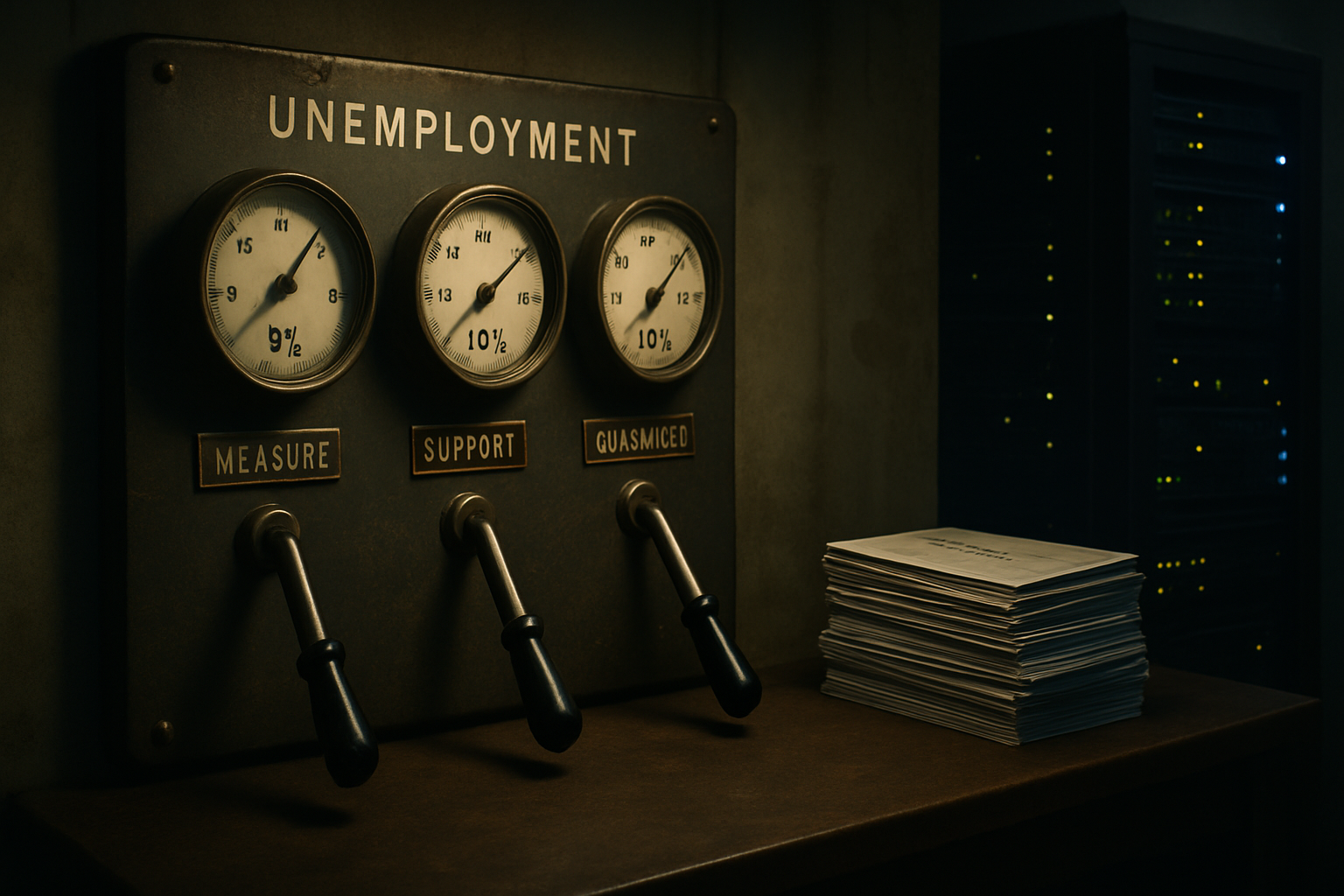
The essay’s architecture departs from the usual white paper cadences. Amodei hangs policy responses on unemployment thresholds, effectively proposing an automatic stabilizer for AI shocks. If joblessness hovers around a historical moderate level—roughly five percent—governments upgrade their gauges. If it swells toward ten, they pivot to pro‑employment supports. If it breaches into territory we haven’t charted, they prepare to guarantee incomes for the long haul.
There’s a lot packed into that. First, the admission that our current data tools are blunt. Counting jobs abstractly is not the same as tracking how many vanished because of a model launch, workflow redesign, or procurement mandate. The call to extend official statistics to tag AI‑linked displacement—and to build on usage indices Anthropic already compiles—would turn today’s anecdotes into tomorrow’s time series. Think of it as creating the labor market’s equivalent of an AI consumer price index: a way to attribute changes, not just tally them.
Second, the mid‑tier is policy with teeth and friction. Wage insurance to cushion workers forced into lower‑paid roles. Retention incentives that make layoffs more expensive at the margin. Training grants with real evaluation baked in, so “reskilling” means more than a certificate printout. And better matching infrastructure, because time out of work compounds loss. These tools don’t assume that growth will fix everything; they try to slow the bleeding and shorten the gap.
Finally, the essay confronts a scenario Silicon Valley rarely names in public: a world where labor demand itself durably falls. In that case, it argues, plan for sustained income support—UBI or universal capital accounts—funded by taxes on the winners: targeted levies on the companies capturing AI rents or higher capital‑gains rates. That’s not just social policy; it is a rebalancing of bargaining power in an economy where mindlike software shifts the production function in favor of capital and code.
From Safety Talk to Labor Talk
For a frontier lab, this is a notable reframing. Safety conversations have usually orbited misuse, hallucinations, and catastrophic risk. Important, yes—but distant from the question that keeps city councils, unions, and school boards awake: what does this do to jobs? By putting nine figures into labor‑market measurement and policy trials, Anthropic moves the center of gravity from norms to incomes. It’s a bet that legitimacy in the age of AI won’t be earned by voluntary model cards alone. It will be earned by evidence that the people who lose in the short run aren’t collateral damage.
The meta‑innovation here isn’t just the money, it’s the operating system: randomized evaluations instead of vibes; pre‑committed triggers instead of ad hoc bargaining; and a willingness to contemplate distribution as the first‑order problem of the AI era. Earlier tech waves leaned on a near‑theological faith that new tasks would absorb displaced workers. That might still happen. But it’s telling that one of the field’s most visible CEOs is preparing for the branch where it doesn’t—and inviting governments to prewire their response.
What Could Break
None of this is easy. Measurement will struggle at the attribution edge. Was a layoff driven by a recession, a new model, or management fashion cloaked in “AI transformation”? Building credible, shared indicators that agencies can publish quickly, and that firms can’t game, will require granular usage data, privacy‑preserving methods, and cooperation that companies rarely offer.
Mid‑tier incentives invite moral hazard. If you subsidize retention, some firms will posture at the cliff to collect. Wage insurance works on paper but demands administrative competence that many states lack; the U.S. tried a narrow version for trade shocks with middling result. Training is where good intentions go to die unless it is attached to verified demand and actual placement. The saving grace is the fund’s explicit emphasis on trials and program evaluation—the willingness to kill what doesn’t work and scale what does.
And then there’s the top tier. Financing long‑term income guarantees by taxing “relevant companies” is straightforward as a slogan and thorny in law. Which companies count? How do you handle cross‑border arbitrage when model inference hops jurisdictional lines? Do you earmark capital‑gains hikes in an economy where intangibles dominate and winners can reclassify returns at will? There are macro questions too: if AI lifts output while labor’s share falls, UBI might be necessary, but sizing it without fueling inflation or sapping local service sectors requires a more careful model than political slogans allow.
What This Really Signals
Even with those caveats, this is an Overton Window moment. When a leading lab tells policymakers, in print, to prepare to slow displacement with incentives and to guarantee income if necessary, it gives cover to moderates who have been boxed in between laissez‑faire on one side and maximalist bans on the other. It also reframes the accountability debate inside the industry. If you plan to profit from automating reasoning, you should also plan to pay for the shock absorbers—not as philanthropy, but as table stakes for operating at scale.
The fellowship program adds another, subtler layer. It will seed pro‑AI capacity into local governments, nonprofits, and small enterprises, which is both public‑spirited and strategic. It means policy trials can run in the real world, not just at Sand Hill Road scale. It also builds a constituency for pragmatic, data‑driven responses that don’t map neatly onto ideological tribes. Imagine a world where a county workforce board can A/B test wage insurance designs with help from fellows fluent in both models and Medicaid eligibility rules. That’s the kind of state capacity the AI era will demand.
The Takeaway for Those of Us Already Living the Disruption
If you read this newsletter, you don’t need convincing that AI can bend markets faster than our institutions can flex. The news is that one of the builders just acknowledged—in capital and in policy—that cushioning workers is not a side quest. If the economy keeps absorbing shocks, the measurement will show it, and the mid‑tier triggers never fire. If it doesn’t, yesterday sketched a path that moves beyond hand‑wringing: find out what actually preserves employment, pay people fairly when it doesn’t, and make the winners underwrite the bridge.
This isn’t the last word on the social contract of synthetic intelligence. But it is the first time a frontier lab has published a response function calibrated to unemployment—and funded the data pipeline to make it more than a press release. In a field obsessed with scaling laws, here’s a different one: as capabilities scale, so must our willingness to measure impact, share gains, and guarantee dignity when the market won’t.