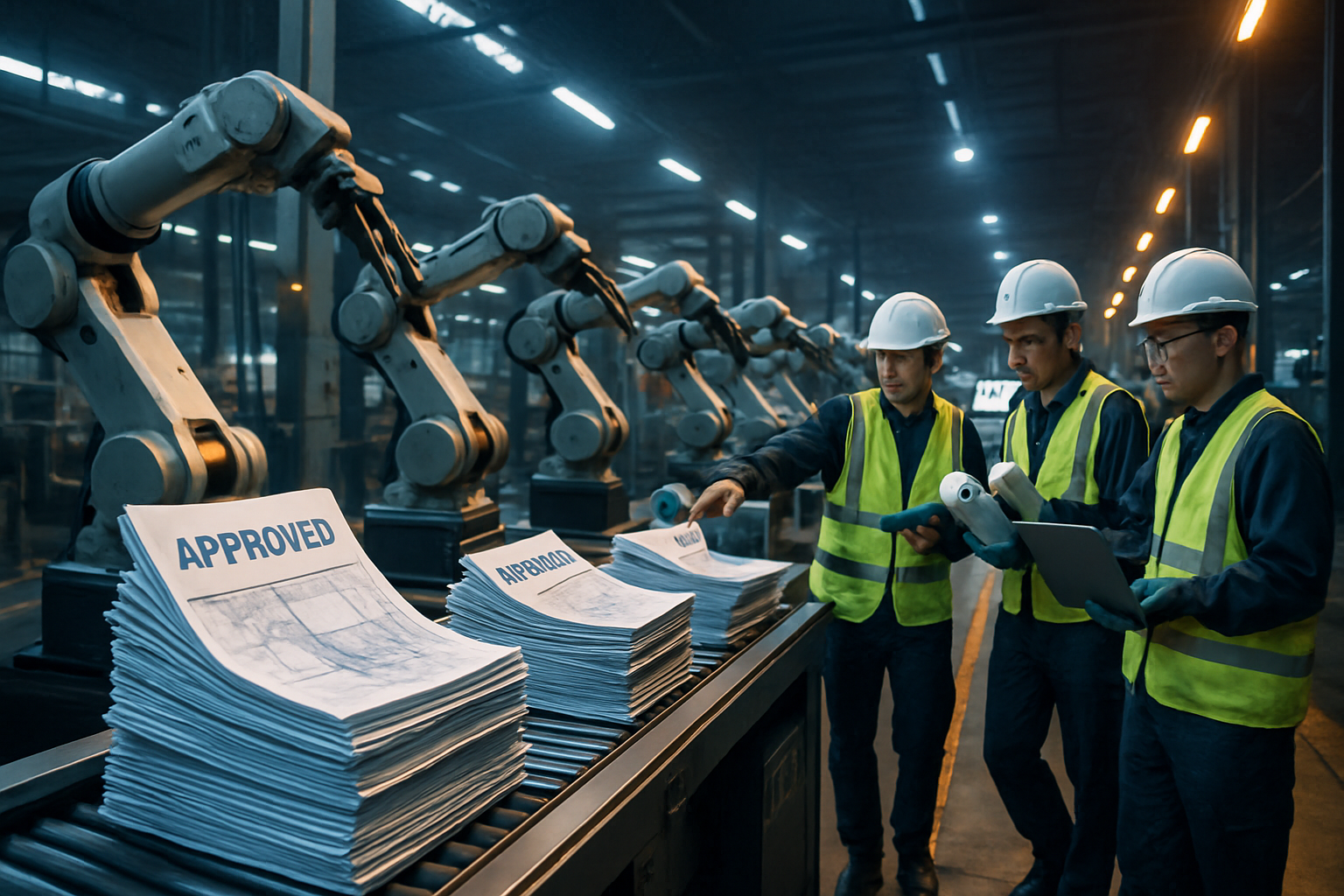
Bezos Stands in Paris and Predicts Not Enough Humans
On the VivaTech stage in Paris, under lights meant to flatter certainty, Jeff Bezos did something unfashionable: he contradicted the ambient dread. “I totally disagree,” he said, with the well‑worn prophecy that AI will make humans redundant. “AI is going to create a labor shortage.” The line landed with the thud of a gauntlet. Beside him sat Blue Origin’s David Limp, teeing up a conversation that was really a wager—about what happens when software learns to build, fix, and design almost everything faster than we do.
Bezos’ thesis is disarmingly simple. Lower the cost of invention and operations, and demand will not merely rise; it will surge past automation’s ability to keep up. History has played this card before: once machines cheapened textiles, we didn’t wrap the world in the same number of shirts more efficiently; we started wearing, washing, trading, and innovating more clothing than any previous century could imagine. In Bezos’ telling, AI does this trick for the entire economy, especially the physical one, where constraints are concrete, not just computational.
The wager behind the words
This was not a stray thought. For weeks, Bezos has been sketching the same arc while quietly assembling the apparatus to test it. His new venture, Prometheus, is pitched as an “artificial general engineer” aimed at aerospace, autos, drug development—the messy frontiers where models must argue with physics. Fortune reports it has raised roughly $12 billion at a valuation near $41 billion, signaling a bet on scale and speed that only makes sense if you believe tomorrow’s bottlenecks are not keystrokes but skilled hands, field technicians, regulatory navigators, supply‑chain whisperers, and systems integrators who can coax atoms to keep pace with accelerated ideas.
That context sharpens the claim. If AI makes design nearly free, the shortage moves to the places design cannot reach alone: certification, safety, installation, human factors, last‑mile quality, and the long tail of exception handling that reality throws at every blueprint. In that world, the scarcest resource is coordination capacity—teams capable of absorbing a torrent of viable plans and turning them into working factories, vehicles, therapies, and infrastructure without breaking the grid, the law, or the social contract.
The room heard a prediction; the data outside heard a challenge
Bezos’ optimism hit a week when the winds were blowing the other way. Tech layoffs have already topped 115,000 through May. Analysts estimate AI has been subtracting on the order of 16,000 U.S. jobs a month, with entry‑level and Gen Z workers feeling the first sting. About half of Americans fear AI could take a job from them or someone at home. He didn’t engage those numbers on stage, and he didn’t need to for the quote to ricochet across wires by afternoon; the phrasing was clean enough to headline itself. Still, the tension is the point. If the long run is a shortage, what do we call the next twelve quarters?
Part of the answer is sequencing. Diffusion rarely arrives evenly. Automation hits the easiest tasks first—drafting, summarizing, coding glue, service workflows—and the early displacement concentrates in precisely the roles that teach newcomers how an industry works. That creates a training paradox: we risk deleting the rungs of the ladder while asking the labor market to climb higher. If you buy the shortage thesis, the immediate challenge is not protecting every task but rebuilding the on‑ramps so that more people can perform the higher‑leverage work that AI cannot finish alone.
Why say it here, why say it now
VivaTech is a European stage at a moment when the G7 is busy sketching the guardrails for AI’s economic pressure. Europe knows shortages in its bones—aging populations, skill gaps, chronic underinvestment in scaling hardware—and a claim of “not enough workers” lands differently when you already have too few nurses, welders, or semiconductor technicians. In that sense, Paris was a shrewd place to stress that demand will outstrip supply, nudging policymakers toward capacity building rather than only containment. It also reframes AI anxiety: if scarcity shifts from cognition to coordination, then immigration policy, technical education, credential reform, energy build‑out, and permitting speed become as “AI policy” as model audits.
What a real shortage would look like
If Bezos is right, the labor market doesn’t get quieter; it gets louder. Wages pull upward in domains where software cannot fully close the loop. Project management, compliance, safety engineering, quality control, field service, advanced manufacturing, logistics orchestration, clinical operations—all become force multipliers for models that can propose perfect plans but cannot lift a beam or clear a trial. Companies hoard people who can thread multiple systems together. Time to value shrinks for organizations that can absorb a faster rate of invention, and expands painfully for those that cannot retrain, cannot hire, or cannot secure energy and components. The productivity dividend still arrives, but its distribution depends on who controls these throttles.
There is a darker symmetry too. A shortage economy can coexist with visible layoffs if the surplus is in the wrong places. We may have too many junior generalists and too few domain‑seasoned supervisors; too many prompt‑craft experts and too few technicians who can pass a weld X‑ray or validate a GMP line. Without deliberate investment in mid‑skill pathways, the shortage narrative hardens into bifurcation: overworked specialists, underemployed entrants, and models accelerating both trends.
The test ahead
The claim is falsifiable. If AI truly collapses the cost of invention across the physical economy, we should see a sustained rise in openings for integration and execution roles, persistent hiring friction despite aggressive pay in those categories, and capital tilting toward infrastructure and training rather than purely digital margins. If, instead, we observe broad compression of headcount even in build‑and‑deploy layers, the shortage story was either premature or parochial to a few well‑capitalized labs.
For now, what mattered about June 17 was not originality—the view has been foreshadowed—but scale. A global microphone converted a thesis into a talking point for CEOs, investors, and ministers rotating through the same halls. And while the numbers outside the venue still point to near‑term displacement, the argument on stage insisted we widen the aperture. If intelligence becomes cheap, ambition becomes expensive. The question is whether we can train, credential, and mobilize people fast enough to pay the bill.
Bezos framed it as destiny. It reads more like an execution problem. And if he’s right, the job of the next decade isn’t finding work for humans; it’s building the capacity to let humans keep up with the ideas their machines won’t stop generating.