The day the AI jobs debate got a budget, a boss, and a clock
Yesterday, the argument over what AI will do to work stopped sounding like a panel discussion and started looking like an operating plan. Gina Raimondo, the former U.S. Commerce Secretary who spent the last years priming America’s AI industrial ambitions, and former Indiana Governor Eric Holcomb unveiled RAISE US—a bipartisan, privately funded nonprofit with more than half a billion dollars already committed and a target of a billion. Its mission is disarmingly specific: prove, in public, how to keep people employed as automation advances, and hand states and employers a playbook they can run before the pink slips print.
A coalition that normally doesn’t exist
RAISE US did not arrive as a white paper. It arrived as a strange-bedfellow cap table. Amazon, Microsoft, Anthropic, the OpenAI Foundation, and Bank of America are anchor partners. UPS, General Motors, Eli Lilly, Mastercard, AMD, Cisco, and IBM are in the building. The mix matters. It signals that the labs building automation and the firms deploying it have accepted a shared burden for its consequences. As Microsoft’s Justin Spelhaug put it, “No single company or sector can solve the workforce challenges.” That admission is new. Even newer: the decision to funnel money and reputational capital into common experiments rather than parallel PR campaigns.
From rhetoric to pilots
Raimondo framed the stakes with unusual bluntness: “If you want to lead the world in AI, you have to take action to make sure our democracy doesn’t crumble.” She is arguing that the jobs question is not a distant skills puzzle but a near-term governance problem. The response is pointedly local. Arkansas, Connecticut, Maryland, and Utah will host the first state pilots, with governors treating the effort as a workforce strategy for the AI transition, not just a training grant. Maryland went further, announcing a formal partnership to test retraining incentives and transition supports that are tied to real employer demand. We’ve heard national promises before; what’s different is the pivot to statehouses, procurement calendars, and measurement.
What will actually be tested
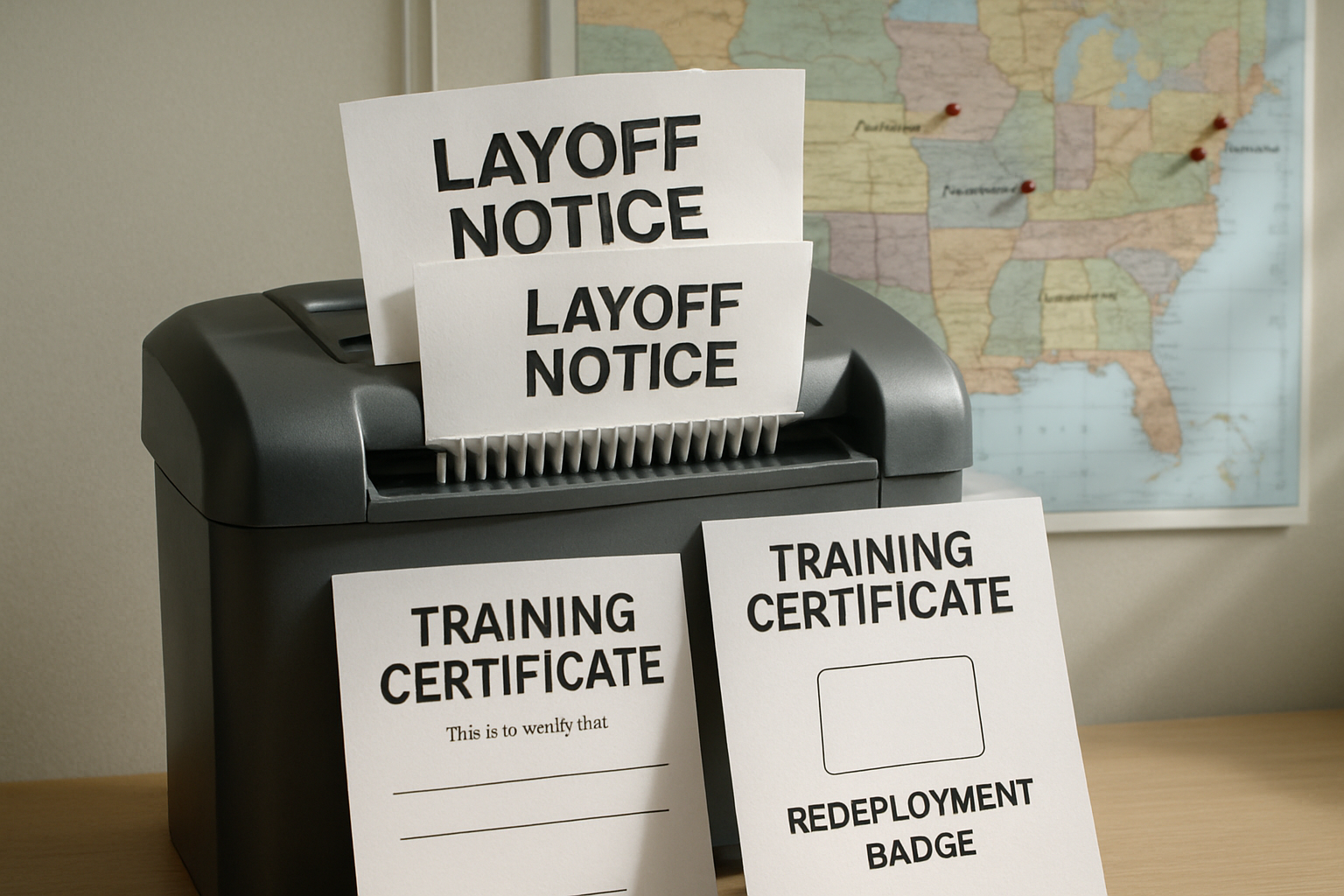
RAISE US is engineered to reward redeployment over redundancy. Expect incentives for companies that retrain and reassign workers instead of shedding them; wage insurance to cushion inevitable earning dips; AI-assisted career coaching that turns model outputs into actual interviews; and short, employer-aligned credentials designed to be fast enough to matter in a volatile quarter. Programs also carve out paid service-year pathways for young adults and an accelerator that treats displaced workers as founders, not casualties. A policy lab will study outcomes and issue recommendations—and, critically, will not take corporate money to preserve independence. That separation is a design choice acknowledging the obvious: effectiveness will hinge on trust in the numbers.
The quiet novelty: rivals sharing the same tent
Anthropic and OpenAI are competitors. Putting their names next to each other on the same workforce line item is not usual practice. That pairing, alongside blue-chip employers and a bipartisan advisory group spanning Paul Ryan, Stephen Schwarzman, AFL-CIO’s Liz Shuler, and economists David Autor, Erik Brynjolfsson, and Raj Chetty, is the real signal. It’s a recognition that labor market shocks don’t respect corporate boundaries or party platforms—and that any solution that does will fail on contact with reality.
If this works, what changes?
Success would normalize a different reflex inside corporations: before layoffs, ask whether a model-enabled productivity gain can be shared with the humans who created the underlying processes. Make redeployment the default and separation the exception. For states, a working playbook would show how to thread incentives, community colleges, and employer consortia into something faster than a multi-year reskilling boondoggle. It would also give budget directors hard numbers on the payback period of wage insurance versus the long tail of unemployment costs. In other words, it would turn “AI disruption” from a pundit’s phrase into a line item with outcomes.
The uncomfortable math
There is no way around it: $500 million is both a lot and not nearly enough. If even a fraction of routine cognitive work gets automated at current trajectories, the number of affected workers dwarfs this fund. That’s why the bet here is leverage, not coverage. If pilots can demonstrate, with credible counterfactuals, that a combination of redeployment incentives, targeted credentials, and wage insurance reduces separations and accelerates wage recovery, states and large employers can scale the model with their own dollars. If they can’t, we will have burned precious time rehearsing solutions that don’t travel.
Where this could break
Three fault lines loom. First, selection bias: employers that volunteer for pilots may already be predisposed to redeploy, inflating apparent success. That argues for randomized or at least quasi-experimental designs, not just feel-good case studies. Second, capture risk: corporate funders will prefer interventions that keep their costs low and flexibility high. The firewall around the policy lab will be tested the first time its findings recommend sticks instead of carrots. Third, credentials: short, employer-aligned certificates are only as valuable as their portability. If a worker’s new badge dies at the company gate, we’ve trained for a dead end.
The politics inside the plumbing
Wage insurance sounds technocratic; it is deeply political. It asks taxpayers or pooled funds to smooth shocks created in private balance sheets, in exchange for social stability and faster reemployment. In countries with stronger social safety nets, this compact is old news. In the U.S., it will be contested until the evidence is unambiguous. That’s why the commitment to measurement matters as much as the money. Show that wage insurance cuts time out of churn and preserves community tax bases, and it becomes infrastructure. Fail to show it, and it becomes a talking point.
What to watch now
Ignore the slogans and follow the boring metrics: redeployment rates versus baseline layoffs in pilot firms; time-to-reemployment for displaced workers; post-transition wage recovery; the share of credentials that translate into promotions across employers; and how quickly non-pilot states copy the playbook with their own budgets. Pay attention to whether unions are co-designers or spectators, and whether small and mid-sized firms—where most Americans actually work—get on-ramps or sit outside the tent. Finally, watch the speed. Automation cycles move in quarters. If the pilots operate on academic time, they’ll be overtaken by the next model release.
The real wager
RAISE US is not betting that AI will be harmless. It is betting that institutional muscle memory can be rewritten quickly enough to prevent a wave of destabilizing unemployment. That is an execution problem, not a press release. If they’re right, states and employers will inherit a tested manual for turning automation into upward mobility. If they’re wrong, the default setting—layoffs first, training later, recovery never—will harden into the norm just as the models get better. The difference between those futures is being purchased now, one pilot at a time.