The Quiet Variable in AI’s Job Story
In conference rooms where AI dashboards glow and pilots multiply, the most decisive asset isn’t the latest model weight—it’s the org chart. That was the subtext, and really the headline, of Wharton professor Eric Bradlow’s conversation with Fortune’s CFO Daily this week. He didn’t talk about a future in which systems replace people in a grand sweep. He talked about managers, incentives, ownership, and the thousand small choices that decide whether AI augments a team or hollows it out.
Bradlow’s claim is disarmingly simple: the bottleneck on AI’s impact is organizational change, not technical capability. Companies still haven’t figured out a holistic way to make people, processes, and models click into a single workflow. The remedy isn’t a bigger cluster; it’s a blueprint for when humans take the wheel, where judgment belongs, and who owns the outcomes. Keep people in the loop, he argues, not as an afterthought but as the operating principle.
That stance flips the usual employment narrative. As AI becomes standard, the most valuable workers are not the cheapest task executors but the deepest experts—the ones who can specify what “good” looks like, train systems to get there, and call a halt when the outputs go sideways. Smart companies, Bradlow insists, don’t shrink talent; they redistribute it. In that frame, the real upside of AI is revenue—new products, extensions, data-powered services—not a blunt attack on payrolls.
Design, Not Horsepower
Fortune situates Bradlow’s argument in the trench-level realities CFOs face. Many firms are graduating from pilots to deployment and discovering that the missing ingredients are guardrails and governance. KPMG’s Global AI Pulse (Q2 2026), cited in the piece, finds a clear pattern: when organizations know who is accountable for AI decisions and can see the full, ongoing cost to operate these systems, measurable ROI shows up. Where ownership and cost visibility are fuzzy, results stall. It’s not that the models can’t perform; it’s that the operating model can’t.
If you strip the buzzwords, the choice is stark. Without redesigned workflows and clear override rules, AI becomes a black box glued onto yesterday’s process—fast at producing outputs and slow at creating value. With thoughtful design, the same models become instruments that let small teams punch above their weight. The distinction lives in mundane specifics: who approves an AI-generated contract clause, what confidence thresholds trigger human review, where responsibility lands when an automated decision goes wrong. Those choices are less flashy than model benchmarks, but they decide who gets the upside and who eats the risk.
What Actually Changes for Workers
When the work is organized well, the skills mix shifts up the value chain. Domain experts stop being end-of-line checkers and become the architects of the system’s judgment—translating messy real-world constraints into prompts, policies, and evaluation criteria the machine can respect. Their craft becomes the quality function of the enterprise, setting the standard by which AI is allowed to act and deciding when it must defer. In that world, job change looks less like elimination and more like a transfer: from execution to supervision, from routine throughput to outcome ownership.
But redistribution doesn’t happen on goodwill alone. Training and reskilling have to be funded at the same intensity as model and infrastructure spend. If people can’t move into the newly valuable work because the organization didn’t buy the time and tools to make that move, pilots pile up, accountability blurs, and the layoff button starts to look like “decisive leadership.” It isn’t. It’s a shortcut that strips out the very expertise the system needs to get better.
The CFO’s Edge
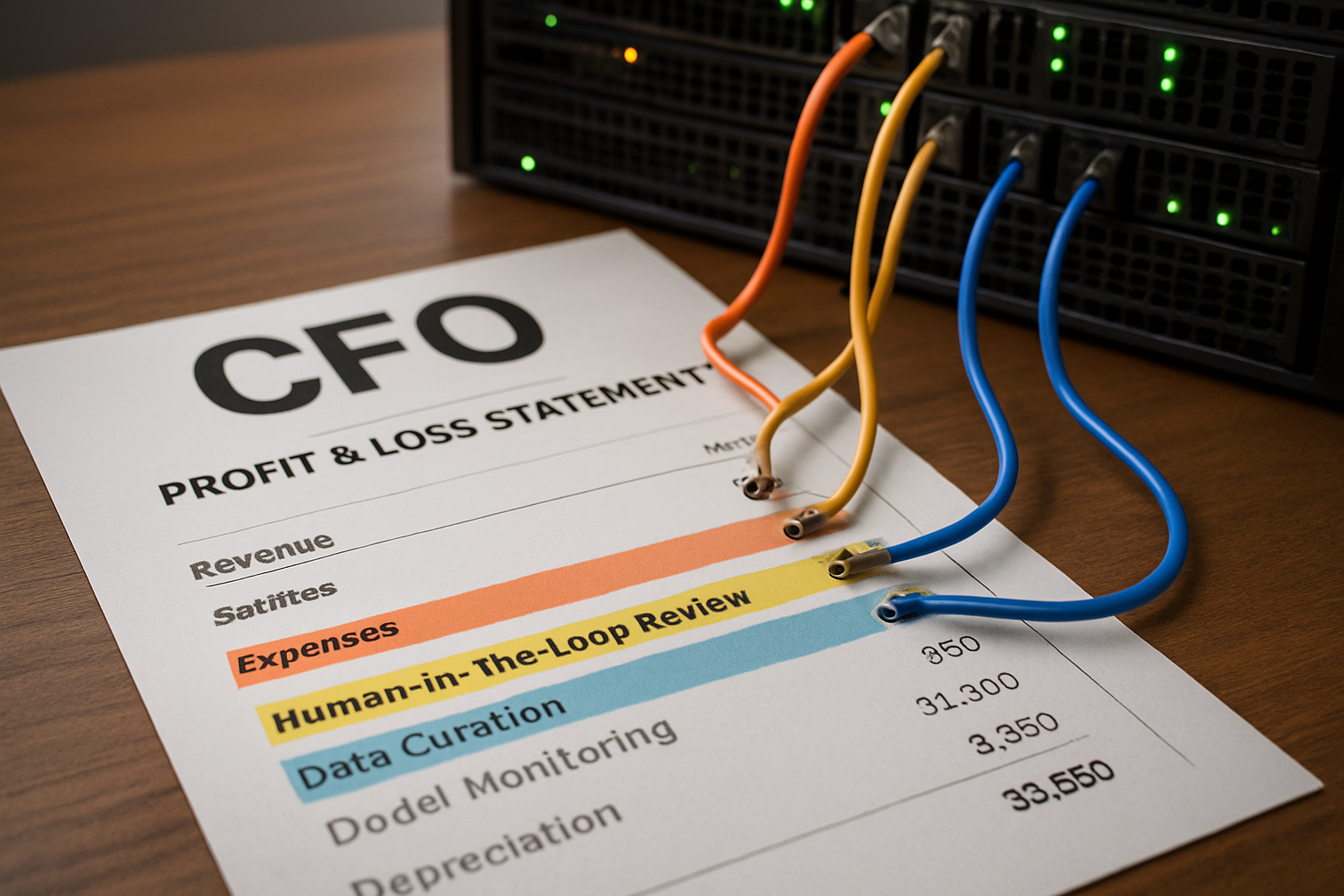
This is why the conversation landed in a CFO newsletter. Finance leaders control two levers others don’t: the architecture of accountability and the visibility of costs. Put AI inside the P&L with real operating expenses—data curation, human review, evaluation pipelines, model monitoring—and a funny thing happens: the economic story tilts from cost trimming to growth. New revenue lines become legible. Product managers can ship a data-driven add-on without mortgaging the support team. Sales can offer a premium tier that’s actually supportable because you priced the human-in-the-loop correctly. The balance sheet stops flattering illusions of “free automation” and starts rewarding systems that can prove they earn more than they consume.
Skip that work and you invite a different equilibrium. Accountability scatters. Shadow models appear. Pilots don’t die; they linger—consuming attention, dodging governance, generating output that nobody quite owns. When a downturn arrives, the organization trims heads because it cannot see where the value lives. The irony is sharp: cuts meant to improve efficiency end up deleting the judgment that would have made the AI efficient in the first place.
A Playbook, Told Straight
Start with a customer journey that truly matters and map every decision where AI might act. Name a single owner for the outcome, not the tool. Make the override thresholds explicit and measurable. Put your subject-matter experts inside the development loop from day one and give them the authority to stop a release. Track the whole cost to operate the workflow, including the people who validate and improve it. Tie compensation to the revenue the system generates or protects, not to the count of features shipped. And when the first win appears, don’t celebrate the headcount you “saved”; move those people into the next growth bet and fund the training to make the move stick.
The Fortune interview reads, ultimately, like a quiet correction to a noisy debate. If AI changes jobs, it will do so through management choices—how we assign responsibility, price the work, and respect the role of expertise—not through an automated pink slip. The companies that thrive won’t be the ones with the biggest models. They’ll be the ones that treat the org chart as the last mile of AI and design it with the same rigor they bring to their code.