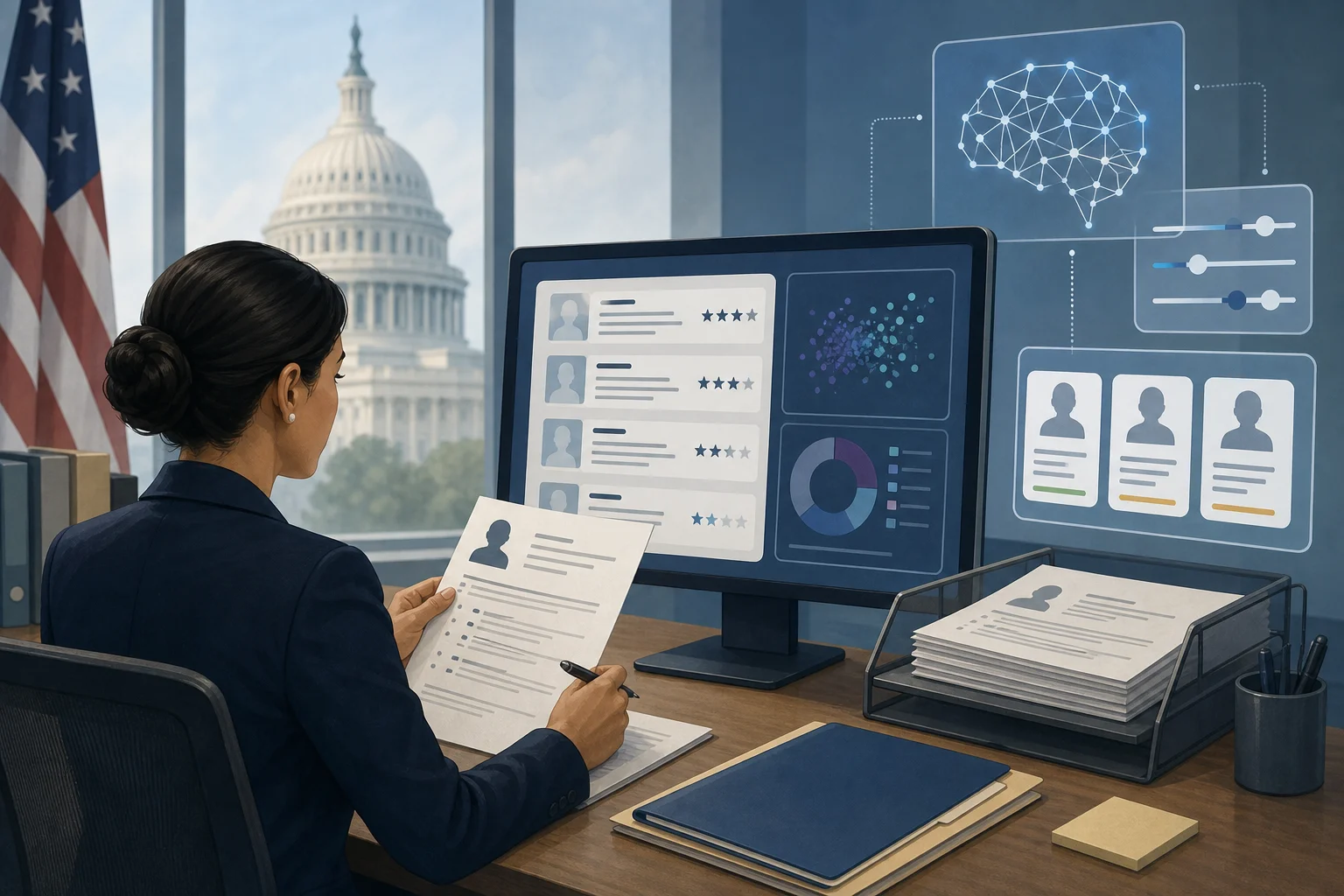
The Office of Personnel Management issued guidance dated August 27, 2026, titled Use of Artificial Intelligence in the Federal Hiring Process. In that memo, OPM tells federal agencies to adopt AI across the hiring lifecycle, including drafting job announcements, screening resumes and qualification reviews, doing pre-offer quality-control reviews, and analyzing aggregate hiring outcomes.
The memo also draws a line around certain employment actions. OPM says AI use in final hiring decisions, promotions, performance management, discipline, and reassignments would in most cases be considered high-impact. The memo says agencies must still validate AI tools, preserve documentation and auditability, and maintain reconsideration avenues for adverse eligibility determinations.
Federal News Network reported the guidance the same day and said OPM stated that agencies may be compromising hiring efficiency if they do not increase AI use. That report also said OPM expects new AI features in USAJOBS, USA Staffing, and USA Hire. The supplied sources do not identify a timetable for those features or say that any specific feature has already launched.
What OPM says AI can help with
According to the memo, the Office of Personnel Management identifies drafting job announcements, resume screening and qualification reviews, pre-offer quality control, and aggregate hiring analysis as generally appropriate AI use cases. The memo also says agencies may be compromising hiring efficiency and quality if they fail to adopt AI. Those statements are specific to the federal hiring process described in the memo; they do not by themselves say that every agency must use every AI tool in every step.
Analysis: The memo treats AI as a tool for ordinary recruiting tasks, but the supplied sources do not say that AI replaces human judgment in those steps. The sources instead show a model in which AI can assist with screening and analysis while human review remains part of the process.
What remains off limits or restricted
OPM says AI use in final hiring decisions, promotions, performance management, discipline, and reassignments would in most cases be considered high-impact. The memo also says agencies must validate tools and preserve documentation and auditability. It further says agencies must maintain reconsideration avenues for adverse eligibility determinations. The supplied sources do not identify any exception to those requirements beyond the memo’s own qualifier that final hiring decisions and the other listed actions would “in most cases” be considered high-impact.
Analysis: The memo separates AI-assisted workflow steps from the final actions it treats as high-impact. That distinction is a source-based reading of the guidance, but the memo itself does not describe a complete implementation model for every agency.
Why the guidance matters for federal hiring
Analysis: The research bundle describes this as a policy shift in how the federal government hires. OPM’s guidance normalizes AI as an operational tool in recruiting while drawing a bright line around decisions that directly affect access to employment. The bundle also says the guidance may shape what kinds of AI tools employers view as acceptable in applicant screening, but that is an inference from the memo and reporting, not a source-stated fact.
The bundle also says the memo references OPM’s 80-day time-to-hire goal. The memo itself, as supplied, does not provide a timetable for adoption, a compliance deadline, or any agency-by-agency implementation schedule. It says agencies should adopt AI more broadly, but the supplied sources do not identify when particular agencies must do so.
What the reporting adds
Federal News Network’s report, published the same day as the memo, says OPM expects new AI features in USAJOBS, USA Staffing, and USA Hire. It also reports that the agency said agencies may be compromising hiring efficiency without greater AI use. The supplied sources do not specify what those features will do, whether they are already in production, or which agency components would receive them first.
The same report, according to the research bundle, cites concerns and reactions from hiring policy experts. The supplied sources do not identify those experts in the bundle text, so this article cannot attribute any particular criticism, endorsement, or forecast to a named person beyond what the reporting itself states.
What to watch next
For now, the key question is implementation. Agencies will need to decide which parts of the hiring workflow to automate or augment, how to validate the tools they use, and how to keep documentation and auditability intact. The supplied sources do not identify which agencies are first to move, whether OPM will issue further instructions, or how the guidance will be measured against the 80-day time-to-hire goal.
Another open question is vendor and platform change. The reporting says new AI features are expected in USAJOBS, USA Staffing, and USA Hire, but the supplied sources do not identify the scope of those features or their release dates. Until OPM or the relevant systems publish more detail, the memo’s practical effect will be defined by how agencies apply its general permission for AI use and its separate limits on high-impact decisions.
Sources
- Use of Artificial Intelligence in the Federal Hiring Process — U.S. Office of Personnel Management
- OPM calls for wider AI adoption in federal hiring process — Federal News Network