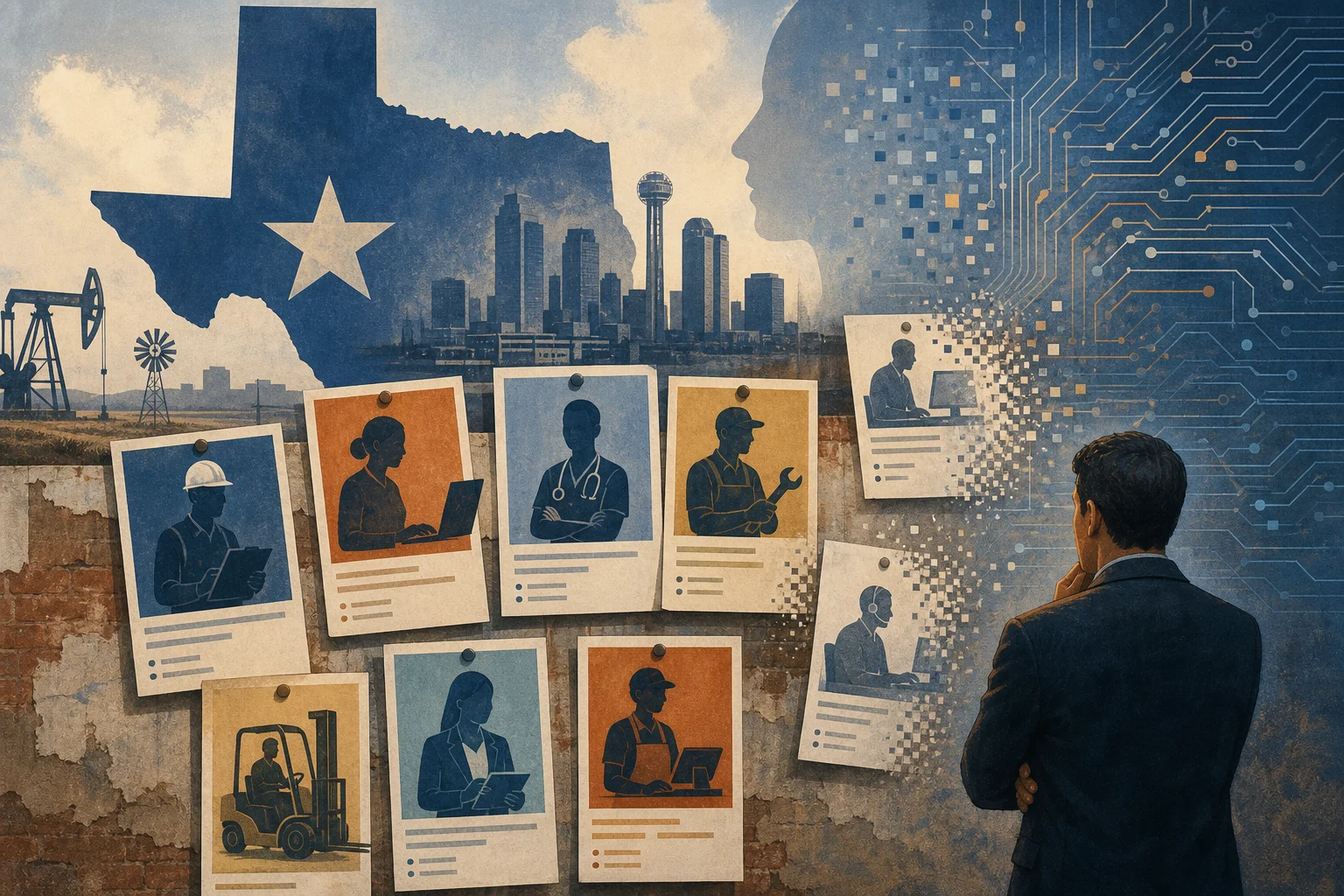
A Dallas Fed analysis says generative AI is already showing up in Texas labor demand. The Federal Reserve Bank of Dallas estimates that AI automation exposure reduced total Lightcast job postings in Texas by about 1.8% in 2024 and 2.6% in 2025, and it says more-exposed firms posted fewer automatable positions relative to their total ads after ChatGPT.
The Dallas Fed article also says firms whose pre-ChatGPT jobs were destined to become 10% more automatable posted jobs with 2 percentage points fewer automatable tasks after ChatGPT, which it describes as nearly a 50% reduction relative to the mean in its data. It says the aggregate effect is modest, but hiring reductions are significant for specific types of workers and may especially affect new labor-market entrants.
An Indeed Hiring Lab note published the same day says the labor market remains in a low-hire, low-fire pattern and says AI is one force likely to eventually break that stalemate. Indeed says AI-exposed occupations led the decline in postings from 2022 to 2026 and then led the rebound over the past year.
What the Dallas Fed says changed
The Dallas Fed’s finding is narrower than a claim of broad layoffs. Its article focuses on job postings and on AI automation exposure in Texas, with Lightcast as the posting data source. On that account, the clearest effect is a hiring pullback in automatable roles, not a general collapse in openings.
The Dallas Fed also says the effect is uneven. Its estimate is modest in aggregate, but the article says the hiring reductions are significant for specific worker types and may especially affect new entrants to the labor market.
What the Indeed note adds
Indeed’s same-day note places the Texas findings in a broader labor-market frame. It says the labor market is still in a low-hire, low-fire pattern, and it identifies AI as one force likely to eventually break that stalemate. It also says AI-exposed occupations led the decline in postings from 2022 to 2026 and then led the rebound over the past year.
Read together, the two reports describe a market where AI is visible first in the composition of posting activity. The Dallas Fed says more-exposed firms reduced automatable hiring, while Indeed says AI-exposed occupations have moved through both the decline and the rebound in postings.
What to watch next
The Dallas Fed article and the Indeed note both point to direction rather than final outcome. The Dallas Fed gives Texas-specific estimates for 2024 and 2025, while Indeed points to a labor-market pattern through 2026. The supplied sources do not identify whether the Texas pattern is continuing beyond the periods they measured.
For now, the reporting suggests that AI’s labor-market effects are appearing first in posting mix and automatable task content, not in a single headline measure. The Dallas Fed’s estimate is small in aggregate but measurable, and its own framing says the burden is not evenly spread across worker groups.
Sources
- Job postings show early signs of AI automation impact — Federal Reserve Bank of Dallas
- July 2026 JOLTS Report: Little Changed. Again. — Indeed Hiring Lab