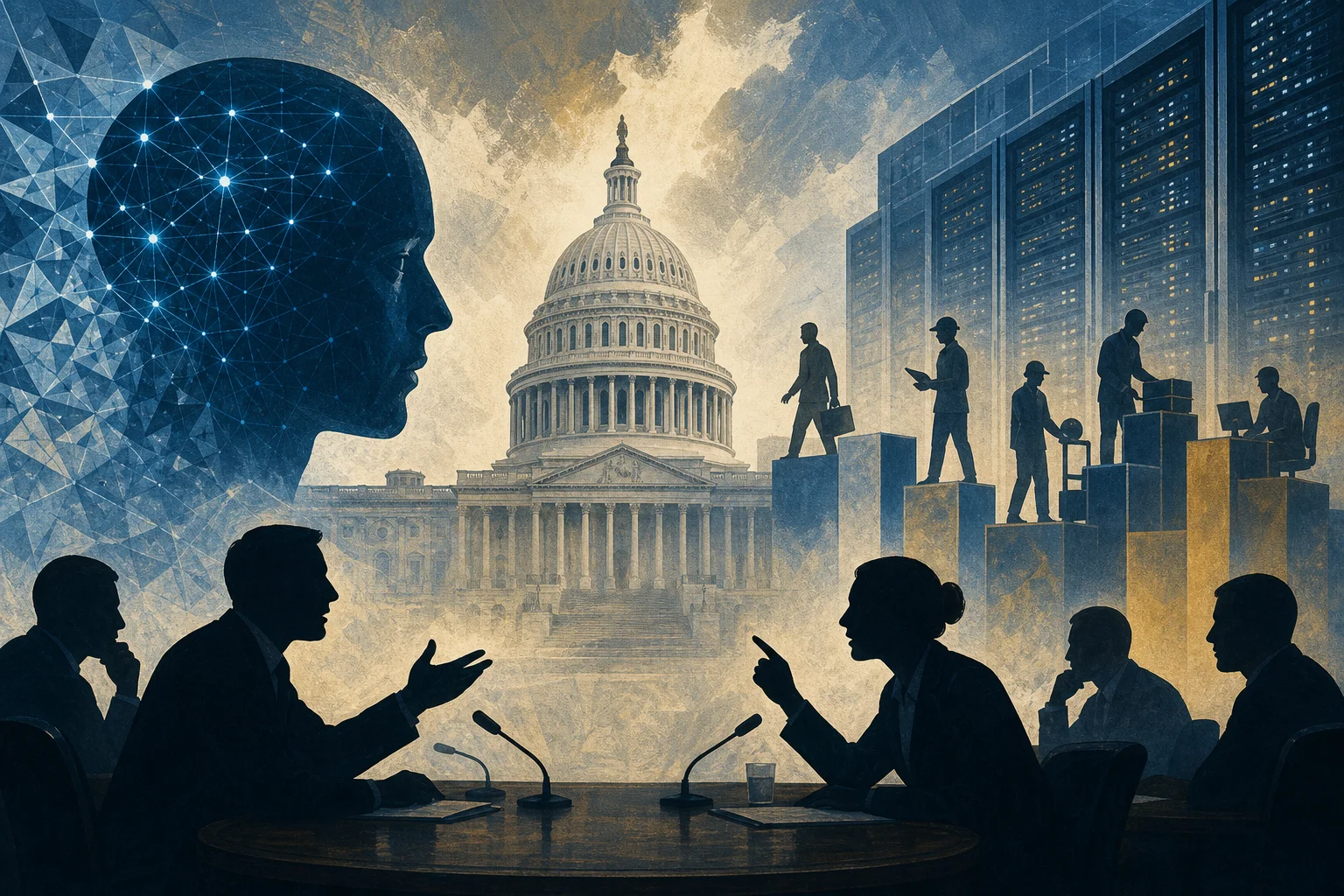
President Donald Trump rejected renewed calls for tighter AI guardrails on Sept. 14, 2026, using unusually sharp language about the risk warnings. In the AP report, he called efforts to limit AI part of a “SICK conspiracy” and described AI takeover fears as a “HOAX.” The same reporting says the dispute is increasingly tied to voter worries about job losses.
The immediate policy pressure came from Anthropic CEO Dario Amodei’s September 2026 essay, We Must Pace the Frontier. In that essay, Amodei wrote that AI systems are advancing faster and said society needs to slow the pace of capability gains so safety work can catch up. He proposed a three-step pacing framework: embedded evaluators with employee-like access, democratic coordination on standards and limits, and global coordination. He also said Anthropic is unilaterally committing to embedded third-party evaluators and is calling on governments to require other frontier companies to match that step.
AP also reported that Trump was pushing back against calls for greater government oversight of AI from Anthropic’s Dario Amodei, OpenAI’s Sam Altman, and Elon Musk. In that same reporting, AP said many Democratic lawmakers and candidates see the need to regulate AI because of worries about rising inequality and higher electricity bills. The supplied sources do not quantify new layoffs or hiring changes in this event.
What changed
The change described in the supplied reporting is political, not a measured workforce shift. AP’s account places AI regulation in the middle of a broader fight over whether frontier development should be slowed or more closely supervised. Amodei’s essay argues for pacing capability gains so safety measures do not lag behind model development, while Trump’s remarks reject the premise that AI needs new guardrails.
The labor-market angle matters because AP says the debate is being linked to job losses, but the supplied sources do not identify any specific workers, companies, or industries affected by this event. They also do not state that any regulation was adopted, that any evaluator requirement was imposed by a government, or that any coordinated standards or limits were put into effect.
Amodei’s proposal and the scope of the request
Amodei’s essay is specific about the mechanism he wants. He says AI systems are advancing faster than safety work and argues for slowing capability gains, then setting up embedded evaluators with employee-like access, democratic coordination on standards and limits, and global coordination. He further says Anthropic is making a unilateral commitment to embedded third-party evaluators and asks governments to require other frontier companies to do the same.
The supplied sources do not say that other frontier companies have accepted that request, nor do they say governments have adopted it. They also do not describe any timetable for implementation. For that reason, the reporting supports a description of a proposal and a commitment by Anthropic, not a completed policy regime.
Politics, jobs, and the case for regulation
According to AP, many Democratic lawmakers and candidates support regulating AI because of worries about rising inequality and higher electricity bills. That is the political backdrop in the supplied reporting. The sources do not provide a numerical estimate of jobs at risk, any sector-by-sector breakdown, or any polling data on how those concerns are distributed among voters.
AP’s framing is limited to the fact that labor-market anxiety is now part of the argument for or against regulation. The sources do not say that AI caused any specific layoffs in this event, and they do not say that any company changed headcount, retraining plans, or deployment strategy in response to Amodei’s essay or Trump’s remarks.
What to watch next
The next thing to watch is whether the public debate moves from statements to procedures. The supplied sources identify three possible fronts: whether other frontier companies adopt embedded third-party evaluators, whether governments pursue the standards and limits Amodei calls for, and whether political messaging around AI continues to focus on job losses, inequality, and electricity bills.
One additional constraint in the record is source scope. In the AP story about Amodei’s safety warning, AP said Anthropic and OpenAI did not immediately respond to requests for comment. That statement is limited to that story and that request. The supplied sources do not identify any broader company response to the policy proposals or Trump’s remarks.
Why this matters for workers
The supplied reporting does not measure direct labor-market effects from this episode, but it does show that worker concerns are now part of the political case for AI oversight. That matters because the debate is no longer only about abstract safety or technical progress. It is also about whether frontier AI development will be paced in a way that gives safety work time to catch up, as Amodei argues, or whether leaders like Trump will continue to reject new guardrails as unnecessary.
For workers, the evidence here is limited but important: AP says job losses are part of the regulatory argument, while Amodei says slower capability gains and evaluator access are needed so safety can keep up. The supplied sources do not tell us which view will prevail, and they do not identify any immediate downstream labor impact from the dispute itself.
Sources
- Trump dismisses idea of new AI guardrails — Associated Press
- We Must Pace the Frontier — Dario Amodei
- Anthropic CEO Dario Amodei says AI industry needs to give safety measures time to catch up — Associated Press