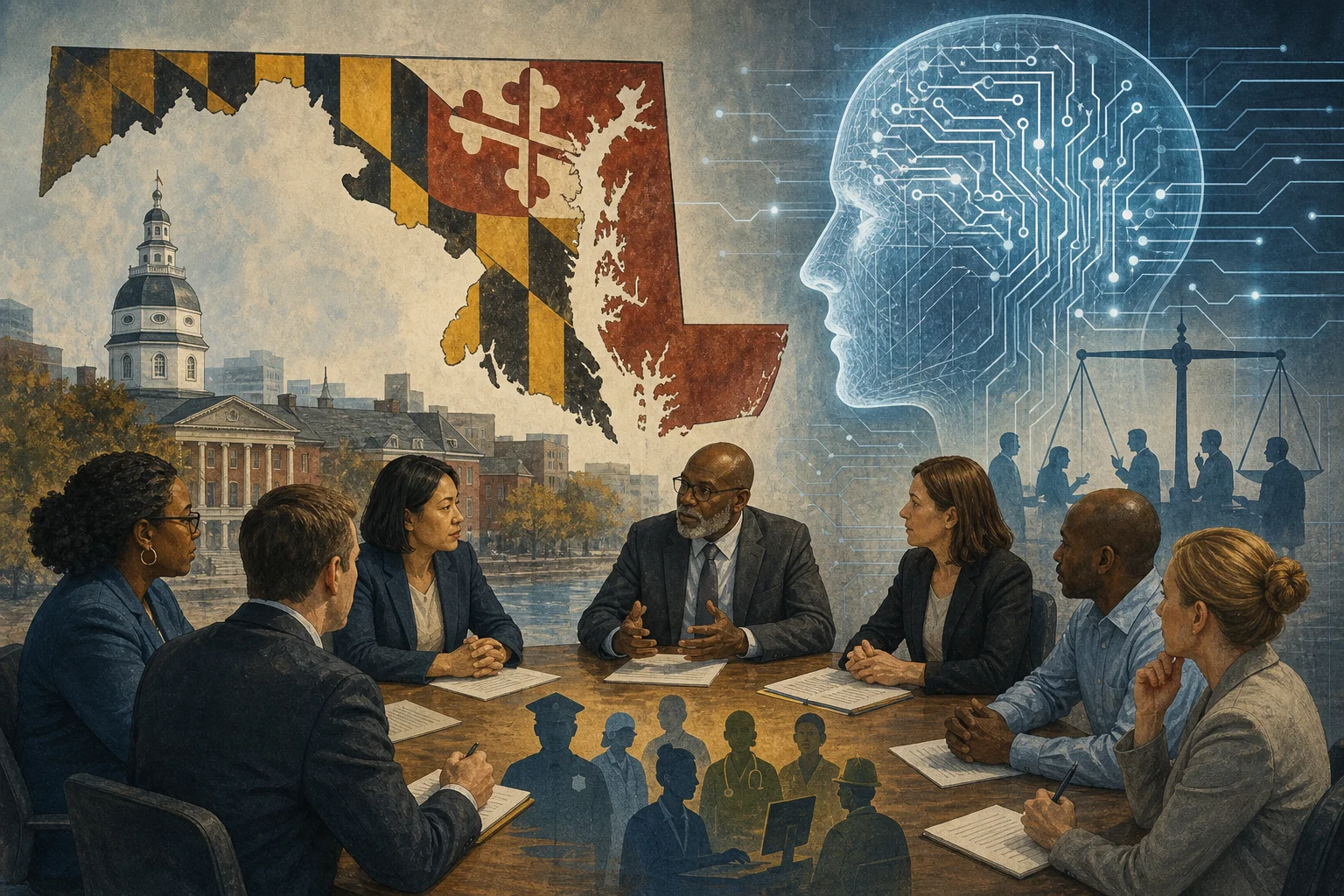
Maryland has outlined a new AI framework that places workers, job transitions, and employment guidance at the center of state policy. According to the governor’s office, Governor Wes Moore announced the framework on September 22, 2026, and said it is meant to protect Marylanders. The framework says Maryland workers and the unions that represent them deserve a voice in how AI affects them, along with worker-centered training and real transition support.
The state’s labor and civil rights agencies are set to issue guidance on how Maryland’s anti-discrimination laws apply to employment decisions made using AI technology. The administration also plans to create a standing labor-management committee to work with unions and state agencies on AI’s impact on workers. Separately, the framework directs regulators to make clear that existing civil rights, consumer protection, housing, and lending laws already reach AI-driven decisions.
The supplied reporting describes the move as a state-level policy effort aimed at protecting workers as jobs and skills needs change. HR Dive reported that the framework aims to support workers as jobs and skills needs change and to strengthen education and career transition pathways. The sources do not identify any final rules issued under the framework, and they do not identify a timetable beyond the announced plans.
What Maryland says it is doing
The governor’s office says the framework includes worker-centered principles, with training and transition support as part of the plan. The same announcement says Maryland workers and the unions that represent them deserve a voice in how AI affects them. In the supplied materials, those points are presented as part of the framework’s stated goals rather than as completed programs.
Two specific employment-related steps appear in the research bundle. First, Maryland labor and civil rights agencies are set to issue guidance on how the state’s anti-discrimination laws apply to employment decisions made using AI technology, according to Bloomberg Law. Second, the administration plans to create a standing labor-management committee to work with unions and state agencies on AI’s impact on workers, according to CBS News Baltimore. The supplied sources do not identify whether either step has already begun, whether any document has been published, or which agencies will lead each piece of work.
The governor’s office also says the framework directs regulators to make clear that existing civil rights, consumer protection, housing, and lending laws already reach AI-driven decisions. That statement is broad in scope, but the supplied sources do not spell out specific enforcement actions, covered systems, or affected sectors beyond the listed areas.
Who is affected
The clearest affected group in the supplied reporting is Maryland workers, including the unions that represent them. The framework also focuses on state agencies and the labor-management process that the administration plans to create around AI’s impact on workers. Beyond that, the reporting points to employers operating in Maryland, because the planned guidance concerns employment decisions made using AI technology.
The sources do not identify a statewide headcount, a particular workforce segment, or a list of job titles that would be covered. They also do not identify any specific employer, vendor, or state agency as having adopted, rejected, or tested the framework’s ideas. Because the bundle does not provide those details, it is not possible to say from the supplied evidence how many workers will be affected or how quickly.
HR Dive adds one more point: the framework aims to support workers as jobs and skills needs change and to strengthen education and career transition pathways. That description is consistent with the governor’s stated focus on training and transition support, but the supplied sources do not give a numerical estimate of the number of workers who may use those pathways or the size of any funding attached to them.
What is new, and what is not yet known
What is new in the record supplied here is the announcement of a framework that ties AI policy to worker voice, anti-discrimination guidance, and transition support. What is not yet known from the supplied sources is whether Maryland has issued the guidance, convened the standing committee, or published implementation details.
The bundle also says HR Dive reported that Maryland already has a law regulating facial recognition software during job interviews. That detail matters because it shows the state has already acted in at least one employment-adjacent AI area, but the supplied reporting does not say that the new framework changes that law or replaces it. No supplied source identifies a conflict between the framework and that earlier law.
The reporting places Maryland within a broader wave of state regulation of AI in employment, according to Bloomberg Law. That is a framing statement from the reporting, not a description of a specific Maryland rule. The sources supplied here do not identify federal guardrails, if any, as the basis for the state’s action beyond the general policy context described in the research bundle.
What to watch next
The next concrete developments to watch are the content of the employment guidance, the creation and membership of the labor-management committee, and any further explanation from Maryland labor and civil rights agencies about how they intend to apply existing law to AI-driven decisions. The supplied sources do not identify dates for those follow-up steps.
Also worth watching is whether Maryland’s announced worker-centered training and transition support appears in budget documents, agency guidance, or implementation plans. The research bundle mentions those aims, but it does not identify the operational details needed to show how the framework will be carried out.
For employers and state agencies, the significance of the announcement is that Maryland is moving from general AI principles toward workplace-specific guidance and labor consultation. The supplied sources support that characterization, but they do not show the final scope of any rulemaking, any enforcement change, or any compliance deadline.
Bottom line
Maryland’s framework is an early policy signal, not a finished regulatory system. Based on the supplied reporting, the state is preparing AI-related employment guidance, a labor-management committee, and worker-centered training and transition support, while also saying existing civil rights and other laws already reach AI-driven decisions. The exact reach of those steps remains unspecified in the sources provided.
Sources
- Governor Moore Outlines AI Framework to Protect Marylanders — Office of Governor Wes Moore
- Maryland Governor Calls for AI Job Bias Guidance, Safety Rules — Bloomberg Law
- Maryland governor’s AI framework focuses on regulation and reskilling — HR Dive