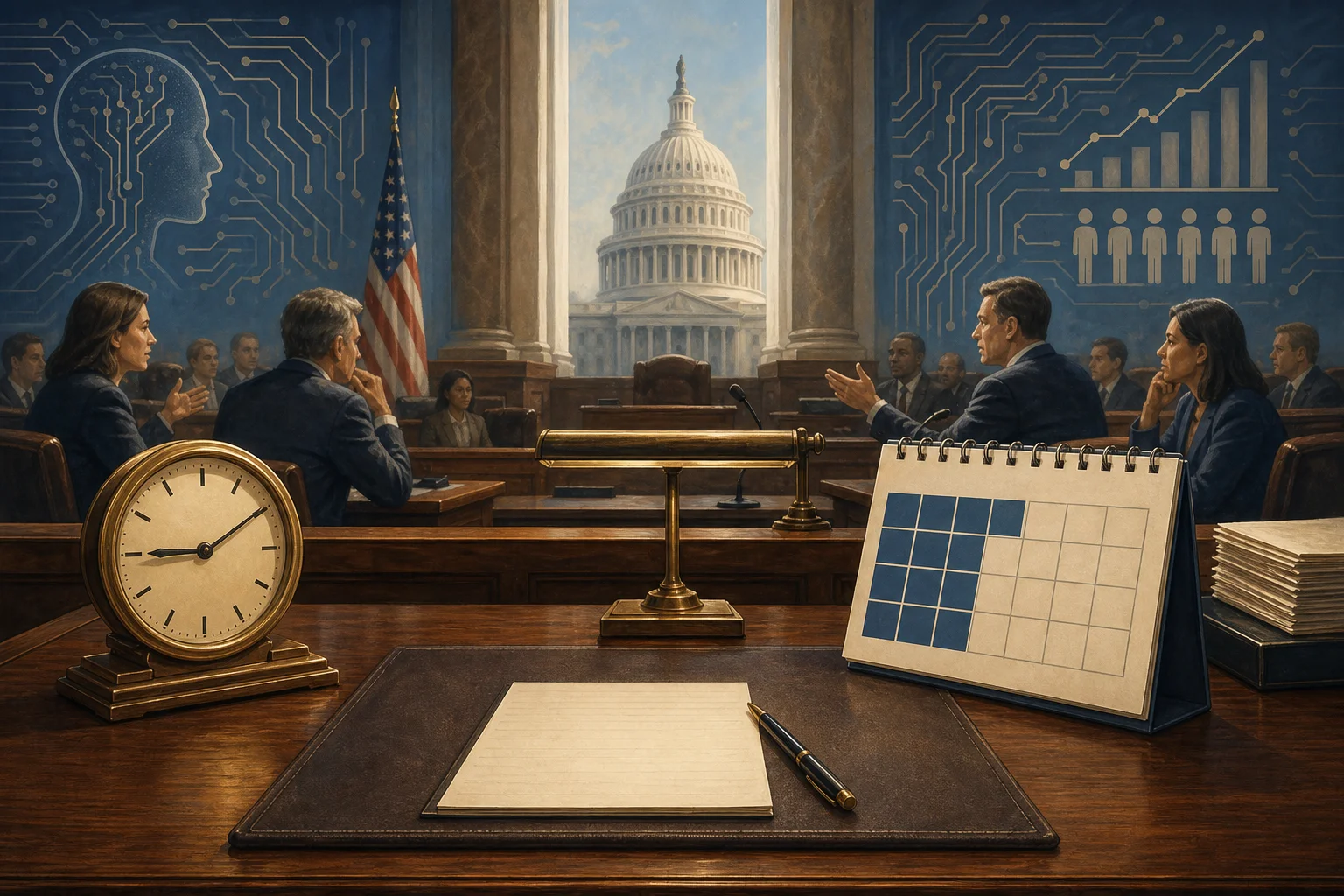
Bernie Sanders and Mark Takano have revived legislation to move the United States toward a 32-hour workweek, and they have tied that proposal to AI and automation. In the September 8 press release, Sanders’ office said the bill is meant to ensure America’s workers benefit from AI and automation, while also describing the measure as a standard 32-hour workweek with no loss in pay or benefits.
The House measure is H.R. 10323, the Thirty-Two Hour Workweek Act. GovInfo says it was introduced in the 119th Congress and referred to the Committee on Education and Workforce on September 8, 2026. According to the bill text and reporting cited in the research bundle, the proposal would reduce the standard workweek from 40 hours to 32 hours and phase that change in over four years: 38 hours in year one, 36 in year two, 34 in year three, and 32 in year four.
WTTW reported on September 23, 2026 that Sanders and Takano said AI had increased workplace productivity and that labor standards needed to catch up. Patch reported on September 16, 2026 that the proposal was being revived in the context of employers’ increasing use of AI, and that supporters argued workers should share in the productivity gains.
The Sanders press release says the proposal is endorsed by AFA-CWA, AFL-CIO, IFPTE, NELP, NNU, UE, SEIU, UAW, UFCW, and WorkFour.
Sources
- NEWS: Sanders, Takano Reintroduce Bill to Move Toward 32-Hour Workweek, Ensure America’s Workers Benefit from AI and Automation — Senator Bernie Sanders
- H.R. 10323 (IH) – Thirty-Two Hour Workweek Act — GovInfo
- New Bill Would Create a 32-Hour Workweek in the US. Here’s What to Know — WTTW
- Revived Push For 32-Hour Workweeks Comes As AI Replaces Human Labor — Patch