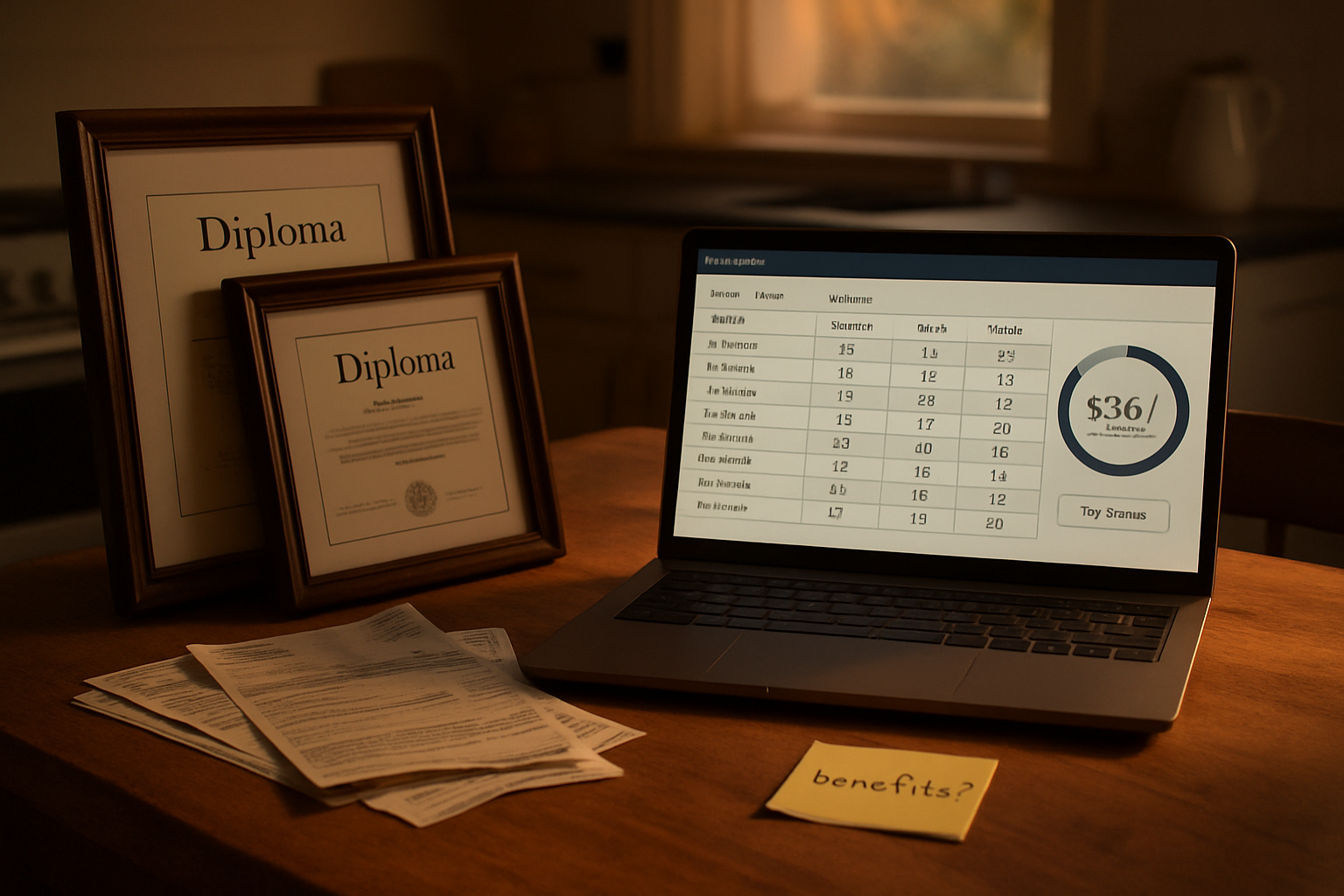
The second act no one asked for
Just after sunrise, a seasoned professional—pick your field, because the résumés in this story span health care, finance, academia—opens a browser to a queue that never quite feels predictable. The task is simple in structure and relentless in rhythm: read a prompt, read a model’s response, judge its accuracy, tone, and safety, suggest improvements, repeat. Each click is a tiny correction, a nudge to a system that is already good enough to unsettle hiring managers and not yet good enough to be left alone. The pay counter ticks at a rate that would have been unthinkable in their last full-time role, and yet here it is, the going price for expert judgment in 2026: mid-twenties an hour, sometimes a bit more for specialized projects, seldom with benefits, always on someone else’s schedule.
Yesterday, The Guardian’s interactive feature distilled this quiet shift into focus: a growing cohort of Americans over 50, detoured from stable careers by layoffs, age bias, or health shocks, now stitching together an income by training the very AI systems that may narrow their future options. Calling these “AI jobs” masks what’s actually happening. This is expert gig work—contracted through staffing networks and platforms that sit between the tech giants and the human evaluators—built for speed, priced by the task, and governed by availability that swells and disappears without notice.
The machinery behind the queue
The route into this world runs through intermediaries with innocuous names—Mercor, GlobalLogic, TEKsystems, micro1, Alignerr—whose pitch is straightforward: your domain expertise can make the models smarter in the places that matter, from medical phrasing to financial compliance. It’s not a fiction; that knowledge does move the needle. But the arrangement decouples expertise from employment. Titles dissolve into task IDs. Seniority translates into slightly better ticket rates, not into security. The most telling phrase from the workers profiled wasn’t about technology at all; it was about classification. This isn’t a job, it’s a gig. Some compare the pace to a digital assembly line, where quality control is measured in throughput.
Why older workers end up here
There’s a labor market backstory behind every login. Research cited in the piece is unambiguous: Americans in their early 50s are frequently nudged out of long-held roles earlier than planned, and workers over 60 take markedly longer to re-enter the market—and often never recover prior earnings. Layer on months of unanswered applications, or a health event that scrambles financial timelines, and a stopgap becomes necessary. For a former six-figure academic now accepting $26 an hour to adjudicate model answers, the platform is less an on-ramp to the future than a guardrail against immediate free fall. Some interviewees spoke about housing worries, the kind of pressure that makes an irregular queue feel like a lifeline even when it frays.
Training the thing that shrinks the lane
There’s a paradox at the core of this economy. The more coherent and compliant these systems become, the less human oversight they will require per unit of output. That trajectory is the product being sold to enterprise buyers. Which means the same workers who imbue models with domain nuance are, at least theoretically, compressing the need for their own kind of labor down the line. The article captures that uneasy loop without melodrama: most people doing this work know it’s temporary. They are building scaffolding for the models, not stairs for themselves.
What’s truly new here
We’ve spent years toggling between headlines about mass layoffs and breathless claims of an AI hiring boom. Yesterday’s reporting showed the third category that actually matters for most people: the transformation of employment conditions. AI is generating a parallel labor market where expertise is real, the work product is consequential, and yet the container is precarious—variable hours, little to no benefits, limited bargaining power. It is the unbundling of white-collar employment into streams of judgments and micro-decisions, priced to the minute, performed at home in environments that sometimes feel less like knowledge work and more like throughput optimization.
The stakes beyond the queue
If this is scaffolding, what comes after the structure sets? Some workers hope the experience will parlay into durable roles in evaluation, safety, or data quality. The pipeline exists, but it is thin. If models require fewer human corrections over time, the volume of this gig layer will contract. That’s not an abstract risk for the cohort highlighted here; it’s a budgeting line item. The safety buffers during this transition—benefits, retraining pathways, and employer or public commitments to portability and upskilling—are still fragile. And until we count those buffers alongside the number of “AI-related” openings, our read on progress will be distorted.
How to read the job numbers now
The Guardian’s piece invites a different metric for AI-era labor health: not how many roles mention AI, but how many offer stability, benefits, and a ladder that goes somewhere. If the answer arrives as a growing reliance on expert gig work to backstop people who once anchored teams and budgets, we should be honest about what’s being created. It’s work that matters, but it’s provisional. It enhances the product more than it advances the worker. Counting it without context risks mistaking a life raft for a fleet.
Back at the browser window, the task queue finally empties. Tomorrow it might swell to thirty hours’ worth of tickets; next week it might vanish. The models will be slightly better because of today’s clicks. The worker’s situation will be only marginally less uncertain. That gap—between systems that harden quickly and livelihoods that do not—is where the real AI-and-jobs story is unfolding.