The Day a Newsroom Drew a Line Around the Algorithm
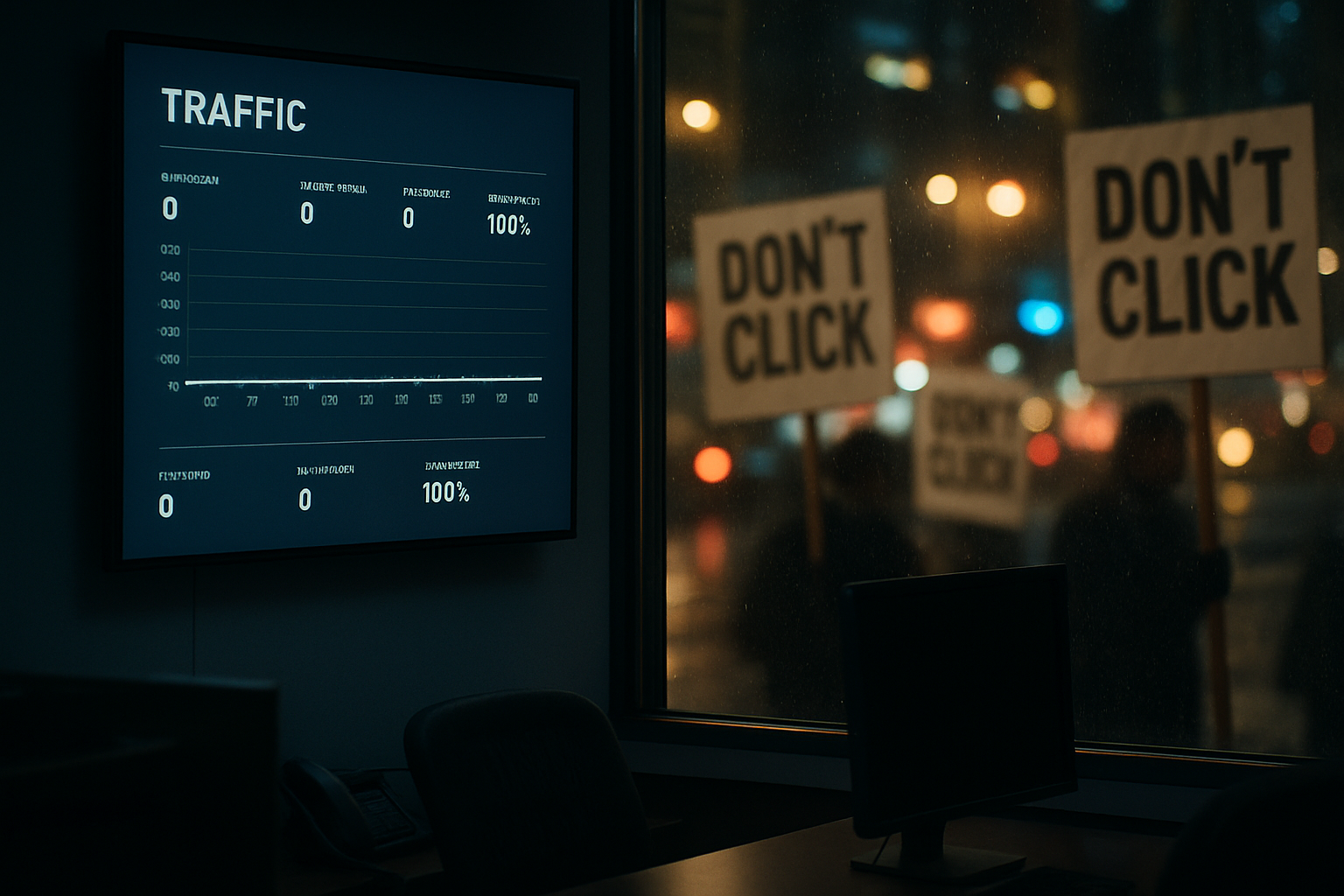
For one day, an investigative newsroom asked the public to look away. Not because the journalism wasn’t there, but because the people who make it decided their absence needed to be louder than any headline. In New York, Chicago, and Washington, D.C., roughly 150 unionized ProPublica staffers formed picket lines and extended that picket to the internet, urging readers not to click. A digital blackout as a bargaining chip—uncomfortable, deliberate, and precisely on point for a dispute about the future of work that lives inside the very screens we can’t stop refreshing.
The fight beneath the bylines
The walkout wasn’t just about dollars; it was about defaults. The ProPublica Guild accused management of unilaterally implementing an AI policy—enough, in their telling, to trigger an unfair labor practice charge filed with the National Labor Relations Board on April 6. In negotiations for a first contract, the union wants clear guardrails: no AI-driven job substitution without bargaining, enforceable seniority rules if layoffs ever happen, and wages that track rising costs. The underlying logic is simple but powerful: before software that predicts and summarizes seeps into every corner of reporting and production, the rules that determine who gets to keep doing the work must be written down and enforceable.
Management replied with a different frame. They stressed a commitment to a “fair and sustainable” first contract, noted that ProPublica has never conducted layoffs, and described an AI policy focused on content integrity—barring AI-generated or manipulated photos, video, and audio, and requiring human review for material touched by AI. It’s too soon, they argued, to know exactly how the tools will reshape their work.
That gap—between a policy built to keep fakery out of the product and a contract built to keep substitution out of the payroll—is where this story lives. One speaks to the audience; the other to the people behind the bylines. Both matter. Only one can be tested on a picket line.
Why this strike mattered beyond one newsroom
American media has seen labor actions over pay, workloads, and layoffs. What made this strike consequential is its center of gravity: the terms of engagement with automation itself. It is one of the first high‑profile U.S. newsroom work stoppages to place AI guardrails—not just wages—at the core of the dispute. The timing also elevates it. The Guild won recognition in 2023 and has been bargaining toward a first contract since late 2023; the conflict has matured from slogans into a concrete test of how AI policies intersect with job-security language in media agreements.
Legally, the contours are familiar even if the technology is new. U.S. labor law treats changes to wages, hours, and other terms and conditions of employment as mandatory subjects of bargaining. If a newsroom’s AI policy touches workload, evaluation, or the potential for role elimination, adopting it without negotiation invites an unfair labor practice claim. That is why “we need flexibility to experiment” and “we need enforceable limits before you experiment” collide so forcefully. Employers prefer optionality when the trajectory of a tool is unclear; unions try to prevent that uncertainty from becoming a warrant for unilateral change.
Contract language is where AI becomes real
AI in knowledge work tends to be discussed as a gradient—assistive today, autonomous tomorrow. Contracts, by contrast, are binary. They either include rights and remedies or they don’t. That mismatch is the strategic battlefield. If ProPublica’s final agreement includes provisions that require notice and bargaining before any AI-related role change, codifies seniority rules for any layoff scenario, and locks in cost-of-living raises to ensure “efficiency gains” don’t flow solely to the balance sheet, that becomes a template. Not just for newsrooms, but for the growing list of guilds and unions representing editors, analysts, designers, and researchers who face the same shifting frontier between “human-in-the-loop” and “human-on-the-sidelines.”
Expect negotiations to circle a few hard questions that many organizations are avoiding. What constitutes “replacement” when a task, not a job title, is automated? What disclosures are required when AI touches reporting, editing, or visuals? Who controls the logs and data that would verify compliance? And is there any domain—fact-gathering, source protection, sensitive image handling—where a moratorium, not just review, is warranted? The union’s current demands focus on bargaining over substitution, seniority, and wages; the settlement may also sketch the auditing and transparency practices that make any of those promises enforceable.
The quiet power of a digital picket
The tactic of asking readers not to visit a nonprofit newsroom’s site carries its own tension. It withholds attention from a public-service institution in order to protect the people who make that service possible. But that friction is the point. Knowledge work has limited levers for visible disruption; the absence of a product and the emptiness of a traffic chart are among the few that bite. If it felt strange to avert your eyes from a place built to be read, that strangeness is precisely what turns a one-day stoppage into a public negotiation about the terms of technological change.
What this signals for everyone else
Hollywood’s strikes in 2023 marked one path for AI guardrails, with protections around likenesses and writing credit. Investigative journalism is testing another, anchored in sourcing integrity and the labor that turns documents into accountability. The outcome here will matter because it will be pragmatic. It won’t be a philosophy of AI; it will be deadlines, clauses, and remedies. And those tend to travel quickly. Donors and boards watch, peer newsrooms watch, and so do unions across professional services who are about to live through their own version of this argument.
By the time the picket signs are back in closets and negotiations resume, nothing essential will have changed about the technology. What will have changed is the leverage on both sides and the clarity of the asks. If a first contract at a national investigative outlet can draw a bright line between guarding against synthetic content and guarding against synthetic headcount reductions—and codify both—it will have done something rare: turned a diffuse conversation about AI’s future into rules that hold tomorrow morning.