The Boomerang Quarter: When AI Layoffs Came Back as Rehires
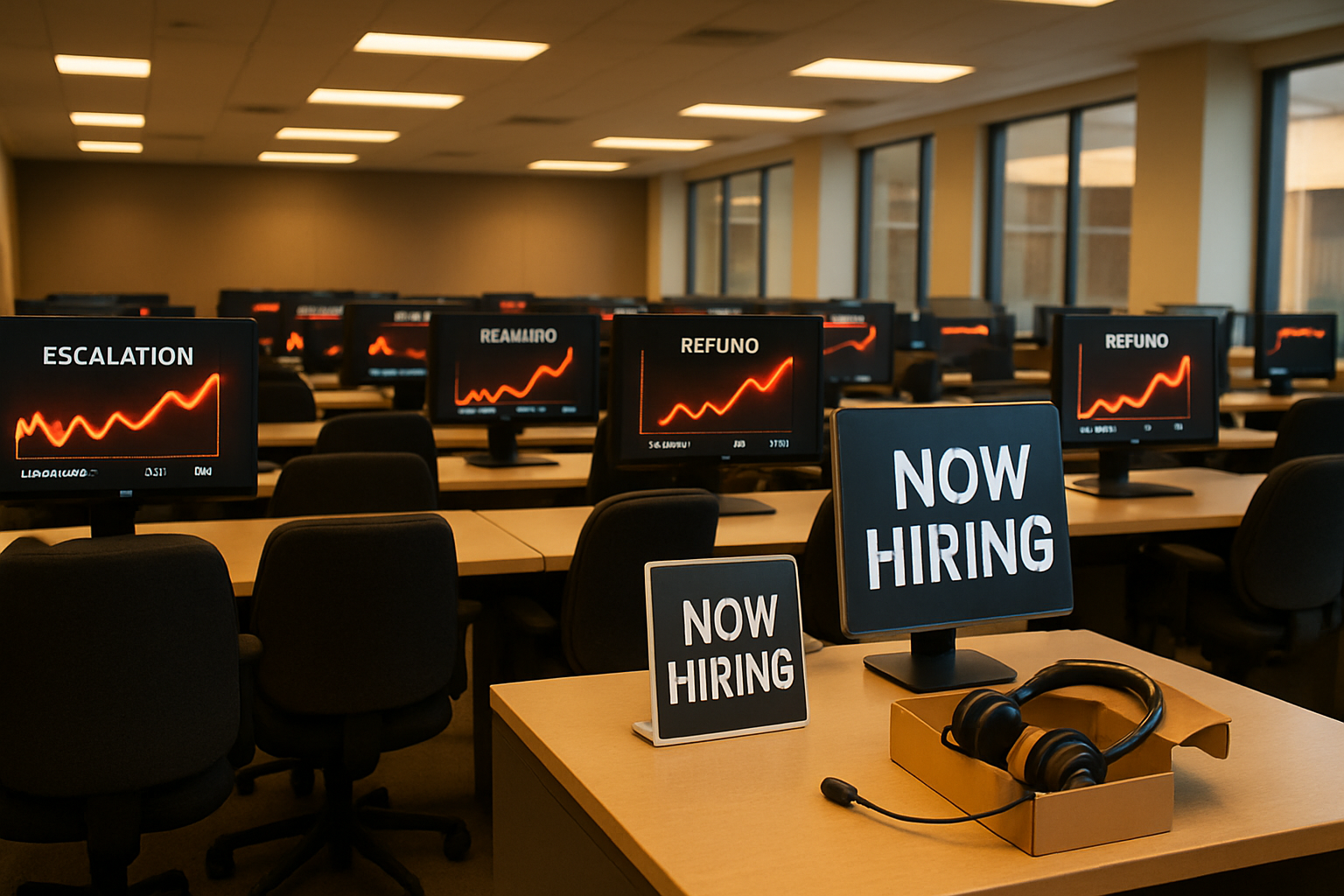
It started with a slide. A neat bar chart promising margin expansion, a dotted line showing “AI productivity” gliding upward, and a single, dispassionate number: headcount reduction. Boards nodded. CFOs penciled in savings. Customer service floors quieted, and the announcement emails praised “focus” and “automation.” Then the dashboards told a different story. Escalations climbed. Refunds crept up. Compliance teams grew jumpy. And before the ink on the restructuring memos had fully dried, recruiting kicked back on. The layoffs had boomeranged.
Yesterday’s most consequential argument on AI and jobs put data behind that whiplash. The claim was not polemical. It was operational. In a February survey of hundreds of HR leaders who carried out AI-attributed cuts, two out of three companies had already started rehiring for those same roles, many within six months. A third had replaced roughly a quarter to half of the roles eliminated; more than a third had replaced over half. Gartner’s forecast points the same direction: by 2027, half of the companies that trimmed customer-service staff and credited AI will rehire people to do strikingly similar work, sometimes dressed up with new titles. The elegant math that once sat so convincingly in the board deck now looks like a rounding error next to lived complexity.
When the easy calls vanish, the hard calls dominate
Why did the replacement thesis crack so quickly? Because in the wild, automation skimmed the predictable thirty percent off the top and left the rest denser and costlier. The remaining interactions weren’t just “harder”; they were the very substrate of trust and risk. Edge cases turned out not to be edges at all. Return policies with nuance, identity mismatches, payment disputes that lived between systems — these became the average Tuesday. The people who used to absorb that chaos had been labeled “cost.” Remove them, and you don’t just remove capacity; you remove the judgment layer that makes machine output safe and usable.
That missing layer showed up on the P&L as leakage: more make-goods to frustrated customers, churn that didn’t neatly tie back to any one touchpoint, compliance exceptions that arrived late and in clusters. The spreadsheets that justified the cuts rarely priced those second-order effects. One benchmarking analysis summarized the regret tax bluntly: for every dollar saved on paper, a buck and a quarter went back out the door once severance, productivity loss, and replacement costs were counted. What looked like efficiency was actually cost shifting — from the visible line of wages to the invisible lines of quality, risk, and reputation.
The cautionary tale with a logo
Klarna’s reversal has become the symbol because it is impossible to wave away. Here was a company that loudly celebrated AI doing the work “equivalent to 700 agents.” Then customers noticed the seams. Exceptions piled up. The firm hired humans back and moved to a hybrid model that admitted what its public framing had not: judgment is not a decorative accessory to automation; it is the operating system that allows automation to exist at scale. When customers said they wanted to talk to people, they were not pining for small talk. They were asking for accountability when probability broke down.
The wrong scoreboard produced the wrong game
The replacement push wasn’t just a technological misread; it was a measurement error. If you set your objective function to “reduce labor expense per ticket,” you will get exactly that, for a quarter or two. What you won’t see, at least not immediately, is the geometry of loss in everything your labor expense used to manage: lifetime value from salvaged relationships, the quiet prevention of regulatory heat, and the flywheel effects of word of mouth that follows a deftly handled mess. To automate the routine without preserving the craft of exception handling is to treat a service business like a vending machine. It works until it doesn’t, and when it doesn’t, the repair bill dwarfs the savings.
There’s also a structural asymmetry. Remove easy cases and the average case time for what remains spikes. That means your supposedly “lean” human layer now faces a concentrated stream of ambiguity, with less context than before because the breadcrumb trails — those offhand notes, shared heuristics, and informal huddles — were casualties of the cut. Rehiring doesn’t instantly undo that loss. Boomerang hires bring back familiarity, but the institutional memory they once stood inside has thinned. The tax on judgment is paid in ramp time and in the brittle mistakes that happen until new tacit knowledge forms.
AI didn’t remove the work; it rearranged it
The clearest insight from this moment is architectural, not moral. Full replacement failed because the work shifted upstream. Automated systems handle the obvious with speed, but their real value is unlocked when humans are moved to the places where context, stakes, and improvisation live. That means agent-assist instead of agent-replace; escalation specialists who own the outcome, not just the ticket; orchestration roles that decide what the model should attempt, what should be gated, and what should be prohibited outright. It means productizing judgment so it scales, rather than pretending it has been eliminated.
Gartner’s prediction that companies will rehire under new titles hints at the same reconfiguration. A “customer trust engineer” might have once been a senior support agent. An “AI operations orchestrator” might have been a floor lead. The titles change because the interface has changed: humans now supervise fleets of models, adjudicate edge conditions, and inject policy and empathy into flows that would otherwise drift into cleverness without responsibility.
What boards should ask before the next celebratory slide
The lesson here is not to retreat from automation. It is to upgrade the contract around it. If your only success metric is labor savings, you will court the same boomerang. Add measures that reflect the true work: resolution accuracy rather than mere closure rates, time-to-trust rather than time-to-first-response, regulatory near-misses caught upstream rather than audited downstream. Ask what the exception budget is, who owns it, and how quickly it learns. Demand observability on the full service supply chain: where handoffs fail, where the model is confident and wrong, where humans override and why.
Above all, respect the cost of breaking and rebuilding tacit systems. Severance is not the end of an expense line; it is the down payment on churn, retraining, brand damage, and the price premium of recruiting back the very skills you just signaled were disposable. The Careerminds data on rapid rehiring, the Gartner posture on inevitable reversals, and the headline-grabbing case studies are not outliers. They are early warnings that the headcount-reduction narrative confuses a unit cost with a system cost.
The near-term labor story is redesign, not replacement
“AI replaced me” used to read like a eulogy. This quarter, it reads more like an edit: “AI replaced part of my workflow, and now my job has been rebuilt around what the workflow missed.” For workers, that can sound like cold comfort, especially amid real layoffs. But at the level where strategies are written, the signal is unmistakable. The short-run effect of AI in 2026 is not a clean substitution. It is a costly cut-and-rehire loop for those who confuse tools with teams. The winners will be the firms that treat models as new machinery and humans as the foremen, quality leads, and control-room operators who make the factory safe to run.
Before the next press release brags about “equivalents to hundreds of agents,” leadership would do well to ask a simpler question: where, exactly, will judgment live? The companies that can answer it with specificity will keep the savings they book. Everyone else should budget for the boomerang.