AI Is Bending the Job, Not Breaking It
Yesterday in Ottawa, a central banker did something unusual in a year saturated with executive euphemisms and spreadsheet‑scented layoff announcements: she drew a clean line between what’s being imagined and what’s actually happening. Michelle Alexopoulos, the Bank of Canada’s external deputy governor, told a room of policy wonks what many workers have sensed in their bones and many headlines have muddied—AI is changing the way we work, but it is not yet detonating the job market. “So far, we don’t have evidence that AI is replacing workers on a large scale. It is transforming work tasks, not replacing people.”
Coming from a G7 monetary authority, this isn’t a vibes check. It’s a baseline. Central banks don’t typically arbitrate technology narratives; they track the real economy because that’s where inflation and growth actually happen. And their read, grounded in fresh Canadian data, is precise enough to be uncomfortable for both optimists and doomers. Among firms that adopted AI, nearly nine in ten reported no staffing change. Roughly four percent reported hiring tied to AI, and about six percent cut roles because of it. Households, for their part, mostly describe AI as a tool for the tasks that nibble at the edges of the day—writing drafts, analysis, summarization—rather than a turnkey replacement for whole workflows.
What It Means When a Central Bank Talks Tasks
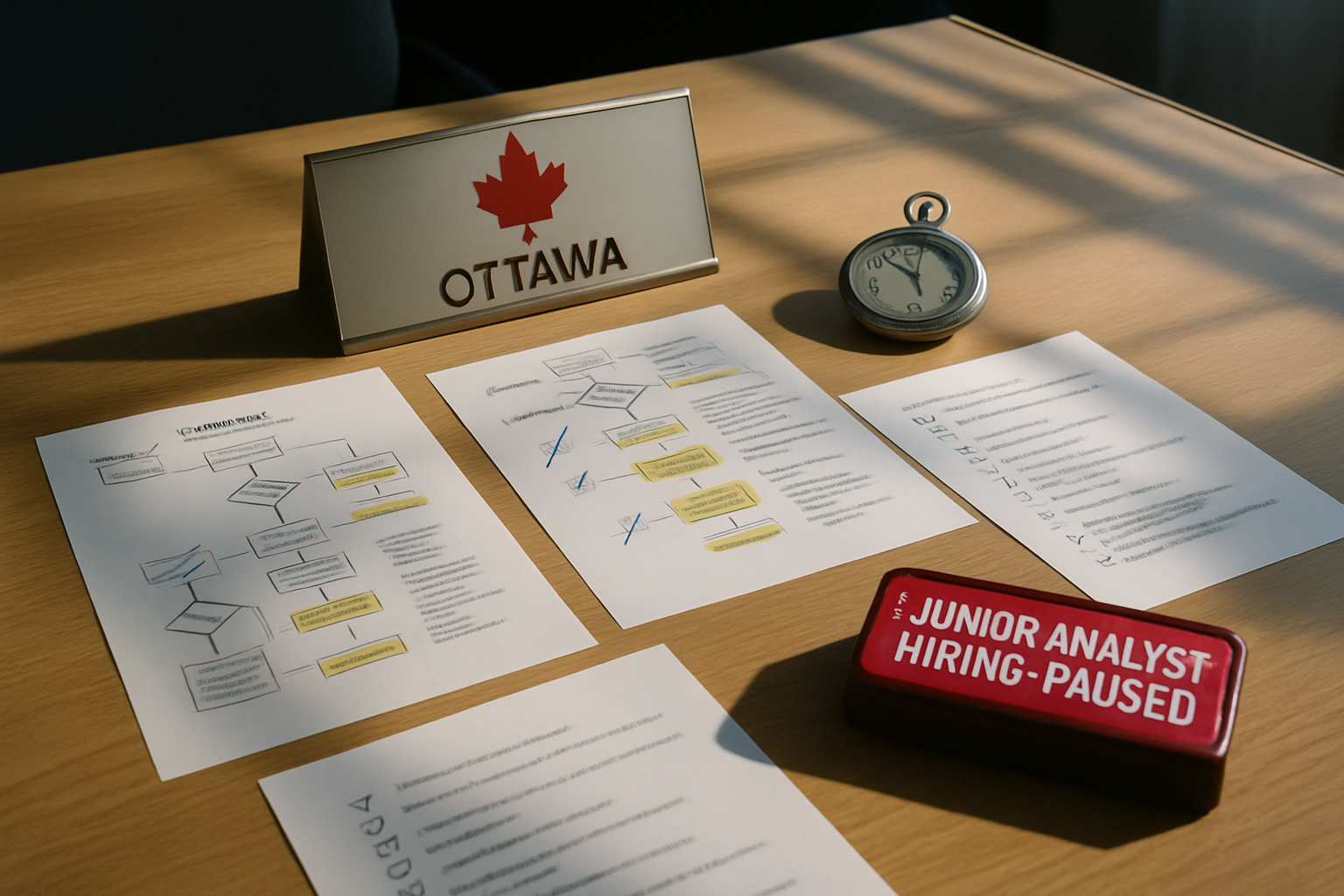
This framing matters because it recasts the unit of analysis. For a decade, the discourse has ping‑ponged between “occupations at risk” and “new jobs we can’t yet name.” The Bank’s language is more operational: tasks inside jobs are being re‑composed. That’s a small difference with large consequences. If AI primarily reshapes tasks, firms don’t need to rip out headcount to see value; they need to rewire how work is sequenced, who does what first draft, and where quality control sits. That’s reorganization, not downsizing—and reorganization takes time, capital, and managerial attention. It also explains why the earliest tremors show up not as mass layoffs but as hiring slowdowns at the entry points of AI‑exposed roles, where on‑the‑job learning used to justify junior seats that an assistive model can now partially cover.
For monetary policy, “task transformation” is not a semantic flourish. Productivity gains from AI are the cleanest path to easing price pressures without pain, but they are notoriously hard to measure at the outset. If firms are redeploying minutes rather than removing people, the first signals are more likely to be cycle times, throughput, and rework rates than a collapsing unemployment rate. The Bank is essentially saying: don’t mistake the absence of a layoff wave for the absence of change. The locus of action has shifted inside the job description.
The Counterweight to Casual Blame
There’s another reason this statement ricocheted across wire services: it pushes back on the convenient habit of attributing every cut to “AI.” In tight markets, technology often becomes the scapegoat for broader restructuring, demand resets, or capital discipline. By offering a data‑anchored view—no economy‑wide job destruction yet—the Bank forces operators and investors to separate genuine automation effects from opportunistic labeling. It doesn’t deny that roles will disappear or that some will be reborn; it insists on chronology. Creative destruction isn’t instantaneous. First you get tool adoption and workflow redesign, then substitution at the edges, and only later the possibility of occupation‑level overhaul if entire chains of tasks can be reliably automated end‑to‑end.
The Frictions That Decide Who Wins
Alexopoulos’s subtext was practical: skills are now the binding constraint. If the near‑term value of AI lives inside tasks, the return to adoption depends on workers who can wield the tools without sacrificing quality. That shifts the burden from grand transformation plans to the gritty work of capability building—prompt discipline, evaluation literacy, privacy hygiene, error‑aware review. Ignore that, and you’ll get the worst of both worlds: slower teams performing more “last‑mile” fixes while junior hiring stalls because managers can’t articulate what entry‑level apprenticeship looks like in an AI‑mediated shop.
Distributional questions also move to the foreground. Task‑level gains don’t flow evenly. They accrue to people whose responsibilities map neatly to what models can accelerate, and to firms that can integrate AI into systems of record rather than leaving it as a sidecar. Without targeted upskilling, the career ladder can kink: senior people retain judgment work, a handful of technical enablers capture rents, and the rungs where novices used to learn by doing get sawed off. That is not visible in headline employment, but it shows up in who advances, who plateaus, and how bargaining redefines “a fair day’s work” when a machine drafts the first 600 words.
What to Watch Next
The Bank was candid about its limits: it can’t steer the scale or speed of AI adoption. But it did set the terms for how to scrutinize what comes next. If you want an early warning for genuine displacement, don’t stare at unemployment; watch for workflows that move from AI‑assisted to AI‑directed, where models stop drafting for a human and start orchestrating chained tasks across tools with minimal oversight. Track whether junior postings in exposed occupations rebound or hollow out. Look for evidence that time saved is being reinvested into higher‑margin work rather than booked as a permanent staffing reduction. And pay attention to the messy middle—procurement, compliance, evaluation—because until those functions certify end‑to‑end reliability, most firms will keep humans in the loop and jobs on the payroll.
The headline, then, is a careful one: the labor market hasn’t cracked under AI; it has flexed around it. That doesn’t absolve leaders from planning for sharper substitution later. It does tell us where reality sits today and where measurement should focus tomorrow—on verifiable task productivity, on rebuilding the skills pipeline, and on the early frictions at the gates of the modern career. For a blog called AI Replaced Me, that might sound like a paradox. It isn’t. Replacement is a destination; right now, the economy is still mapping the route.