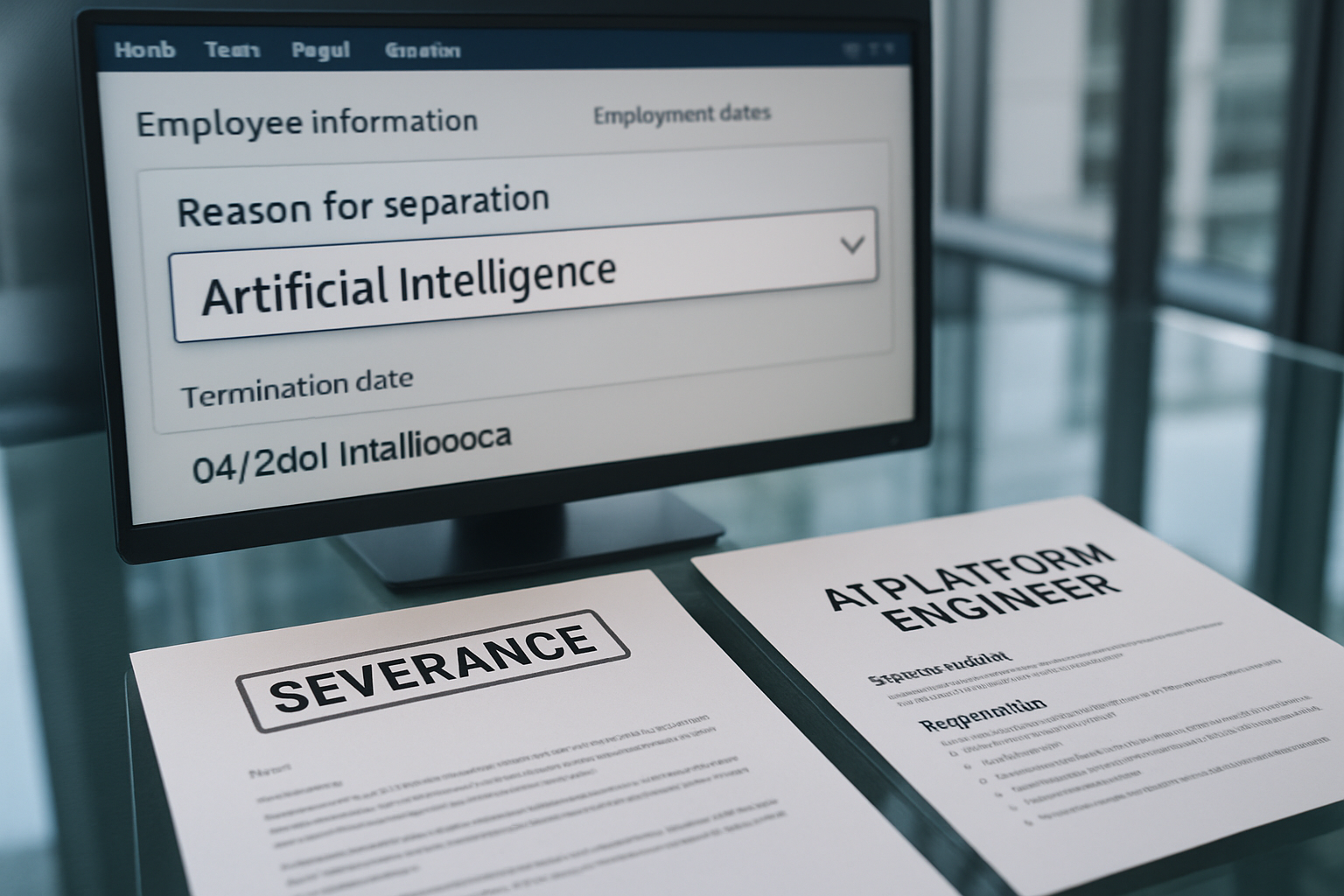
The month AI moved from slide decks to severance memos
There’s a moment when a trend stops being speculative and starts appearing on paperwork. In May, that moment arrived with all the subtlety of a stamped form letter: U.S. employers told Challenger, Gray & Christmas they planned 97,006 layoffs, and a record 38,579 of those cuts were explicitly attributed to artificial intelligence. For the third straight month, AI topped every other reason—bankruptcy, closures, plain-vanilla restructuring—and by a widening margin. Forty percent of announced May cuts were tagged “AI,” up from 7% in January, 25% in March, and 26% in April. Whatever you think about causality, the language executives are using has changed.
Numbers with teeth
Tech led the retrenchment with 38,242 announced cuts in May, the sector’s highest monthly total since August 2024. That single line item nearly covers the entire AI-cited figure, and it pairs with something that sounds paradoxical until you see the new org charts: tech also posted the most May hiring plans, 11,250 roles. Year-to-date, companies have now attributed 87,714 planned cuts to AI—22% of all 2026 layoffs—already eclipsing the 54,836 AI-cited cuts logged in all of 2025. May’s overall total was the highest for that month since 2020 and marked the third consecutive monthly rise.
Challenger’s Andy Challenger tried to split the difference between alarm and reality: this isn’t a “jobpocalypse,” he said, but companies are acting on AI now. The data backs him up. We’re not seeing a collapse; we’re seeing a deliberate reshaping, visible in the juxtaposition of pink slips and new requisitions landing on the same desks.
The intent economy
Challenger tracks announced actions—what leaders intend, not yet what happens. That distinction matters, but it also makes the signal sharper. These are the words employers choose when they tell investors, regulators, and employees why the headcount line is moving. If AI keeps showing up as the primary reason across three consecutive months, it tells you less about macro labor demand and more about what boards expect their operating model to look like by year-end. It also hints at internal accounting: attributing cuts to AI can justify capital reallocation to model development and infrastructure, tame questions about near-term margin pressure, and frame layoffs as transformation rather than retreat.
Reshape, not retreat
The hiring blip in tech is not a contradiction; it’s the blueprint. Companies are trimming roles adjacent to repeatable cognitive work while opening seats in AI platform engineering, data stewardship, evaluation, safety, and integration. The distribution of skills is barbelled: fewer generalists running legacy processes, more specialists building and governing the systems that will absorb those processes. The work doesn’t vanish; it moves into software, playbooks, and guardrails. That migration is why severance checks and offer letters are going out in the same week.
Sector texture
Beyond tech, transportation and fintech stood out in May’s numbers. Fintech’s “bulk” of cuts citing AI suggests the industry is consolidating routine decision flows—underwriting, fraud, compliance reviews—into model-assisted funnels, where humans supervise escalation rather than originate every action. Transportation’s reductions likely reflect network optimization and predictive operations that compress scheduling, dispatch, and customer support headcount. None of this requires a factory-floor robot; most of the displacement is happening in the interfaces between data, policy, and customers.
AI and the consolidation undertow
Alongside the AI rationale, mergers and bankruptcies are ticking up. That pairing isn’t incidental. As compute, data pipelines, and model operations become core infrastructure, the cost of competing rises, and so does the pressure to acquire capability or exit. Some cuts will be labeled “AI” when they’re really about consolidation forced by AI-era economics. Others will be labeled “restructuring” when they are, in practice, the downstream of AI-led redesign. The taxonomy blurs, but the direction is the same: fewer companies with larger AI stacks, employing fewer people to produce the same—or more—output.
From headlines to handbooks
The media read the moment simply because it is simple in one way: tech led the cuts as it “ramps up spending on artificial intelligence,” as Bloomberg Law put it. CFO Dive emphasized the three-month streak at the top. But the more important shift is administrative. Once AI becomes the accepted, reportable reason, it migrates into policy documents, severance scripts, and HRIS codes. That standardization accelerates adoption because managers now have a sanctioned path to pursue it. The words on the form unlock the budget.
Policy clock starts now
This is the first clear, multi-month, quantified signal that employers are not only experimenting with AI but reorganizing around it. It sharpens every debate that matter-of-factly stalled on hypotheticals last year: how to measure displacement versus augmentation; whether training dollars should flow to domain expertise or tooling proficiency; how to audit “AI-cited” versus “AI-caused.” Legislators and labor negotiators now have a number to react to, even if it’s just intent. Expect works councils and unions to press for transparency on task mapping, evaluation criteria, and redeployment pathways instead of generic “AI transformation” slides.
What June will tell us
If AI remains the top-cited reason for a fourth month, the narrative hardens from impulse to operating rule. Watch whether the AI share of cuts stays near 40%, and whether the tech sector keeps pairing trims with hiring plans. If that barbell persists, we’ll see a labor market that is simultaneously cooling for roles built around manual synthesis and warming for roles built around model stewardship. Challenger’s dataset won’t tell us everything about realized separations, but it tells us what matters most about intent: executives now see AI not as a pilot, but as a reason—and they’re writing it down.
Source: Challenger, Gray & Christmas May report on U.S. job cut announcements.