The UK Tries to Rebuild the First Rung of the AI Economy
Somewhere between a school leaver’s last exam and a company’s first automated workflow, the bottom step disappeared. Entry‑level work—the messy, repetitive, formative tasks that teach you how an industry breathes—has been quietly absorbed by software. On June 6, the UK government did something unusual: it acknowledged the missing step and announced a plan to rebuild it.
The “Early Careers Jobs Alliance,” a new national partnership co‑chaired by Prospect union’s Mike Clancy and the government’s AI sector champion Katie Gallagher, isn’t just another training badge. It is explicitly about job architecture: mapping how first‑rung roles are mutating under automation, publishing guidance that employers can implement, and keeping paid progression routes open even as routine work vanishes. Backed by £20 million and beginning in the Digital & Technologies sector before expanding across eight priority industries, its first report lands this autumn. The premise is simple and radical: if AI eats the grunt work, you must design novice work on purpose rather than hope it survives by accident. The announcement, trailed ahead of Monday’s AI Adoption Summit, frames an “AI future that is pro‑business and pro‑worker,” as Technology Secretary Liz Kendall put it, and turns that slogan into operational commitments (gov.uk).
From pipelines to guarantees
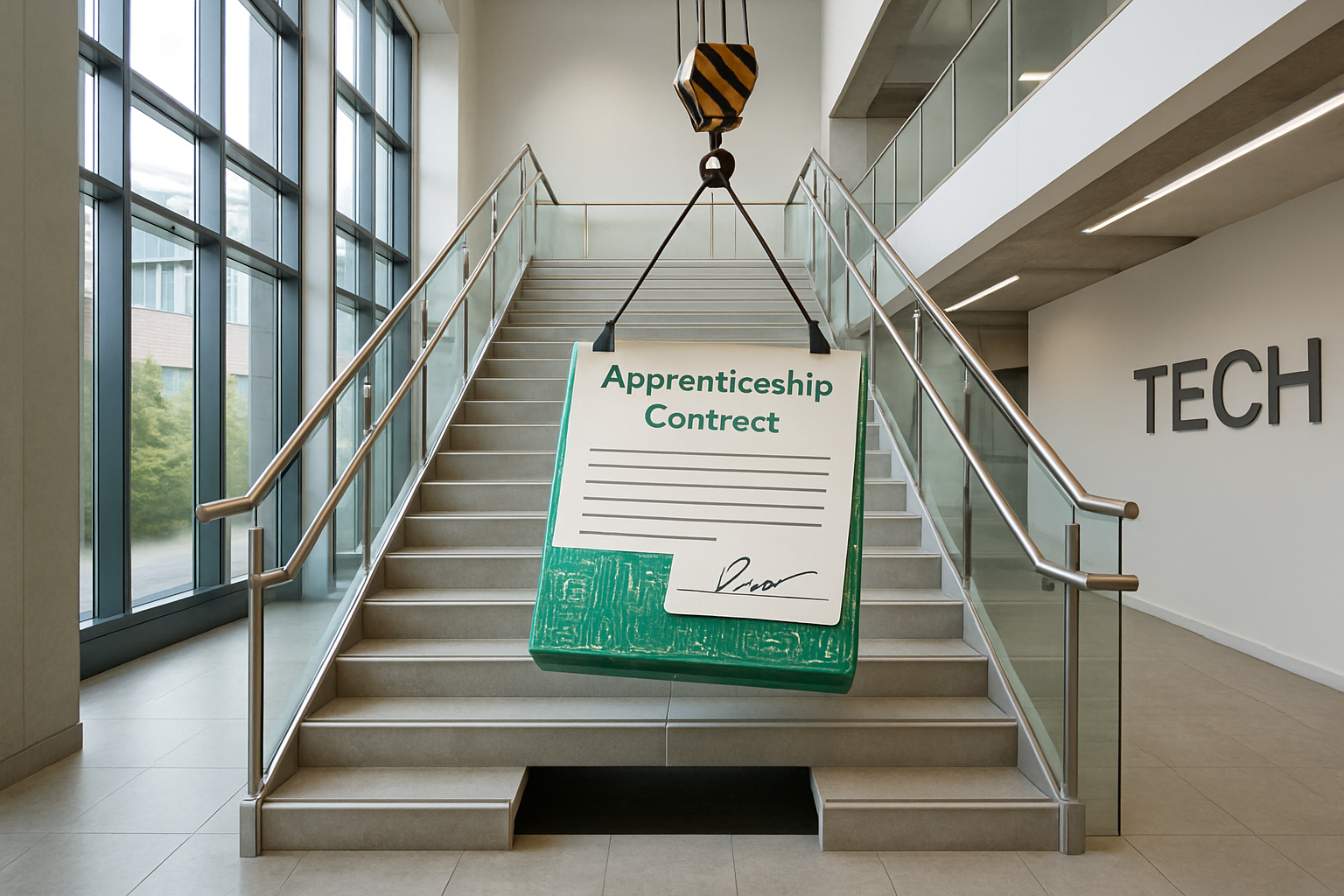
The real novelty is not the rhetoric; it’s the guarantees. The Alliance is paired with a set of experiments that convert training into contracts rather than certificates. This summer, new AI Bootcamps in North West England will give school‑leavers at risk of becoming NEET free training with a guaranteed, paid Level 3 apprenticeship on completion, delivered with employers that actually hire—JD Sports, BAE Systems, PA Consulting, Agilisys, and several local councils. If the model proves out, it scales nationally in the 2027–2028 academic year. In early 2027, the North East AI Growth Zone will offer at least six months of paid, on‑the‑job AI training for 18–24‑year‑olds not in education or work, delivered with Accenture, Microsoft, and Sage via a government Jobs Guarantee. And upstream, TechFirst will reach at least 400,000 students from the UK’s most disadvantaged schools by 2029, wiring AI and tech skills into the journey before the first job interview is even booked (gov.uk).
Designing novice work in an age without novice tasks
This is a quiet rewrite of how economies socialize beginners. For a century, entry‑level workers learned by doing the tasks everyone else was glad to avoid. In AI‑dense firms, those tasks are either automated or gated behind tools that assume context you don’t have yet. The Alliance is, in effect, funding the missing pedagogy inside companies: how to break down AI‑augmented roles into scaffolded, paid experiences that build judgment safely and quickly. That’s not a curriculum problem; it’s an operating model problem. It asks employers to specify where a junior sits in a loop with models and mentors, how feedback is captured, what counts as production‑grade contribution, and when the learner graduates to independent decision‑making.
Tripartite design—government, industry, and unions—matters here. It anchors the incentives so apprenticeships and placements aren’t cosmetic. Unions can push for real progression and fair pay; firms can shape tasks that deliver value while training; the state can underwrite the friction and set standards that travel across sectors. If it works, the UK doesn’t just produce more “AI‑literate” youth; it produces a template for keeping opportunity open when automation removes the very rungs people used to climb.
The bet, the risks, the export
The bet is that guaranteed pathways outperform the old “train and pray” model. That’s testable. Within a few years we should know whether completers land durable roles, whether employers retain them, and whether the designed entry‑level experiences produce faster ramp‑up and fewer safety incidents in AI‑mediated workflows. We should also see whether these schemes reach those most likely to be shut out as low‑complexity work evaporates.
There are obvious risks. £20 million buys architecture and guidance, not a revolution. Guarantees can decay into queues if employer demand softens, or into low‑responsibility roles if task decomposition is sloppy. Quality will hinge on what “entry‑level” means in practice: are apprentices labeling data at arm’s length from the real action, or participating in AI‑assisted service, engineering, and operations with guardrails and feedback? And timing matters. The most ambitious pieces—national rollout of bootcamps and the North East growth zone—arrive from 2027 onward, while automation pressure continues today.
Still, this is one of the first national attempts to treat entry‑level work as critical infrastructure in an AI economy. Other countries have focused on safety standards, compute, and research. The UK just put a stake in the ground on something more everyday and more fragile: the first job. If it hardens into policy and practice, expect the model—guaranteed pathways, co‑designed novice work, and a curriculum‑to‑contract bridge—to be copied. If it fizzles into pilots, the lesson will be equally clear: you can’t preserve mobility in an automated economy without paying, explicitly, for the time it takes to learn.
Either way, the smallest promise here is the most radical: your first encounter with the AI workplace won’t be a sink‑or‑swim login screen. It will be a paid invitation to join the loop.