Minneapolis Drew the Map: Labor Just Made AI a 2028 Campaign Test
The country’s largest labor federation didn’t raise its voice in Minneapolis so much as change the pitch of the 2028 race. At the AFL‑CIO convention, leaders from 65 unions translated years of shop‑floor anxiety into electoral architecture: candidates will be graded on how they constrain AI from eroding jobs and how they harness it to improve work. Axios captured the mood with the line delegates kept returning to—“It’s us or the machines”—but the more consequential shift was subtler. AI is no longer merely a bargaining topic or a think‑tank panel. It is now a litmus test for the presidency.
This is not a flash of technophobia. It is coalition management under the hottest light in American politics: a campaign cycle where industrial policy, data infrastructure, and labor power are colliding. The federation’s resolution—demanding leaders choose between Big Tech’s profit‑maximizing deployments and what it calls “responsible and careful” change—codifies a view that has been developing in scattered strikes and contract fights for years. What changed in Minneapolis is scale and timing. The pivot from internal platform‑setting to explicit electoral pressure landed as the convention adjourned; the message went public before would‑be candidates could rehearse safe answers.
From the shop floor to the ballot box
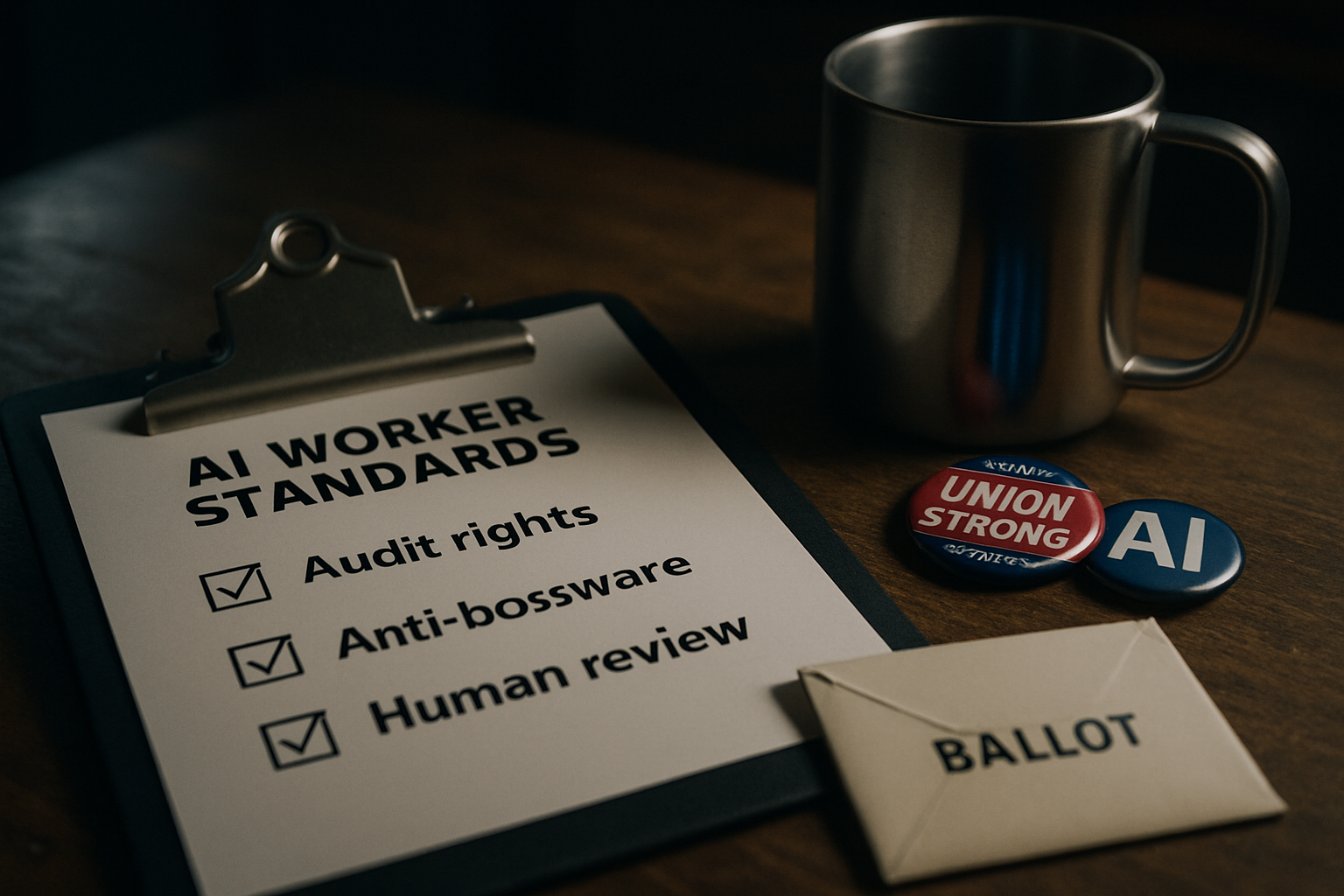
Organized labor has been negotiating against algorithmic management and data extraction in specific workplaces—no‑camera clauses, audit rights, human review for automated discipline. Those tactics matter, but they can’t touch sector‑wide deployment choices made by platforms and cloud providers upstream. By treating AI governance as an election filter, unions are signaling they want statutory constraints, not just contractual ones: curbs on “bossware,” accountability for discriminatory models, rules against digital replicas that harvest a worker’s voice or likeness without consent, and enforceable safety standards for AI‑mediated worksites.
That escalation is also a reading of political math. Labor’s leverage in tightly contested states doesn’t come from tweets or white papers; it comes from member mobilization around concrete asks. A questionnaire that forces candidates to address algorithmic surveillance or layoff triggers is a different instrument than the broad tech optimism both parties have used for a decade. When AFL‑CIO president Liz Shuler says leadership should “put workers at the center,” she’s not auditioning a slogan. She’s drawing a line through current plans from both parties and finding them wanting.
The unexpected fissure on the left
One of the most telling choices in Minneapolis was what labor did not do. Even as some progressives, including Sen. Bernie Sanders and Rep. Alexandria Ocasio‑Cortez, floated moratoriums on new AI data centers, union leaders publicly rejected blanket bans. For the building trades, data centers mean years of union paychecks and apprenticeships; for others, they are leverage to demand community benefits and safer job sites. The message wasn’t “full speed ahead” so much as “prove the build‑out is responsible.” That puts labor slightly cross‑current with parts of the climate and digital‑rights left, and it exposes the movement’s own time horizon: safeguard today’s work while forcing rules that mitigate tomorrow’s harms. It is an old labor dilemma—near‑term jobs versus long‑term risk—rewritten in fiber and GPUs.
This stance matters for another reason. By avoiding absolutist bans, unions keep a seat at the table where siting, permitting, and public subsidies are negotiated. That is where conditions can be attached: project labor agreements, training pipelines tied to local hiring, and operational standards that limit surveillance and protect data dignity for on‑site workers. It’s a wager that governance beats abstinence, and that the terms of deployment, not just the fact of deployment, are where worker power can bite.
What “worker‑centered AI” could become in law
The phrase has been easy to nod at and hard to define. Minneapolis pushes the conversation toward specifics. Think of a package that treats AI systems affecting employment like hazardous equipment: documentation and testing obligations before deployment; auditable logs of automated decisions; a right to explanation and human appeal for high‑stakes outcomes; prohibitions on covert monitoring in break rooms and off‑hours devices; limits on synthetic replicas of workers without negotiated consent and compensation; and real penalties for data practices that strip people of bargaining power. Pair that with procurement rules—no federal contracts for firms that deploy algorithmic management without guardrails—and you have immediate leverage without waiting for a grand bargain in Congress.
There is a parallel track as well: enforcement capacity. The agencies that will police these rules—the NLRB, EEOC, OSHA, state labor departments—were built for clipboards, not code. A worker‑centered regime implies budget lines for algorithm auditors and forensic data experts, plus whistleblower protections that cover digital retaliation. If unions succeed in making this the benchmark for endorsements, the next primary season will force candidates to say whether they will fund that muscle.
The 2028 equation just changed
By not inviting 2028 aspirants to the convention, labor denied them the usual performative drop‑in and instead critiqued from a distance. California’s approach drew fire—Gov. Gavin Newsom’s executive order was called “not helpful”—a public signal that generic innovation‑friendly language won’t pass. On the Republican side, the fault lines are widening between pro‑business boosters of AI expansion and populists who see algorithmic management as one more way to squeeze workers. Both parties now face the same test written in simpler terms: will your AI platform create better jobs or fewer good ones?
Expect the donor map to complicate that calculus. Big Tech money traditionally leans toward candidates promising speed and scale; unions are now offering an alternative: speed with safeguards, and scale conditioned on worker power. If labor can translate that into turnout—in suburban logistics hubs, in swing‑state manufacturing corridors, among public‑sector workers facing software‑mediated austerity—it will force campaigns to pick a lane rather than triangulate with buzzwords.
What to watch after Minneapolis
The convention’s timing explains its bite. With the summer of 2026 ahead, there is room for union questionnaires, scorecards, and early endorsements to shape the 2028 field long before platform committees meet. Watch for state‑level test cases—laws curbing bossware or requiring human review of automated discipline—that become proxies for federal commitments. Track whether federal agencies update guidance on algorithmic management and whether major employers move preemptively, offering audit rights or no‑layoff guarantees tied to AI deployments to blunt the coming pressure.
The larger significance is cultural as much as legal. For a decade, AI policy has oscillated between innovation boosterism and existential dread. Minneapolis injected a third pole: a practical, enforceable worker standard that makes AI deployment a democratic choice, not a private default. If campaigns accept that premise, we will spend the next two years arguing over thresholds, audits, and rights rather than abstractions. If they don’t, unions just told us what happens next: they organize around the absence—and make it the story of 2028.