The Day the Jobs Debate Grew Up
Yesterday, while pundits continued their ritual of arguing whether AI will take “all” the jobs or “most” of them, Brookings quietly changed the channel. A 43‑minute read by Xavier de Souza Briggs landed with the energy of a policy adult entering a room full of slogans. Instead of more anecdotes about chatbots and layoffs, it offered a blueprint to treat employment disruption like a system you manage, not a storm you endure. Election year theater has been doing what it does—heightening dread without sharpening choices. This framework does the opposite: it lays out what those choices actually are, and how fast they must be made.
The premise is disarmingly simple: AI’s labor impacts are real, but not linear and not foreordained. Machine capability is only the first move; employer behavior and public guardrails decide the rest. If you’ve been following the past year of “AI did X” headlines—X being a spreadsheet of dismissals or a stratospheric valuation—this argument feels refreshingly concrete. The authors don’t ask us to choose a tribe in the jobs apocalypse debate. They ask us to build a portfolio and execute.
From Patchwork to Portfolio
Brookings structures its plan around four concurrent strategies—brakes, steers, buffers, shifts—and the order matters less than the simultaneity. Each counters a specific failure mode. Together, they form the difference between managing transition and getting managed by it.
Brakes are not about smashing innovation with a sledgehammer; they are about installing handrails where a slip would be catastrophic. That includes rules keeping humans in command for decisions that implicate safety, liberty, or livelihoods, plus serious automation‑impact assessments before organizations push the “replace” button. The subtle but crucial turn is worker consent: if your creative output trains the very model that underbids you, policy can say that’s not a free input. We already see sector bills experimenting here—teaching, counseling, and other trust‑heavy roles—and the idea is spreading through states faster than Washington can schedule a hearing.
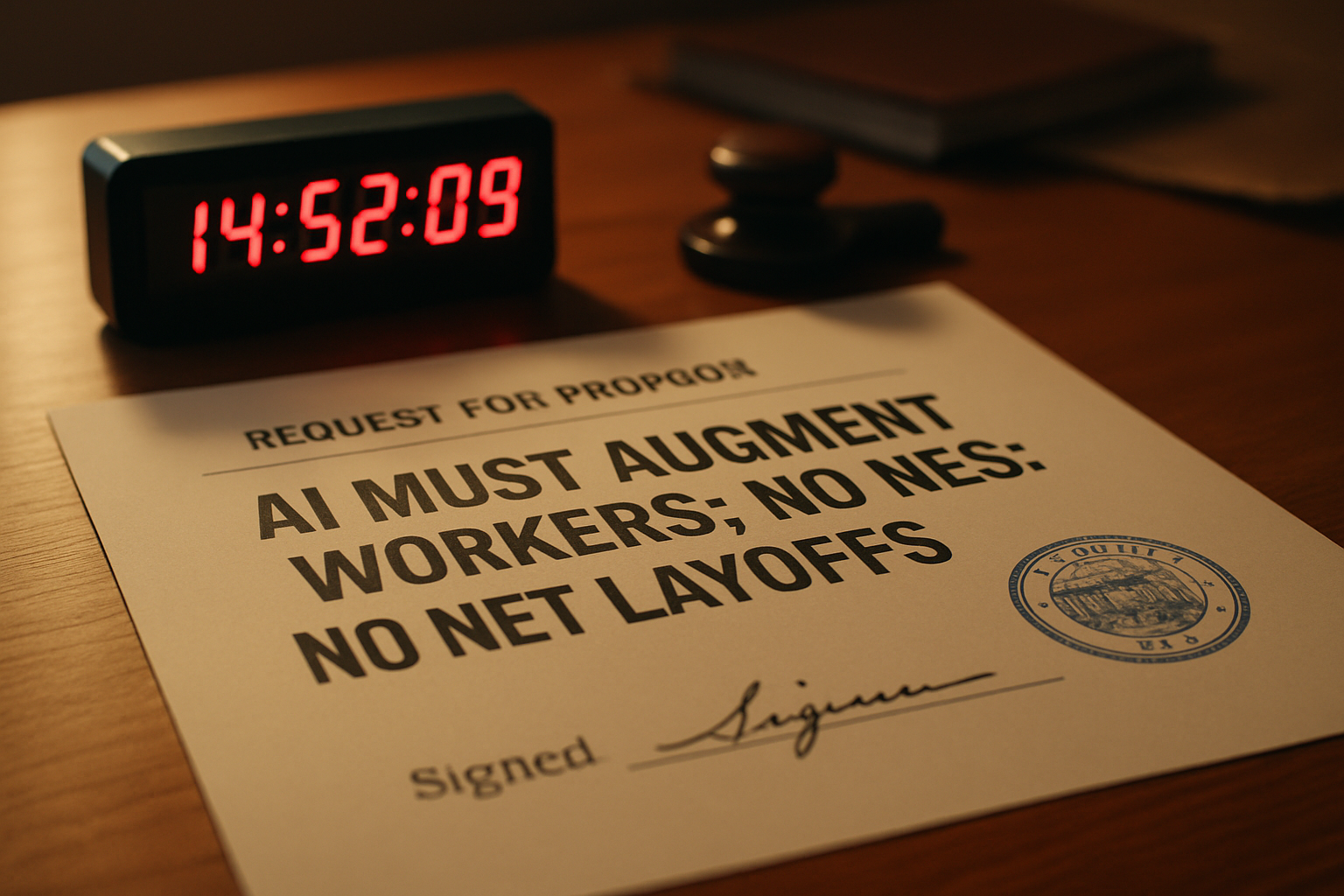
Steers are the invisible hand with a wrist brace. Government procurement, often treated as a clerical function, becomes a demand signal for “pro‑worker AI”—systems designed to raise output without shedding headcount. Public buyers can require augmentation features, transparent audit trails, and commitments to redeploy rather than release staff. Bargaining tables can hard‑code automation governance, from disclosure timelines to retraining budgets. And states can test sharper tools: conditioning subsidies when firms swap people for software, requiring notice when layoffs are AI‑related, even experimenting with targeted taxes on specific uses that do nothing but shave labor costs. The point is to increase the expected value of complementing workers and to reduce the arbitrage value of replacing them.
Buffers are the acknowledgement that even with the best steering, some workers will be displaced, and speed matters. Flexicurity models—generous, time‑limited income support paired with aggressive re‑employment services—turn a cliff into a ramp. Wage insurance, once a white paper curiosity, deserves a pilot at AI scale: if a displaced worker lands quickly but at lower pay, the system can bridge the gap while skills catch up. The workforce apparatus we have was built for longer, slower shocks. The one we need must behave more like an airbag than a pension plan.
Shifts are the long arc: sharing gains and rethinking the rhythm of work. Brookings dusts off ideas that markets, not morals, forced back onto the table. If software is expensed and labor is taxed as if it were a luxury good, don’t be surprised when spreadsheets point toward substitution. Rebalancing the code can move the dial. So can public wealth mechanisms—broad‑based capital accounts or sovereign‑style funds tied to AI’s upside—so the prosperity narrative isn’t “your job or my margin,” but “our dividend from the machines we collectively enable.” And yes, the workweek is fair game: if productivity rises, time can be shared as well as income.
Stop Arguing About Whether; Start Tracking Where
One of the most useful passages is the least glamorous: measurement. Right now, we don’t credibly track when and where AI is the actual cause of a workforce change. Layoff trackers are noisy; adoption surveys conflate dabbling with deployment. Without better instrumentation, public responses risk being performative. Brookings proposes hardening the data: require employers to disclose AI‑related job impacts; fund academic dashboards that combine administrative records with usage signals; and standardize what counts as “AI‑related” so we can target help, not headlines. This isn’t trivia—it’s the spine of triage.
The Power Imbalance We Don’t Like to Name
Another under‑told reality: the jobs most exposed to advanced AI are among the least unionized. That asymmetry makes “worker voice” a talking point instead of a lever. The framework calls for raising bargaining coverage and adopting worker‑first AI principles that travel with the tech, not just the firm. It’s not nostalgia for 20th‑century labor relations; it’s about putting a counterweight in rooms where software makes workforce decisions in milliseconds and budgets in quarters.
Policy Is Local, Disruption Is Lumpy
Risks won’t hit every place the same way. Governors and mayors should be running AI scenario planning like climate stress tests, mapping which sectors in their regions are complementing versus substituting, and preparing “AI‑readiness” plans that tie training dollars to real employer roadmaps. New York’s new FutureWork Commission is cited as a template: convene employers, unions, educators, and local officials, and put a clock on it. While we’re at it, let’s fund pipelines into work AI is least likely to hollow out—nursing, the building trades, and other skilled roles we chronically understaff but pay well—while telling a more honest story to Gen Z about where white‑collar displacement risk actually sits. Not everyone needs to pivot to prompt engineering; many should pivot to work machines want to assist, not replace.
The Spicy Ideas
Two proposals will make CEOs sit up. First, directly taxing certain AI uses, potentially using model usage tokens as a metering substrate. Think of it less as a broad “robot tax” and more like pricing a narrow externality: if the only point of a deployment is wage arbitrage with diffuse social costs, price the choice. Second, public wealth mechanisms that let the mass public participate materially in AI’s capital gains. Combined with tax reforms that stop making labor the expensive input and code the cheap one, these aren’t punishments; they’re alignment tools.
What Changes If We Take This Seriously
Here’s the meta‑shift. The framework refuses the false binary of “ban it” versus “let it rip.” It builds a lane for “go fast where it helps, slow down where it harms, protect people when it does both, and redesign the rules so tomorrow’s incentives don’t recreate yesterday’s damage.” That stance treats policy and procurement as technology shapers, not spectators. It assumes employment outcomes are still profoundly shapeable—if we move in parallel instead of in sequence.
For readers of this newsletter, the implications are immediate. If you build AI, your buyer will soon ask whether your product augments headcount or replaces it—and may pay accordingly. If you run a team, you’ll need an automation impact assessment as routine as a security review, and you’ll have to negotiate not only with finance but with the people whose tasks you intend to refactor. If you govern, your procurement office is now a workforce strategy team, your labor agency a data operation, and your economic development playbook a lot less about ribbon cuttings and a lot more about rapid redeployment.
Markets can price innovation quickly. Democracies have to earn their speed. Brookings just handed decision‑makers a map and a clock. The question isn’t whether AI will change work. It’s whether we’ll do the policy work fast enough to decide which changes stick.