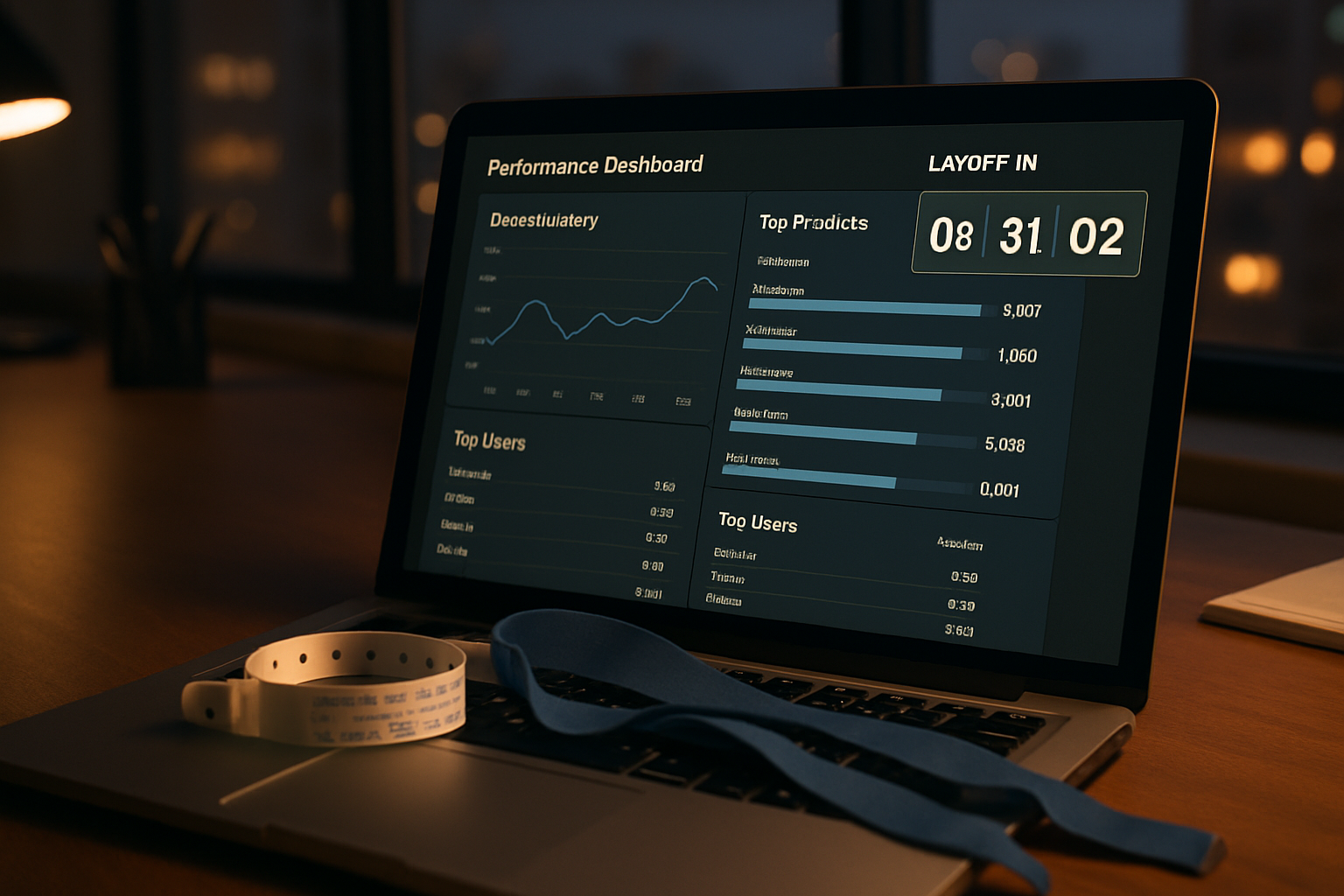
When Protected Leave Turns Into a Data Point
By late afternoon in Oakland, a different kind of headcount meeting arrived in the form of a lawsuit. Twenty-six current and former Meta employees asked a federal judge to do something HR never will: stop the clock. Separations are set to begin July 22, but the plaintiffs argue the countdown was started by a stack of internal AI systems that translated absence into underperformance and turned protected leave into a liability score. Whether you call it automation or assistance, the claim is stark: a May reduction in force was fed by metrics that punished pregnancy, disability, and family care as if they were lapses in effort.
Meta answered with the familiar refrain that people made the ultimate decisions. But if you have ever watched a modern performance review, you know how gravity works. Dashboards tilt the table. When a “constellation” of internal tools—keystroke and activity monitors, token-usage dashboards, algorithmically assisted rankings, and a system employees call Metamate—produces composite scores, the person at the end of the chain often ratifies the number. Humans are present; the frame is set by the machine. The case will probe whether that frame crossed lines set by the Family and Medical Leave Act, the Americans with Disabilities Act, the Pregnancy Discrimination Act, and the Pregnant Workers Fairness Act, and whether Title VII’s disparate impact doctrine reaches an algorithm whose inputs never say “pregnant” or “disabled,” yet make those statuses legible through proxies.
The Moment the Metric Met the Law
Disparate impact law was built for situations exactly like this—facially neutral practices that tilt outcomes against protected groups. The doctrine forces a simple but uncomfortable question: even if an employer never asked who took leave, did its chosen measures make leave functionally disqualifying? In court, that plays out through a burden-shifting dance. Employees show the pattern; the employer claims business necessity; the employees propose less discriminatory alternatives that still meet business needs. Here, the alternatives are not speculative. Anyone who has designed time-based productivity metrics knows the obvious step: normalize output by available hours, exclude protected absences from activity windows, or delay rankings until a representative sample period exists. If discovery reveals those options were available and ignored, “the algorithm did it” will not help; it will hurt.
That is why this lawsuit is as much about architecture as it is about outcome. An AI-native company can still build guardrails that understand context. Instead, the complaint paints a system in which recent output became the lodestar during a period when thousands were being evaluated and a sizable share were off the field for lawful reasons. Keystroke counts do not account for newborns. Token-usage dashboards do not know about physical therapy. A ranking system that collapses time into a quarter, while ignoring the reasons that time was legally excused, will predictably sweep up people who were never meant to compete in that window at all.
The Technical Crux Hiding in Plain Sight
Nothing here requires an exotic model failure. It is the default failure of metric design. When activity is the dependent variable and recency is the weight, absence becomes an error to be corrected rather than a right to be respected. You can hear it in the vocabulary: “gaps,” “downtime,” “idle time,” “quiet weeks.” If those signals feed a scoring system without context masks, the model learns a fact that is both statistically true and legally treacherous: people who do not type, ship, or generate tokens recently are less productive. The right question is not whether that correlation holds; it is whether the system was allowed to operationalize it for decisions where the law prohibits it.
This is why Meta’s “humans made the call” defense may not be the exit ramp it once was. The law does not grant immunity because a person clicked approve on a forecast. Courts and regulators have already warned against the alchemy of pushing bias upstream into a model and calling the downstream signature “judgment.” If the evidence shows managers were handed ranked lists, confidence scores, or “areas of concern” flags—especially in a high-pressure, high-volume layoff cycle—the human element risks being recharacterized as execution rather than deliberation.
Discovery Will Be the Real Audit
The plaintiffs have asked for an independent audit, but the first meaningful audit will happen through subpoenas. Feature definitions, weighting schemes, calibration memos, and change logs will matter. So will the innocuous-seeming glue: product briefs that define productivity, emails debating whether to normalize for leave, Slack threads about deadline pressure, and A/B tests that quietly tightened recency windows to make the rankings more “responsive.” Even the celebrated tooling around gen‑AI adoption—token-usage dashboards designed to reward early internal uptake—could become evidence if low usage maps onto parental leave or disability accommodations and then maps again onto termination decisions.
Expect expert battles to move beyond accuracy and into design intent. Did the team consider counterfactuals, such as how a given employee would rank had protected leave days been masked? Were fairness constraints or eligibility filters applied before a person became rankable? Were managers warned that certain scores could be misleading for recent returnees? In algorithmic management, governance is not just differential privacy and red-team drills; it is the mundane discipline of excluding the wrong data at the right time.
Precedent at Scale
This is not a cottage-industry dispute over a fringe tool. It is a challenge to AI-assisted ranking at one of the country’s most watched employers, applied to one of the most consequential decisions a system can influence: who keeps a job. The timing adds pressure. Employees slated for termination are still on payroll, and the court will decide whether to freeze the process before July 22. A preliminary injunction requires showing likely success on the merits, irreparable harm, a favorable balance of equities, and alignment with the public interest. That last prong is not abstract when a case tests how civil-rights law applies to the metrics now standard in enterprise software. Granting relief would not just pause a layoff; it would signal that employers must prove their data-driven workflows are time-off aware before they translate into pink slips.
Even without an injunction, the case will travel. HR vendors will read the docket like a design brief. Enterprise IT leaders, who spent two years turning every activity into a signal, will be asked if their signals are legally admissible for anything beyond coaching. And companies that blended adoption metrics for internal AI tools into performance rituals will confront a new question: are you measuring initiative or simply tallying logins from people who were available to log in?
What Changes If the Plaintiffs Win
If the court finds the process unlawful, the remedy will not be a philosophical debate about human versus machine. It will be the spreadsheet-level reality of re-ranking with protected absences excluded, instituting eligibility windows that start after a return-to-work threshold, documenting fairness analyses alongside performance distributions, and giving employees audit rights over the features that feed their scores. The audit the plaintiffs seek could become the blueprint future employers must follow, not as a gesture of transparency but as a prerequisite for defensible workforce decisions.
There is a broader cultural shift embedded here too. For a decade, tech firms have chased the fluency of quantification, convincing themselves that more metadata yields more meritocracy. The lesson coming out of Oakland is less romantic. Numbers do what we tell them to do, and sometimes we tell them to ignore the law because ignoring it looks like discipline. Protecting leave and disability rights inside algorithmic systems is not a matter of model sophistication; it is a matter of choosing not to convert certain realities of human life into penalizing variables.
The Week Ahead
Watch for early rulings on temporary relief. If the judge hits pause, it will force an immediate redesign under a microscope. If not, the center of gravity moves to discovery, where we will learn whether Meta’s internal tools were built with the off-switches that any responsible architect would include for protected absences. Regulators will not be far behind. Even absent formal intervention, guidance already on the books about algorithmic employment decisions will acquire teeth as companies recalibrate their dashboards. And somewhere in a product meeting, a team is rewriting a spec so that the next layoff cycle does not start with the same silent, simple error: mistaking lawful absence for lack of value.
In the end, the story is not really about whether AI made the call. It is about whether organizations that call themselves AI‑native can design systems that understand something older than any model: people leave work to have children, to heal, and to care for others—and when they return, their worth is not something you can rank by subtracting the days they were gone.