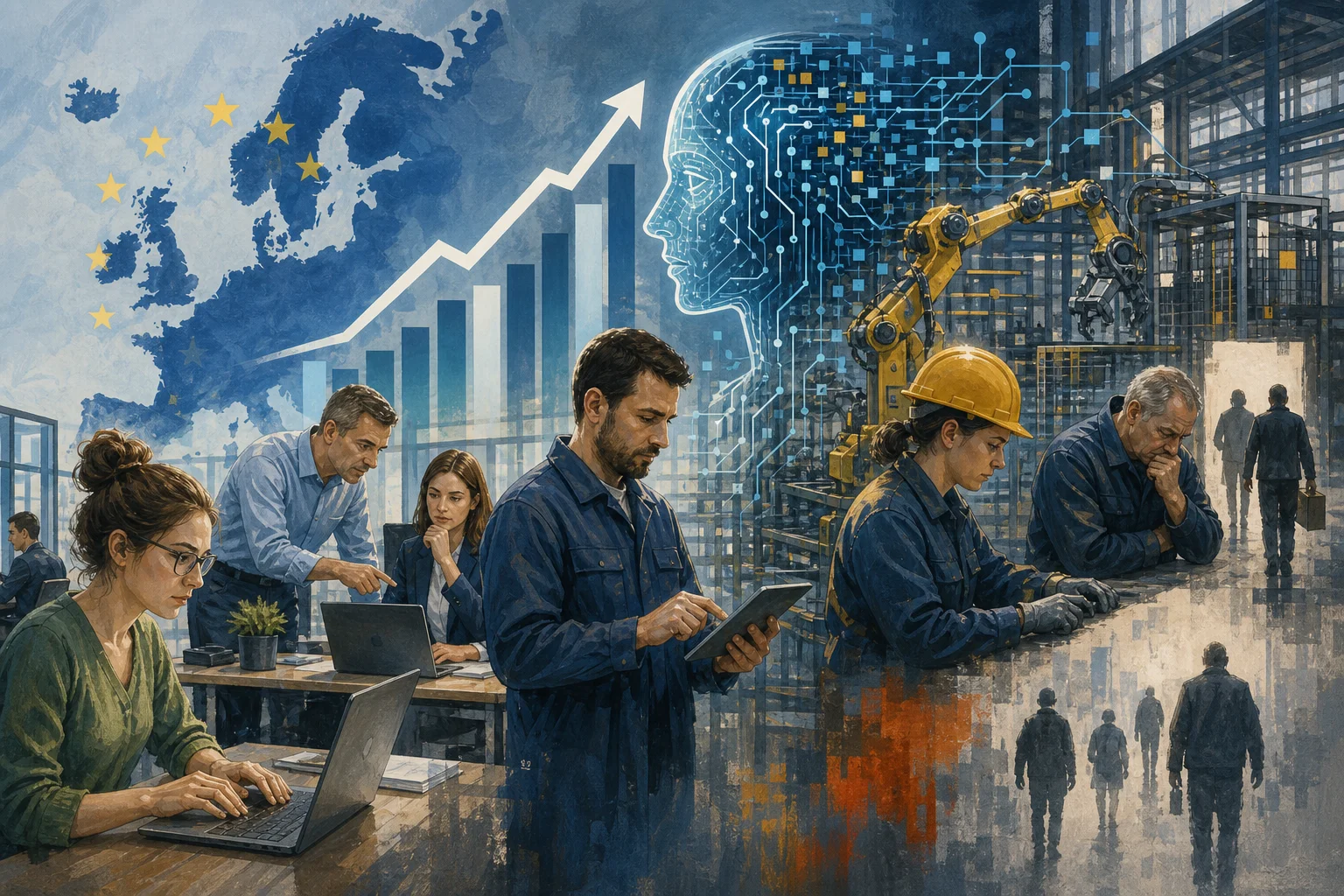
The International Monetary Fund said AI could lift European productivity by about 1% over five years, while also warning that the gains and costs are likely to be distributed unevenly across countries, regions and workers. Reuters reported that the IMF paper was prepared for an informal meeting of EU finance ministers in Dublin on September 18-19, 2026, and the IMF said about 60% of workers in advanced European economies are in occupations highly exposed to AI.
The same IMF material said around one in ten job vacancies in advanced economies already asks for at least one new skill. It also said Europe needs retraining and social supports to facilitate churn from old vocations to new ones, and Reuters reported that some workers faced displacement as routine tasks become automated.
Taken together, the IMF’s message is not that AI produces a single labor-market outcome, but that the region’s results will depend on how benefits, costs and adaptation are distributed. The supplied sources identify productivity gains, exposure risk, skill demands and displacement pressure, but they do not identify which specific countries, regions or occupations within Europe would gain or lose first.
What the IMF said
The IMF said AI could raise European productivity by about 1% over five years. In the IMF’s wider framing, AI could lift global annual potential growth by 0.1–0.8 percentage points eventually, and could hit the labor market like a tsunami, affecting up to 60% of jobs in advanced economies. The IMF also said around one in ten job vacancies in advanced economies asks for at least one new skill.
The report also said Europe needs retraining and social supports to manage churn from old vocations to new ones. The supplied sources do not identify a specific program, budget, or timetable for that response. They do not say the measures have been adopted; they only state the IMF’s call for them.
Who is affected
The clearest group identified in the supplied sources is workers in advanced European economies. The IMF said about 60% of them are in occupations highly exposed to AI. Reuters added that some workers faced displacement as routine tasks become automated. The IMF’s own framing, as supplied here, points to routine-task jobs as a particular area of risk, while also saying that labor-market effects are likely to be uneven.
The sources also say the benefits and costs are likely to be distributed unevenly across countries, regions and workers. That is a broad statement about distribution, not a claim that the same outcome will occur everywhere or for every occupation. The supplied material does not identify which workers are most likely to gain wage premiums, which are most likely to lose jobs, or which countries would be most affected.
What changed
The change described in the bundle is not a policy decision but a warning and an estimate. The IMF put a numeric estimate on the possible productivity gain—about 1% over five years—and paired it with a warning about uneven distribution, displacement pressure and the need for retraining and social supports. Reuters said the IMF paper was prepared for an informal meeting of EU finance ministers in Dublin on September 18-19, 2026.
That combination matters because it links AI to labor-market restructuring rather than to vague long-term speculation. But the supplied sources do not state that European governments adopted the IMF’s recommendations, nor do they identify any ministers’ response, any agreement, or any follow-up decision.
Scale and uncertainty
The scale in the supplied reporting is large, but it is specific. The IMF said about 60% of workers in advanced European economies are in occupations highly exposed to AI. It also said around one in ten job vacancies in advanced economies already asks for at least one new skill. Those figures suggest a broad labor-market transition, but the sources do not provide country-by-country totals, sector-by-sector exposure, or a forecast for how many jobs would be lost or created.
The uncertainty is also explicit. The IMF said the benefits and costs are likely to be distributed unevenly across countries, regions and workers. That wording leaves open where gains will accumulate, where costs will land, and how quickly workers can move from old vocations to new ones. The supplied sources do not define the pace of that adjustment beyond the IMF’s call for retraining and social supports.
What to watch next
The next developments to watch are the ones the supplied sources already point to: whether European policymakers respond to the IMF’s warning with retraining plans, social supports, or other labor-market measures; whether more countries or regions report similar exposure levels; and whether vacancy data continue to show demand for new skills. The sources do not identify any announced timeline for those steps, so any update would need to be reported as it emerges.
For now, the most concrete conclusion in the supplied material is that AI’s effects in Europe are being described as both a growth opportunity and a labor-market stress test. The IMF’s figures point to potential productivity gains, but also to broad exposure among workers in advanced European economies and to the need for adjustment if routine tasks continue to be automated.
Source scope
The supplied material attributes the productivity estimate and the retraining call to the IMF, and attributes the Dublin meeting context and the displacement framing to Reuters. It does not supply additional company statements, and it does not identify specific firms, unions, or government departments. It also does not state that any requested action has been granted or that any labor-market program is underway.
Sources
- Europe and the Global AI Race — International Monetary Fund
- IMF tells EU ministers AI could boost growth but increase economic strains — Reuters