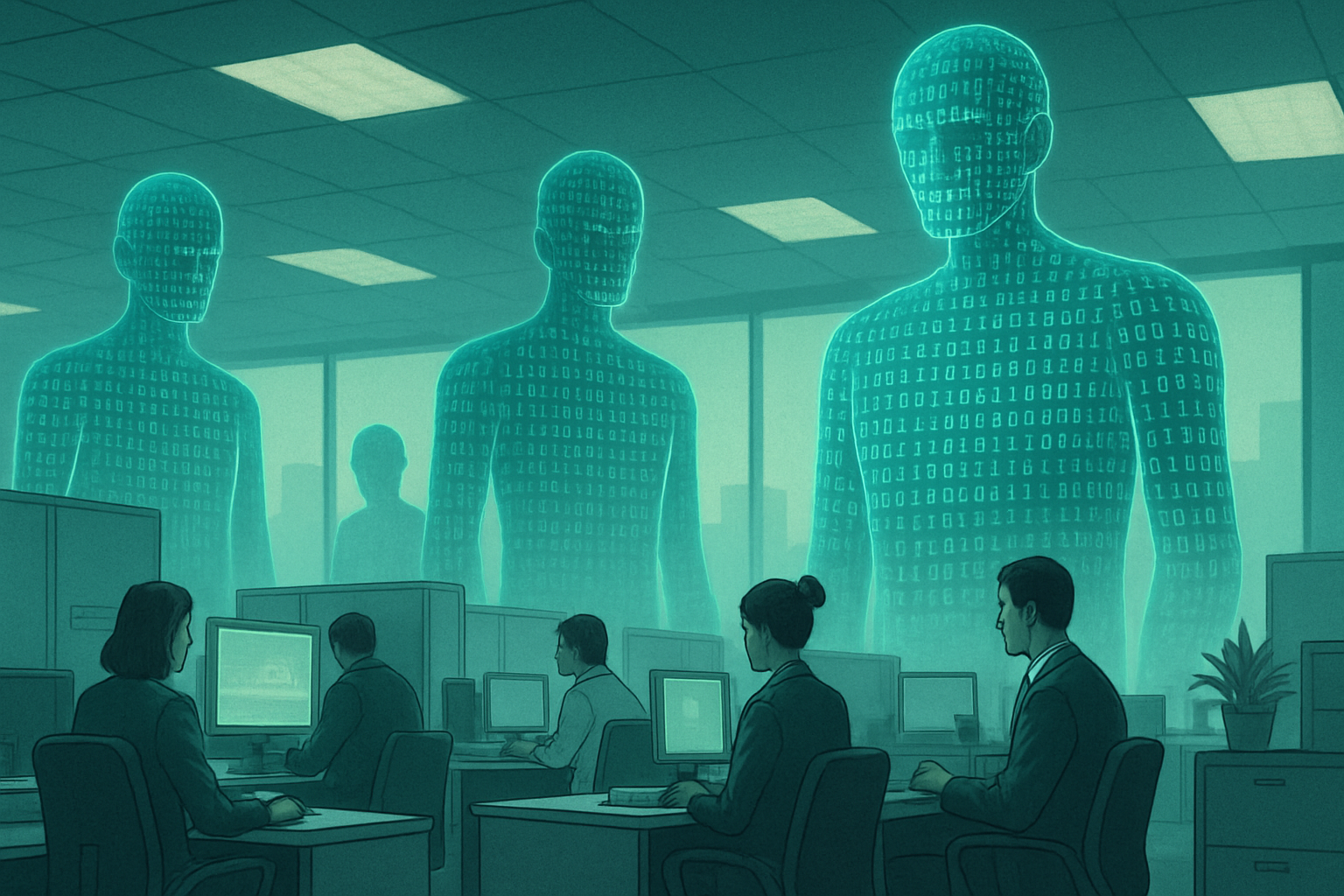
AI Impact on the Job Market – News (August 1, 2025 to August 8, 2025)
Ever notice how fast those “future of work” predictions age these days? It feels like just yesterday we were debating *whether* AI would impact the job market. Now, it’s all about *how much* and *how fast*. This week, the news hit harder and faster than a runaway Roomba – layoffs directly linked to AI are mounting, industry leaders are sounding alarms, and the legal landscape is scrambling to keep up. Buckle up, because this isn’t your grandma’s technological revolution.
AI-Driven Job Cuts: The Numbers Don’t Lie
The numbers are starting to paint a grim, but increasingly clear, picture. Outplacement firm Challenger, Gray & Christmas dropped a bombshell this week: **over 10,000 jobs were cut in July *alone* due to generative AI adoption.** That’s not a typo. AI is now a top-five reason for job losses in the US, and since 2023, over 27,000 jobs have been axed thanks to our silicon overlords. Think about that for a second. What was once theoretical is now a hard, cold statistic. And it’s not just about automating repetitive tasks anymore; these are jobs requiring cognitive skills, creativity, and problem-solving – the “thinking” economy is next.
Why is this important? Because these aren’t just random job losses; they represent a fundamental shift. The speed at which generative AI has moved from a niche tool to a major job displacement factor is alarming, suggesting an exponential curve of adoption and impact. While reskilling is touted as the solution, the sheer volume and speed of this shift present an unprecedented challenge: what skills remain relevant when the very tools of creation and analysis are being automated?
The bleeding is particularly acute in the tech sector. More than 89,000 tech jobs have vanished through July 2025, a 36% jump from last year. And while companies might not always explicitly blame AI, the writing’s on the wall. IBM, for example, is planning to replace around 7,800 back-office positions with AI in the next five years. It’s the new corporate math: fewer humans + more AI = bigger profits.
The View from the Top: Dystopia or Augmentation?
The titans of tech and finance are weighing in, and the forecasts are… well, let’s just say they’re all over the map. Billionaire investor Vinod Khosla is predicting AI could make *80%* of current jobs obsolete within five years, advising the younger generation to rethink their career paths. Ford CEO Jim Farley echoed this sentiment, warning AI will “replace literally half of all white-collar workers.” That’s a lot of existential dread to unpack.
Perplexity AI CEO Aravind Srinivas is putting his money where his mouth is, announcing their new AI browser, Comet, is designed to fully automate recruiters and administrative assistants. Anthropic CEO Dario Amodei previously warned that AI could eliminate 50% of entry-level white-collar jobs within five years. It’s not just about automating tasks; it’s about automating entire *roles*.
However, not everyone’s singing the same doomsday tune. Google’s Sundar Pichai sees AI as an “accelerator” that will enhance productivity and *create* demand for employees. Salesforce CEO Marc Benioff and Nvidia CEO Jensen Huang are also firmly in the “AI as augmentation” camp. Bill Gates offered a more nuanced view, acknowledging AI is already replacing humans in roles like telesales and coding because it’s “way cheaper and more accurate.”
So, who’s right? The optimists or the pessimists? The truth, as always, is probably somewhere in the messy middle. But one thing is clear: the debate is shifting from *if* AI will change work to *how drastically* and *how quickly*.
Gen Z in the Crosshairs: The Entry-Level Apocalypse?
This week, the focus sharpened on the immediate impact of AI on younger workers, particularly those in entry-level roles. Goldman Sachs senior economist Joseph Briggs warned that Gen Z professionals, especially in junior tech positions, are on the front lines of job displacement as companies automate routine tasks. The data bears this out: there’s been a noticeable drop in listings for those entry-level corporate jobs typically filled by recent grads.
GitHub CEO Thomas Dohmke delivered a blunt message to software developers: “Either you embrace AI, or get out of this career.” The job of a developer isn’t disappearing, he argues, but it’s being “reborn,” demanding a new skillset centered on partnering with AI. It’s a sink-or-swim moment, and the water’s rising fast.
California’s Legal Firewall: AI Discrimination Under Scrutiny
While the federal government seems content to let the AI chips fall where they may, California is taking a different approach. The California Civil Rights Council approved sweeping new regulations, effective October 1st, 2025, that fundamentally reshape how AI is used in employment decisions. These rules define AI tools as potential sources of illegal discrimination, expanding the existing Fair Employment and Housing Act (FEHA) to encompass “automated decision systems.”
Why is this a big deal? Because it means the algorithms, the data, and the outputs of AI tools used in hiring, firing, and promotions will be scrutinized with the same rigor as human biases. But the real kicker is the redefinition of an employer’s “agent,” which now includes third-party AI vendors. AI companies selling their platforms to California businesses are now potentially *liable* for discriminatory outcomes produced by their tools, even if the employer is the end-user. Expect a scramble for “FEHA-compliant” AI solutions and a new layer of legal scrutiny in sales contracts. The question now isn’t just “Can AI do this job?” but “Will AI doing this job expose us to legal peril?”
The “Super-Stimulant” Paradox: Economic Boom, Unequal Benefits
It’s not all doom and gloom, right? Well, sort of. While AI is displacing workers, it’s also acting as a “super-stimulant” for the U.S. economy, injecting unprecedented capital into advanced semiconductor manufacturing, data centers, and energy infrastructure. Giants like Nvidia, Microsoft, and Alphabet are pouring resources into AI development and deployment, providing a significant boost to an otherwise shaky economy.
But here’s the rub: the primary beneficiaries are the tech behemoths and their shareholders, consolidating wealth at an alarming rate. While capital flows freely and corporate profits soar, how much of that wealth is trickling down to the workforce, especially those displaced by the very technologies fueling the boom? We need to think beyond mere retraining programs and reassess how economic gains are shared and what constitutes valuable human contribution in an AI-driven world.
AI-Accelerated Downturn: The Next Recession Will Be Different
Speaking of economic instability, a recent Axios report suggests the next recession could trigger an AI-induced purge of millions of workers. Historically, companies turn to automation to cut costs during downturns. But with the current maturity and accessibility of AI, this cost-cutting impulse could trigger an unprecedented wave of displacement across white-collar professions. U.S. Federal Reserve officials are reportedly acknowledging AI’s profound role in reshaping labor markets, suggesting AI is now a factor in how the Fed views core economic metrics like “maximum employment.” It forces us to consider not just AI’s transformative power in isolation but its role as a catalyst, turning a cyclical downturn into a structural reset for millions of workers.
The Outsourcing Earthquake: Even India’s IT Giants Are Feeling the Heat
The AI revolution isn’t just impacting Western economies; it’s shaking up the global outsourcing industry as well. Tata Consultancy Services (TCS), India’s leading outsourcing firm, announced its largest-ever layoff, impacting over 12,000 employees. While officially attributed to “skill mismatches,” industry experts agree that AI is automating core functions like coding, testing, and customer support that have long been the bread and butter of the outsourcing industry. Projections are sobering: up to 500,000 jobs are at risk in the coming years in India’s IT sector. The message is clear: the onus of adaptation is shifting, and it’s increasingly falling on individual employees to acquire new skills and proactively manage their career trajectories.
State-Sponsored AI Fraud: A New Level of Economic Infiltration
Just when you thought the AI job market chaos couldn’t get any weirder, a cybersecurity firm, CrowdStrike, revealed a chilling new trend: North Korean operatives are leveraging generative AI to secure remote tech jobs globally, funneling the illicit earnings directly into the nation’s weapons programs. These actors use synthetic personas, AI-simulated video call appearances, and automated execution to manage multiple full-time roles simultaneously. This isn’t just about job displacement; it’s about the weaponization of AI to bypass traditional gatekeepers and exploit systems designed for efficiency and remote collaboration. It raises profound questions for the future of work: How do organizations verify the authenticity of a remote hire when every facet of their digital identity can be synthetically generated?
The week’s takeaway? AI’s impact on the job market is no longer a distant threat; it’s a present reality that demands our attention and action. The rules of the game are changing, and those who adapt will have the best chance of surviving – and even thriving – in this new landscape.