The day the entry-level went missing
Somewhere between a requisition form and a procurement ticket, a habit hardened into policy. A hiring manager opened a headcount request and, before typing the job title, sent a message to IT: “Can our current stack do this with AI?” That reflex—try software before salaries—was the spine of yesterday’s story. The British Standards Institution surveyed more than 850 leaders across seven economies and found what many graduates already feel in their inboxes: companies are edging out junior hires not with a round of layoffs, but with a quiet reroute of the funnel toward machines.
The numbers are bracing because they come from the people making the calls. Forty-one percent of executives said AI is enabling them to reduce headcount. Nearly a third now search for an AI answer before posting a role, and about two in five expect that to be standard in five years. A quarter believe most entry-level tasks can already be handed to AI, and 39% acknowledged they’ve cut or reduced junior roles because research, admin, and briefing work is now automated. The rhetoric in annual reports mirrors the behavior: “automation” is showing up almost seven times more often than “upskilling” or “retraining.”
The quiet reroute
What looks like a tech upgrade is, in practice, a structural rewrite of how careers start. The entry layer of modern organizations—where interns triage inboxes, analysts scrape data, and assistants draft briefs—has historically been a training market disguised as a labor market. Those first tasks teach tools, norms, and unwritten rules. If AI absorbs the tasks, it also swallows the on‑ramp. Leaders know it; more than half in the survey reportedly admitted they feel fortunate to have begun their careers before AI became ubiquitous. That’s nostalgia with a spreadsheet behind it: the apprenticeship model is being unstitched at the bottom while expectations remain fixed at the top.
Senior‑only orgs and the training debt
There is a seductive logic to “no juniors”: fewer managers, quicker output, cleaner budgets. But it accrues a training debt that compounds. Without entry roles, who becomes mid‑level in three years? Who builds system intuition that doesn’t show up in documentation? You can buy senior talent, but you can’t buy institutional memory that hasn’t been grown. Yesterday’s data sharpened the paradox: 76% of UK leaders expect tangible AI benefits within a year—fast enough to justify skipping hires now—while many of the same organizations will face a capability cliff later if they automate the apprenticeship.
The language tells you the destination
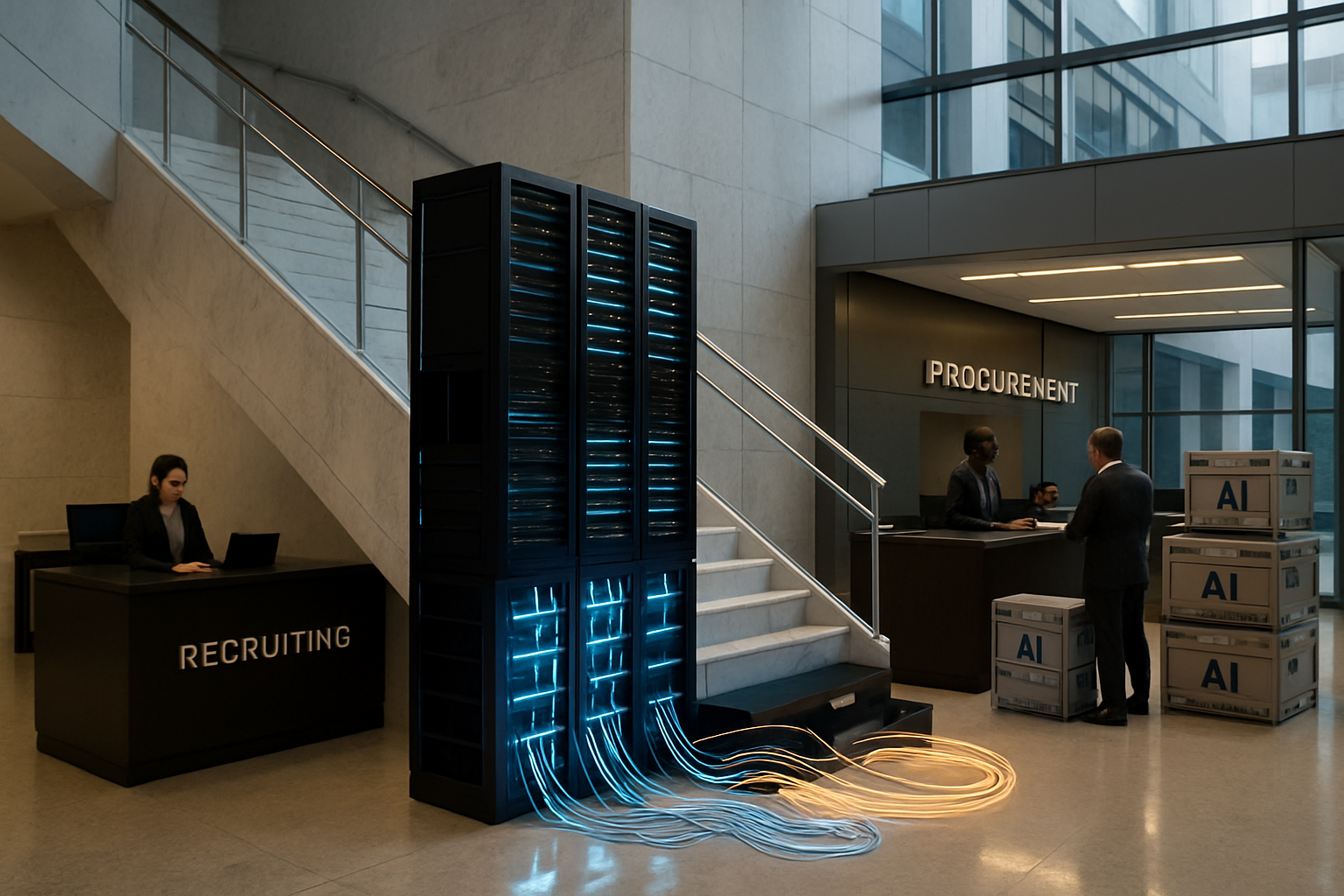
Corporate filings are rarely poetry, but they are maps. When “automation” outruns “upskilling” seven to one, the destination is replacement, not redesign. That phrasing has budget consequences. Recruiting budgets shrink while AI procurement lines expand. The firm’s cost base tilts from labor to compute, from HR to vendor contracts, from onboarding to integration. In that shift, career ladders are replaced by dashboards, and the only way to climb is to arrive already on the roof.
Fragility behind the efficiencies
BSI’s study tucked a warning in the footnotes of enthusiasm: only about half of leaders felt confident operations would continue uninterrupted if key AI tools went down. In the rush to prune headcount, firms are quietly creating single points of failure. The redundancy that juniors once provided—the messy, human ability to improvise when systems hiccup—doesn’t have a procurement SKU. Resilience now depends on model uptime, vendor solvency, and prompt libraries that no one has printed. Cost savings today can become continuity risk tomorrow, and the incident postmortem won’t accept “the model was rate‑limited” as an excuse to clients.
Why yesterday mattered
This wasn’t another forecast about jobs in 2030; it was employers admitting they’ve already changed the order of operations. The most consequential labor story in AI right now is not layoffs—it’s non‑hires. When the “entry” in entry‑level evaporates, the social signal arrives a year later as graduates cycle through unpaid projects, as job posts quietly add “3–5 years’ experience” to roles that used to teach novices on the clock, and as the informal economy of internships turns into unpaid prompt‑ops. The market impact shows up as wage compression at the bottom and premium inflation at the top, with fewer rungs to travel between them.
What to watch next
If this AI‑first posture persists, expect graduate schemes to shrink and rebrand as “AI operations residencies,” with work that blends tool evaluation, data curation, and safety testing—roles that didn’t exist five years ago but now carry the learning content juniors once got from spreadsheets and standups. Watch the ratio of procurement spend to recruitment spend; it’s a clean indicator of where the firm thinks capability lives. Pay attention to risk disclosures around AI downtime and to any measurable commitment to training hours per employee; those two sentences will tell you whether leadership sees people as a control surface or just a redundancy line item.
A narrower but better path
There is a way through that doesn’t romanticize the past or pretend the spreadsheet will be ignored. It starts by acknowledging that AI does eat entry‑level tasks—but it doesn’t have to eat apprenticeships. Companies can pair models with structured rotations that deliberately teach judgment, make evaluation and red‑teaming core early‑career work, and measure managers on how many juniors graduate into independent contributors. Regulators and standards bodies can nudge continuity planning so the cost of over‑replacement shows up before an outage does. And executives can say, with their budgets rather than their press quotes, that “people power progress,” as BSI’s Susan Taylor Martin put it, not as a sentiment but as a system design choice.
The story yesterday was not that AI is coming for jobs. It’s that the first rung is already being removed. In the short run, that looks like efficiency. In the long run, it looks like a ladder to nowhere.