
(Warning: This article contains statistics and projections that may cause career anxiety. Reader discretion is advised.)
The Unsettling New Reality – The Storm Has Arrived
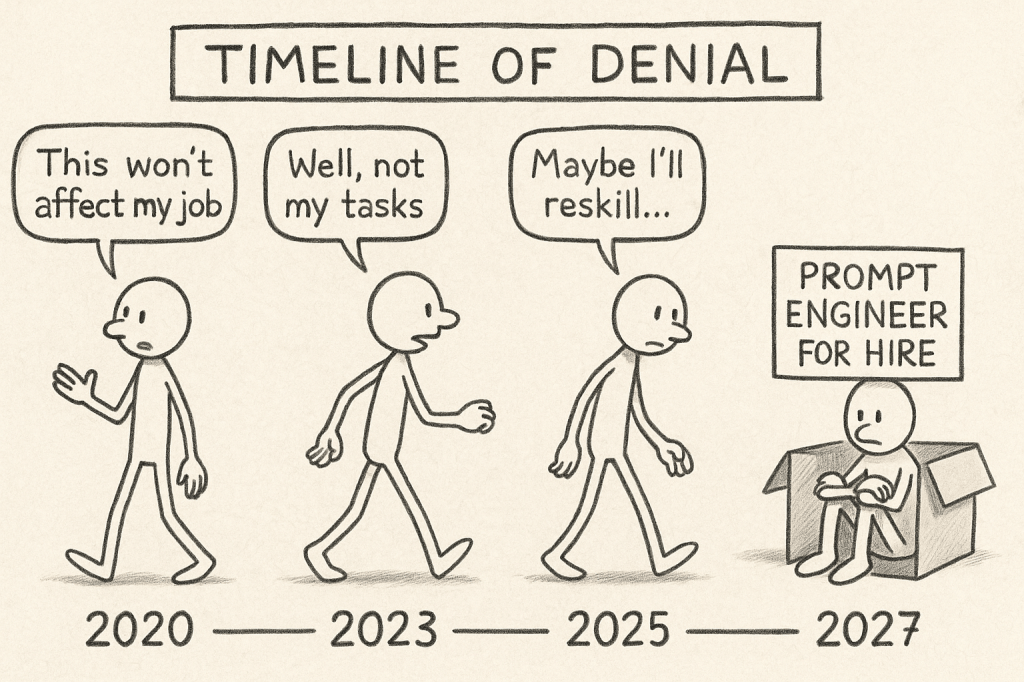
The International Monetary Fund (IMF) sent an alarming jolt through the global workforce in early 2024: AI is expected to affect nearly 40% of jobs worldwide, a figure that skyrockets to a shocking 60% in advanced economies. This isn’t a distant forecast; it’s an immediate, stark reality. The quiet worries have turned into loud alarms. Headlines that once guessed at the future now report what’s happening daily. The unease about the future of work, once a small rumble, is now a major earthquake. We’re not just at the edge of a cliff anymore; we’re in the middle of a huge tech storm driven by Artificial Intelligence (AI). This is not a drill. This is the new, unsettling reality. As Elon Musk bluntly says, “We will have for the first time something smarter than the smartest human… there will come a point where no job is needed”. This statement, from someone at the forefront of new technology, casts a long, worrying shadow over all workers worldwide.
The question troubling every workplace, from busy factory floors to quiet offices, is no longer just a ‘what if’ question, but something urgent everyone needs to face: “What happens if an algorithm takes my place?” Pretending this big change won’t touch your career, your industry, or your basic sense of value as a professional is a risky and foolish idea. AI isn’t spreading slowly like past technologies that took decades to catch on. Instead, as Microsoft CEO Satya Nadella notes, we are witnessing “the fastest diffusion of technology in our lifetime”. This AI shadow isn’t just creeping; it’s swallowing things whole, and the time to just watch is over.
The Statistical Tsunami: Updated, More Alarming, and Undeniable
Let’s stop guessing and look at the hard facts. The numbers coming from the world’s top economic and research groups show a deeply worrying and immediate shake-up—a flood of numbers that’s already hitting us.
The Cold, Hard Data: A Deluge of Disruption
The scale of AI’s possible effect on jobs is shocking. Analysts at Goldman Sachs warn that AI could affect the equivalent of 300 million full-time jobs worldwide. This represents a scary 9.1% of all workers worldwide who could face major changes. The World Economic Forum’s (WEF) “Future of Jobs Report 2025” predicts that by 2030, while 170 million new roles may appear, a shocking 92 million current jobs will disappear. This “churn,” as the WEF calls it, is 22% of today’s jobs—a time of massive upset for people, even if more jobs are predicted overall. So many jobs will be lost that nearly one in four workers will see their job change completely or disappear.
“by 2030, it’s predicted that only 33% of tasks will be done only by humans”
World Economic Forum Report (2025)
Short-term predictions aren’t much better. An earlier WEF report showed a net loss, with 83 million jobs globally expected to be cut by 2027, while only 69 million new ones were created. The International Monetary Fund (IMF) in 2024 estimated that AI is expected to affect nearly 40% of jobs worldwide, a number that jumps to a scary 60% in richer countries. This isn’t a small issue; it’s a powerful economic wave hitting all countries and types of businesses. McKinsey’s research, while pointing out AI’s potential to add $13 trillion to the economy by 2030, also warns that these improvements will probably make the differences bigger between countries, companies, and, most importantly, individual workers. This suggests that the huge economic benefits of AI won’t be shared equally, possibly creating a very divided job market where people who can’t adjust are left even further behind. In fact, a previous McKinsey report predicted that by 2030, 14% of the global workforce, or 375 million workers, might have to find completely new careers because of AI.
Sector-Specific Annihilation: Where the Algorithmic Axe Falls Hardest
AI isn’t hitting all jobs equally. Certain areas and roles are directly targeted and could disappear soon. Data from aireplaced.me, looking at over 22,500 submissions, shows an average risk of jobs being replaced is almost 35% by 2030, and some jobs have even worse chances: Accounting and Auditing at 53.7%, Travel Agents at a shocking 85%, and Payroll Coordinators at 75.0%.
The WEF has repeatedly pointed out the danger to roles like Data Entry Clerks (expected to lose 7.5 million jobs by 2027), Administrative Secretaries, Customer Service Representatives, and Paralegals. Analysis from CognitiveToday.com predicts huge job losses by 2025 in important areas: Manufacturing (4.6 million jobs, 20% loss), Transportation (3.3 million jobs, 50% loss), Financial Services (2.9 million jobs, 28% loss), and Customer Service (2.5 million jobs, 40% loss). The same source estimates job loss percentages for specific roles across different industries: Data Entry (90%), Customer Service Representatives (75%), Factory Workers (70%), Retail Salespersons (65%), and Call Center Operators (80%).
AI is moving in without stopping. NoCodeInstitute.io shows that 0% of factory tasks will be automated by 2025, and it will also heavily affect bookkeeping, online customer support, and even bank tellers. WINS Solutions lists a depressing number of jobs in danger, including discovery preparers in law, medical secretaries, transcriptionists, proofreaders, cashiers, receptionists, radiologists, pathologists, assembly line operators, quality inspectors, and contract lawyers. A study by Antonin Bergeaud highlights secretaries, accountants, and telemarketers as some of the jobs most at risk.
Even jobs that seemed safe because they needed a lot of skill are now clearly at risk. The user draft’s worry about entry-level programmers is made worse by Elon Musk’s shocking prediction that robots will be better than even the best human surgeons in about five years. This breaks the nice idea that having a good degree or special skills will protect you from automation, spreading fear to highly educated and skilled workers who used to feel safe. Jobs that relied on thinking and knowledge are being steadily worn away.

Executive Mandate: Efficiency Over Everything – Your Job is a Line Item
This huge shake-up isn’t happening by chance; more and more, it’s planned. Company leaders are actively and strategically planning to use AI, and cutting jobs is often a clear or hidden goal. The WEF’s 2025 “Future of Jobs Report” found that 40% of employers expect AI automation to reduce their workforce. A PwC survey showed something similar, with one in four CEOs expecting that smart AI will lead to job cuts of 5% or more in 2024 alone. More data from Resume Builder shows that 44% of companies currently using or planning to use AI think it will cause layoffs in 2024.
The main reason is the push for more efficiency and to get ahead of competitors. PwC’s 2024 AI Jobs Barometer reveals that 70% of CEOs say AI will significantly change how their company creates, delivers, and captures value in the next three years, and 84% believe it will boost employee efficiency. This constant drive for efficiency, while good for company profits, often means fewer human workers are needed. Sundar Pichai, CEO of Alphabet, summed this up by saying, “The risk of underinvesting is dramatically greater than the risk of overinvesting” in AI. These huge investments always lead to big changes in how things are done, with jobs being closely looked at and often cut. A revealing survey of Chief Human Resource Officers by The Conference Board found that while 62% said trying out AI for human resources tasks was a top priority, only 7% said they were putting plans in place to retrain people in jobs that AI is very likely to take over. This big difference shows that companies are focused on using AI to make more money, and helping workers who are affected seems to be a much lower priority, if it’s a priority at all. In this way of thinking, employees risk being seen as just numbers on a spreadsheet to be managed for cost.
Task Automation is Pervasive: AI is Nibbling Away at Your Role, Bit by Bit
Even for jobs that are not completely cut, how we work is changing in a very basic way. AI is steadily automating specific tasks within jobs, which could mean many jobs slowly disappear piece by piece. Researchers from OpenAI and the University of Pennsylvania estimate that 80% of the U.S. workforce could see at least 10% of their work tasks affected by Large Language Models (LLMs), with about 19% who could have half or more of their tasks affected. McKinsey predicts that by 2030, a shocking 30% of work hours in the U.S. could be done by AI. Goldman Sachs agrees with this trend, guessing that AI could affect 50% of all work tasks in all types of businesses by 2028.
The WEF’s “Future of Jobs Report 2025” gives a clear timeline for this change: by 2030, it’s predicted that only 33% of tasks will be done only by humans, a big drop from 47% in 2025. Machine-only tasks are expected to go up to 33%, and work done by people and machines together will make up the other 34%. This means a complete change in what ‘work’ means, where being able to work well with AI becomes most important. Economist Erik Brynjolfsson questions stories that are too positive, stating, “There’s no economic law that says ‘You will always create enough jobs or the balance will always be even’, it’s possible for a technology to dramatically favour one group and to hurt another group, and the net of that might be that you have fewer jobs”. This automation of tasks, even if it doesn’t replace whole jobs, can lead to jobs needing fewer skills, where the important human parts of a job get smaller, making the human work left less important and possibly paid less.
The table below pulls together some of the scariest predictions, giving a serious, quick summary of the AI-driven changes rushing towards workers everywhere:
| Metric | Projection | Source(s) | Year of Projection | Implication for YOU |
| Global Jobs Impacted/Exposed | ~300 million full-time job equivalents | Goldman Sachs | 2023/2024 | Huge scale of possible disruption. |
| Global Job Displacement | 92 million roles by 2030 | WEF | 2025 | High chance your job or industry will see big changes. |
| Global Job Creation (New Roles) | 170 million roles by 2030 | WEF | 2025 | Opportunities are there, but need new skills and change. |
| Net Global Job Change | +78 million roles by 2030 | WEF | 2025 | Overall growth, but hides the pain of individual job loss. |
| US Occupations Exposed to AI Automation | Roughly two-thirds | Goldman Sachs | 2023/2024 | High chance your US-based job is exposed. |
| Workload Replaced in Exposed US Occupations | 25% to 50% | Goldman Sachs | 2023/2024 | Large parts of your daily work could be automated. |
| US Workforce with 10%+ Tasks Impacted by LLMs | 80% | OpenAI/UPenn | 2023 | Most jobs will change, even if not fully replaced. |
| US Work Hours Automated by 2030 | 30% | McKinsey | 2023 | Basic shift in how work is done. |
| Global Employment Affected by AI | Nearly 40% (60% in Advanced Economies) | IMF | 2024 | AI isn’t a small issue; it’s a big economic force. |
| Employers Expecting AI to Reduce Workforce | 40% | WEF | 2025 | Your employer might be planning cuts. |
| CEOs Expecting GenAI to Lead to Job Cuts (5%+) | 1 in 4 (in 2024) | PwC | 2023 | Immediate pressure on number of jobs. |
| Shift in Human-Only Tasks | From 47% (2025) to 33% (2030) | WEF | 2025 | Your job will increasingly involve or be done by machines. |
The Algorithmic Onslaught – Companies Making Moves NOW
The threat of AI-caused job loss is not something far off; it’s happening right now. Many companies, including well-known ones, are already making big decisions that directly affect their workers, saying AI is a main reason.
- Klarna, the fintech company, has been very open, saying its AI helper is doing the work of 700 full-time customer service staff and has helped cut marketing costs by $10 million a year.
- Google started layoffs in 2024, especially in its ad department. While not always clearly stated as AI replacement, these cuts happened at the same time as a lot of AI was used in customer service and ad sales to make things run more smoothly. CEO Sundar Pichai also showed a faster push into AI, hinting in early 2025 about new AI products and features, emphasizing how urgent things are and the need to “reimagine our products and processes for a new era”.
- IBM has publicly said it plans to replace about 30% of its back-office jobs—around 7,800 positions—with AI and automation in the next five years. The company has already cut back or stopped hiring for some jobs that don’t deal directly with customers, including in human resources.
- Duolingo, the language learning app, let go of 10% of its contract workers in January 2024. This was part of a major change towards using AI to create content and translate, as the company wants to put AI first.
- British Telecom (BT) has laid out a plan to cut its workforce by as many as 10,000 employees within seven years, with using AI being a big help in making the company smaller and more efficient.
- Tech giants Meta and ByteDance also had layoffs in 2024-2025, with news connecting these cuts to using AI for jobs like checking content and aiming ads. Meta, like Google, had previously had big layoffs after hiring a lot during the pandemic.
- Logistics company UPS announced plans to cut 20,000 jobs, with automation and AI changing jobs mentioned as reasons.
- Intel, a leader in making computer chips, had the biggest tech layoffs in 2024, cutting 15,062 jobs, and was still mentioned for job cuts into 2025 as the industry changed and AI’s widespread effect grew.
- In the finance world, DBS Group in Singapore saw its CEO, Piyush Gupta, say they plan to cut 10% of jobs as AI systems start doing work that was based on contracts.
These company actions are not just happening here and there. They are happening during widespread tech layoffs, with over 100,000 jobs cut in the tech field in 2025 and 95,000 in U.S.-based tech companies in 2024. While not every layoff is directly blamed on AI in company statements, the main push for AI-driven efficiency is a clear, strong force. In fact, a Resume Builder survey found that 23.5% of U.S. companies admitted they already replaced workers with ChatGPT, and even back in May 2023, 3,900 U.S. jobs were lost directly because of AI. These examples change AI job loss from just a scary number into something real and happening now. The “efficiency” companies want often directly means people lose their jobs.
Why This Time Is Different: The Unstoppable AI Engine
History is full of examples of technology changing things, from the Luddites smashing machines during the Industrial Revolution to ATMs changing banking. Each new wave brought worries about job losses, but in the past, economies adjusted, and new kinds of jobs appeared. However, there are strong reasons to think the AI revolution is very different, possibly a bigger threat to the usual idea of work.
Speed & Scale: An Unprecedented Velocity of Change
Previous big technology changes, like electricity becoming common, happened over many decades, giving people, businesses, and schools time to change. The AI revolution, especially with new types of AI that can create things, is happening at a speed never seen before in history. As Microsoft CEO Satya Nadella has said, AI represents “the fastest diffusion of technology in our lifetime”. This idea is supported by analysis from the Tony Blair Institute, which notes that “More than 50 per cent of the US population used ChatGPT within 10 months of its launch – the internet took 17 years to reach the same level”.
How can you get Ready?
Keep Your Job, Don’t let the machines win
The AI job revolution isn’t coming — it’s already here. Get Future-Proof today and learn how to protect your career, upgrade your skills, and thrive in a world being rewritten by machines.
Buy on Amazon
This amazing speed is because AI is getting better very quickly and costing less and less. Sam Altman, CEO of OpenAI, points this out: “The cost to use a given level of AI falls about 10x every 12 months… Moore’s law changed the world at 2x every 18 months; this is unbelievably stronger”. McKinsey’s research suggests that AI use usually starts slowly and then speeds up fast as companies compete and AI gets better. Current evidence strongly suggests we are now in that fast part of the curve, where AI’s effect on the economy—both good and bad—is set to grow much bigger by 2030. This short time to adjust means our usual ways of dealing with change will likely be overloaded, greatly increasing the risk of massive, uncontrolled problems for people and the economy. The point where AI use becomes so common it’s almost impossible to stop is coming very quickly.
Cognitive Capabilities: AI is Coming for Your Brain, Not Just Your Hands
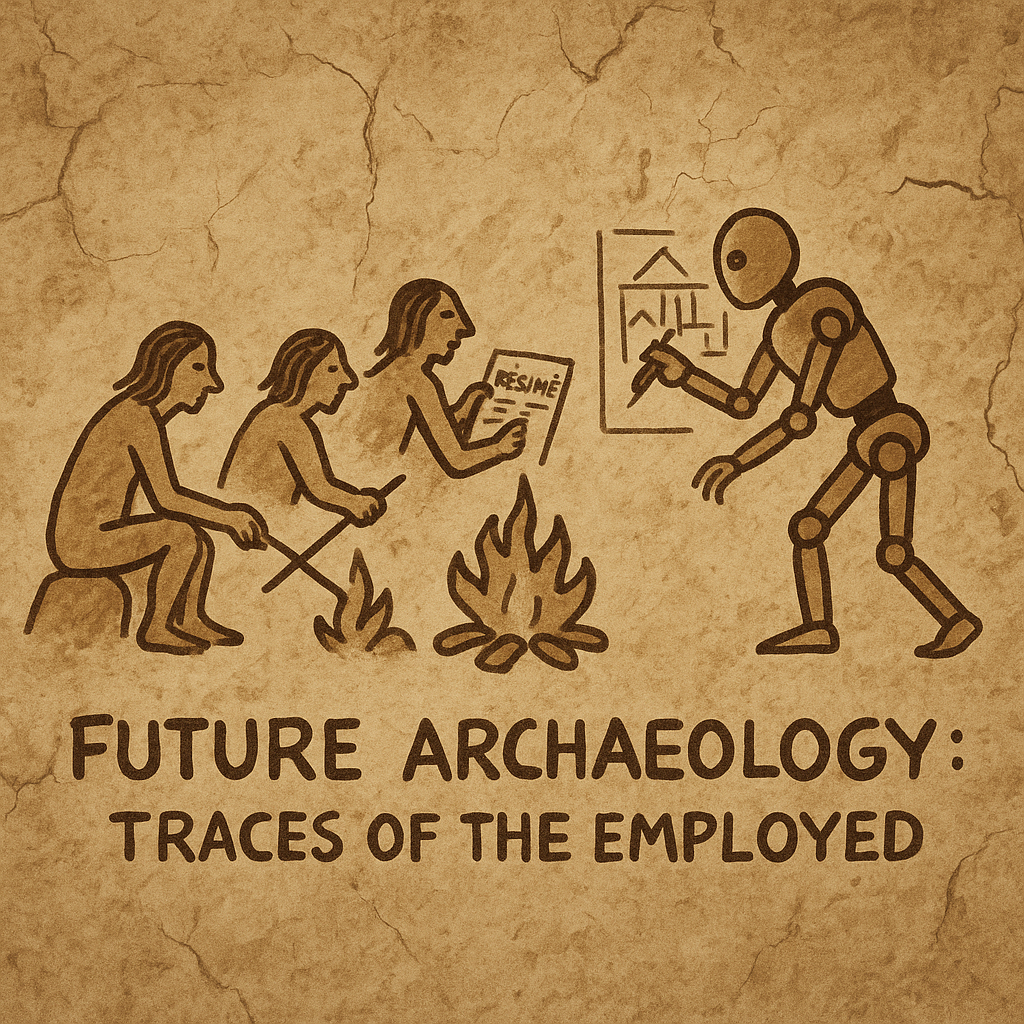
In the past, automation mostly affected physical jobs or repetitive office work. AI, especially the kind that can create new things, is very different because it can do complex thinking work that only humans were thought to be able to do before. This includes jobs like writing computer code, preparing complicated legal papers, accurately looking at medical scans, creating new artistic content, and doing complex money analysis.
What AI can do is amazing and getting better quickly. McKinsey notes that “GPT-4 can so easily pass the Uniform Bar Examination that it would rank in the top 10 percent of test takers, and it can answer 90 percent of questions correctly on the US Medical Licensing Examination”. This shows AI is good at things that take people years of special training to learn. Smart AI’s ability to “create content that profoundly supports human expertise and skills—writing memos and reports, designing website graphics” is changing jobs that require knowledge. AI isn’t just automating single tasks; it is automating thinking itself. A study from the Bank of Italy recognizes smart AI’s ability to “solve complex cognitive tasks and to create original material,” which “may enhance productivity in a wide range of work activities”. Even important planning work like predicting trends is changing because smart AI can look at all sorts of information and find complicated patterns. OpenAI’s Sam Altman has openly admitted, “Our latest model feels smarter than me in almost every way”.
10 Reasons to Read “Keep Your Day Job”
- Assess Your Personal Risk: Use the “Task DNA” framework to pinpoint exactly how AI might impact your specific job duties.
- See the Bigger Picture: Apply the “Trend Decoder Canvas” to understand industry-wide shifts and identify new career opportunities.
- Future-Proof Your Skills: Master the “Skill Barbell” strategy to balance deep human expertise with crucial AI literacy.
- Leverage Your Human Edge: Learn to identify and capitalize on the “Human Latency Premium”—where human judgment beats algorithmic speed.
- Turn Anxiety into Action: Get practical, step-by-step guidance to move beyond fear and proactively adapt.
- Get Realistic, Tested Strategies: Benefit from actionable advice grounded in real-world observation, not just theory.
- Understand AI’s Unprecedented Speed: Grasp why this technological shift is happening faster than previous ones and why you need to act now.
- Identify At-Risk Tasks: Recognize the “Ghost Town” chores in your role that are ripe for automation.
- Build Mental Resilience: Develop techniques to manage the stress and uncertainty of navigating career changes.
- Learn from the Past: Gain valuable perspective from historical technological disruptions to make smarter choices today.
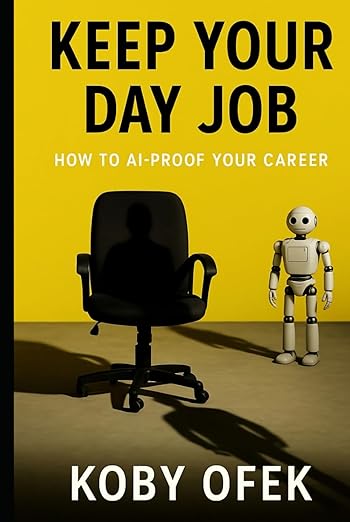
Get “Keep Your Day Job” Right Here.
AI moving into these smart job areas breaks the old idea that complicated thinking, creativity, and expert decisions are special human skills safe from being automated. As Andrew Ng, a world leader in AI, has stated, “It is difficult to think of a major industry that AI will not transform. This includes healthcare, education, transportation, retail, communications, and agriculture”. The message is clear: people who work with information, professionals, and creative types are no longer protected just because their jobs are complex.
Economic Efficiency: The Brutal Calculus of Automation
Companies’ constant push for efficiency and profit gives them a strong, almost unstoppable reason to use AI. AI offers a harsh reality: it doesn’t need pay, benefits, sleep, or encouragement. The money saved and the increase in work done can be huge, making it very attractive for businesses to automate, often more important than worries about people losing jobs.
The example of Klarna, which cut $10 million from its yearly marketing budget by using AI and whose AI tools can do the work of 700 human agents, is a clear example of this money-driven need. PwC’s research supports this, finding that business areas with a lot of AI are seeing almost five times (4.8x) more growth in how much work gets done. Also, 70% of CEOs surveyed by PwC believe AI will greatly change how their companies create, deliver, and capture value, with 84% of those already using AI expecting their workers to get more done. The predictions for the whole economy are just as convincing: Goldman Sachs estimates that smart AI could boost the world’s economy by 7% (almost $7 trillion) and increase productivity growth by 1.5 percentage points over ten years. McKinsey estimates the long-term AI opportunity is a shocking $4.4 trillion in extra productivity growth just from how companies can use it.
These huge money reasons create a situation where using AI isn’t just a choice but a must for businesses trying to stay ahead. The sheer size of these possible gains means that people losing jobs, while maybe sad for some, is often seen as something that just has to happen for progress and efficiency. This creates a strange situation for workers: AI makes the economy and companies more productive, but this doesn’t automatically mean things get better for all workers. In fact, it often means fewer workers are needed to do the same amount of work, or even more, because companies decide to cut jobs to save money from being more efficient.
AI-First Workflows: Humans in Support Roles, If At All
The use of AI is changing from just using AI tools in current ways of doing things. Businesses are increasingly changing their basic ways of working to be “AI-first,” where people’s work is set up to help AI systems, instead of AI helping people. This big change in thinking has huge effects, possibly making whole departments useless if their work can be done better by AI from start to finish.
Nvidia CEO Jensen Huang imagines a future full of “AI factories,” where companies don’t just make their main products or services, but also have separate places just for making and using the AI that runs their business. This shows a basic rebuilding of how businesses are set up, with AI as the main driver. While Microsoft’s Satya Nadella talks about designing AI with “human agency both at a premium and at the center,” the word “premium” itself hints that lots of people being involved might become more special and less usual.
The data from the WEF’s “Future of Jobs Report 2025” shows this change in numbers: the share of tasks done only by humans is expected to drop sharply from 47% in 2025 to just 33% by 2030. At the same time, tasks done only by machines are expected to go up to 33%, and work done by people and machines together will make up the other 34%. This big change shows that “AI-first” isn’t just a popular phrase but a description of how things are starting to work. It means AI is becoming the main control system of businesses, requiring a total change in methods that will surely find many old human jobs to be slow or problematic. The area of “human-only” work is quickly getting smaller, putting pressure on people to show their special, can’t-be-replaced value in a world increasingly run by smart machines.
The constant push for efficiency, along with AI’s fast-growing thinking skills and the basic rebuilding of how work is done, makes its deep and widespread use in jobs seem less like a maybe and more like something that has to happen for money reasons.
The Human Cost: Beyond the Paycheck, Into Your Psyche
Job loss due to AI is much more than just an economic adjustment; it’s a very personal and often upsetting event that hits people’s sense of who they are, their money security, and their mental health hard. This wave of AI threatens to wear away not just how people make a living, but also their feelings of self-worth and their contribution to society for millions.
Identity Crisis: When Your Skills Become Algorithmic Echoes
For many people, work is very closely tied to their feelings of self-worth, purpose, and who they are. Losing a job, especially to an unfeeling algorithm, can cause deep feelings of being useless, worried, and sad. As Koby Ofek, author of “Keep Your Day Job,” sadly asks, “What happens when our hard-won skills start losing their economic value… Or when the very nature of work feels hollowed out, automated not just in its drudgery but potentially in its meaning…?”. This question gets to the heart of the worry: when skills you’ve worked hard to get over years are copied or done better by a machine, what happens to how valuable you feel?
The numbers are serious, the trend seems like it can’t be stopped, and what it means for people is scary. It’s easy to feel helpless, lost in this AI wave. But you can adapt. You can become stronger. This is where “Keep Your Day Job: How to AI-Proof Your Career” by Koby Ofek comes in. This isn’t just another book of vague advice; it’s a vital guide based on real experience and proven methods, made for people who feel their careers are becoming unstable. Realizing that “passively waiting for disruption is the riskiest strategy”, “Keep Your Day Job” offers a sensible, real guide for getting through these rough times. It gives you practical tools and ways of thinking to, first of all, Figure Out Your Risk. Using new ideas like “Task DNA”, the book helps readers carefully compare their current skills and job duties with what AI can do as it quickly gets better. This very important first step, as Koby Ofek says, deals with the urgent need for answers as “The ground is shifting beneath our feet, impacting real jobs and demanding answers now”. By understanding your specific risks, people can go from being passively worried to actively and smartly adjusting.
Financial Instability & The Widening Chasm: AI and Deepening Economic Polarization
The most direct and painful effect of AI-caused job loss is often serious money problems. But beyond individual struggles, AI also carries a big risk of making existing money differences worse, possibly splitting society into a divided job market with AI-boosted high earners on one side and a struggling lower class on the other, as thinkers like Yuval Noah Harari have warned.
An IMF study from 2024 shows a complicated situation: while AI might replace some high-income workers, which could reduce wage gaps, these same people are often in a better position to benefit from AI through increased productivity (as their tasks work well with AI) and higher profits from investments. The overall effect, especially when companies can choose how much AI to use, is a “pronounced increase in wealth inequality”. This suggests that even if some high-paying jobs are affected, the way wealth is spread out could become much more uneven.
The IZA World of Labor agrees, saying that “AI also exacerbates labor market inequalities by displacing routine-based, low-skilled jobs and favoring highly educated employees. The risk of job displacement disproportionately affects workers without AI skills, increasing the divide between high- and low-skilled employees,” and predicts that AI might worsen overall income inequality. Economists Acemoglu and Restrepo also point out that AI is likely to make inequalities bigger by increasing returns on money invested and having different effects based on age and education.
A clear reason for this division is the much higher pay that AI-specific skills command. Research shows that AI skills can mean a pay increase of 23% to 25%. This creates a high barrier for many, effectively splitting the job market. McKinsey’s research further supports this, suggesting AI may widen performance gaps between workers, with demand and wages growing for those with digital and thinking skills, while shrinking for those doing repetitive tasks that are easily automated. Economist Nouriel Roubini has repeatedly warned of AI’s potential to create “surplus humans” and deepen inequality, imagining a situation where “a tiny top echelon will win while everybody else loses”. The fast loss of value of non-AI skills in this new situation threatens to push many into difficult financial situations, making economic divides even stronger.
The Psychological Siege: AI’s Toll on Our Well-being
The constant fear of being replaced by AI, even before actually losing a job, creates ongoing stress and takes a big toll on the mental health of workers. The American Psychological Association (APA) found that workers worried about AI are nearly twice as likely to say that their job negatively affects their mental health. Specifically, 51% of those worried that AI might make some or all of their job duties outdated also said that their work has a negative impact on their mental health, compared with only 29% of those who did not report being worried about AI.
This worry shows up in real ways: 64% of those worried about AI typically feel tense or stressed during the workday, compared to 38% of those not worried. These worried workers also more often experience signs linked to workplace burnout, such as being irritable, wanting to be alone, lack of motivation, feeling less productive, feeling emotionally drained, and feeling ineffective. They are also more likely to feel that they don’t matter at their workplace, are not valued, and are being micromanaged.
Recent surveys confirm this widespread worry. A February 2025 Pew Research Center survey found that 52% of U.S. workers are worried about the future impact of AI use in the workplace, and 32% believe it will lead to fewer job opportunities for them in the long run. Only 6% think AI will create more job opportunities for them. A Resume Now survey from the same month revealed that a shocking 89% of workers are concerned about their job security due to AI, and 43% personally know someone who has already lost a job to AI. Furthermore, 63% of workers in this survey believe AI use will introduce workplace bias affecting hiring and promotions.
This worry is not spread evenly. Young workers (aged 18-24) are 129% more likely to be worried than older workers (65+) about AI making their jobs outdated (32% vs. 14%, respectively). An IBM study supports this growing unease, noting that nearly 25% of workers worry about their jobs becoming outdated due to AI, an increase from 15% in 2021. This “anxiety tax” is a significant mental health burden, reducing productivity and engagement for many workers, and it can ironically prevent the very ability to adapt needed to get through these difficult times. The loss of psychological safety and trust, fueled by fears of job loss and a lack of employer openness about AI plans, can stop the innovation and risk-taking that are essential for adapting.
Erosion of Dignity: The Algorithmic Overseer
Beyond job loss and money worries, the increasing use of AI in workplace management—what Koby Ofek’s book calls “algorithmic management”—can feel deeply dehumanizing. When performance is constantly tracked by software, and important career decisions are made by unclear algorithms, people can be reduced to just numbers on a screen, taking away their sense of control and dignity.
The OECD has clearly identified “loss of agency, bias and discrimination, breaches of privacy and a lack of transparency” as significant risks associated with AI in the workplace. When AI systems heavily influence or decide hiring, promotion, and firing decisions, the lack of openness and the potential for built-in biases within these systems can leave employees feeling powerless and subject to mysterious, often unfair, technological forces. This “black box” effect on careers undermines the basic human need for fairness and control over one’s work life. The shift from human-led management to algorithmic control can also reduce vital human elements like mentoring, empathy, and supportive leadership, creating a colder, more transactional, and ultimately less dignified work environment.
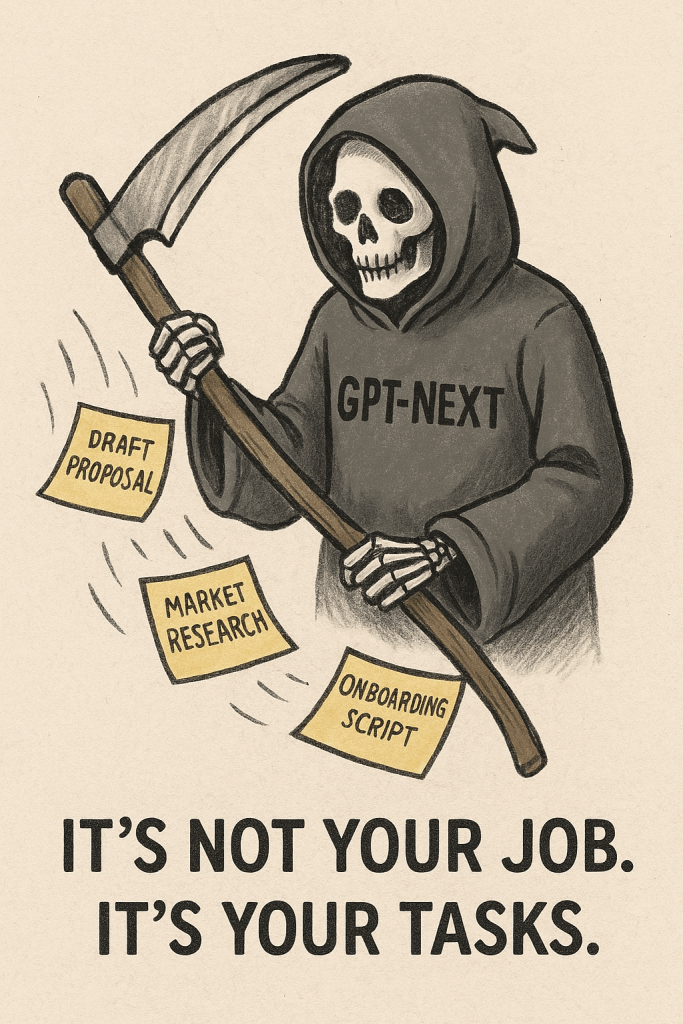
The ground is definitely shifting, and the psychological, social, and economic effects are huge. Passively waiting, hoping the storm will pass you by, is without a doubt the riskiest thing to do in this new era.
The challenges shown by these numbers and trends are huge, creating a sense of urgency and, for many, deep worry. However, giving in to helplessness is not an option. The key is to actively adapt and strategically prepare. This is exactly what “Keep Your Day Job: How to AI-Proof Your Career” focuses on. After figuring out your specific risks with tools like “Task DNA,” the book then gives you ways to build strong defenses. One such vital tool is the “Trend Decoder Canvas”. This framework helps you look beyond immediate job threats to understand the bigger technological and economic changes reshaping your industry. By understanding these trends, you can find new areas of “adjacent value”—new opportunities that appear as old jobs change or disappear. Furthermore, the book introduces the “Skill Barbell” strategy: a powerful method that involves developing deep, uniquely human skills (like complex ethical judgment, empathy, and subtle strategic thinking that algorithms find hard to copy) on one end, and essential AI knowledge (the ability to effectively use AI tools as partners) on the other. This balanced approach, focusing on what Koby Ofek calls the “Human Latency Premium”—areas where human insight and responsibility are valued more than just algorithmic speed—is key to building a strong and future-proof career. “Keep Your Day Job” is about strategically investing in the skills and viewpoints that make you essential, even as the definition of ‘your place’ in the workforce changes.
The Uncomfortable Truth: Adaptation is Not Optional, It’s Survival
The evidence is overwhelming, experts largely agree, and the real-life experiences of a growing number of workers are undeniable: the AI-driven change of the job market is not a distant possibility but a quickly speeding-up reality. To ignore this is to risk your career becoming obsolete.
The Converging Consensus: Experts Agree, the Deluge is Real
A striking agreement of concern comes from the top levels of technology, economics, and policy. These are not anti-technology alarmists but the very people creating and analyzing the AI revolution.
Satya Nadella, CEO of Microsoft, admits the big shift: “The biggest lesson learned is we have to take the unintended consequences of any new technology along with all the benefits and think about them simultaneously”. While he also notes that “AI won’t replace programmers, but it will become an essential tool in their arsenal”, this itself means a massive change in how work is done, needing new skills and the ability to adapt.
Elon Musk’s statements are typically blunt: “We will have for the first time something smarter than the smartest human… there will come a point where no job is needed”. He further warns, “The risk of something seriously dangerous happening is in the five-year time frame. 10 years at most”, covering societal and job risks.
Sundar Pichai, CEO of Alphabet, calls AI “the most profound shift of our lifetimes” and has stressed that “2025 will be critical… These are disruptive moments”, urging a proactive approach.
Jensen Huang, CEO of Nvidia, a company powering much of the AI hardware, predicts Artificial General Intelligence (AGI) by 2028 and believes “Everything that moves will be autonomous someday”. He estimates that AI will eventually handle “20, 30, 40% of 100% of the jobs in the world”.
Sam Altman, CEO of OpenAI, expects that “Eventually, I think the whole economy transforms. We’ll find new things to do… It’s true that some jobs go away, but we find so many new things to do and hopefully so many better things to do”. While somewhat optimistic in the long term, admitting that “some jobs go away” is crucial. He also emphasizes the “super-exponential” nature of AI’s increase in socioeconomic value, meaning rapid and massive change.
Demis Hassabis, CEO of Google DeepMind, agrees with the AGI timeline, predicting it will arrive within five to ten years and voices a significant concern: “AGI is coming… and I’m not sure society’s ready”.
Well-known AI investor and author Dr. Kai-Fu Lee suggests that AI “replacing routine jobs is pushing us to do what we should be doing anyway: the creation of more humanistic service jobs”, clearly indicating the loss of routine work.
Economist Nouriel Roubini offers a chilling view: “No matter what work you do, artificial intelligence might eventually do it better”, warning of AI potentially creating “millions if not billions of ‘surplus’ humans”.
His contemporary, Erik Brynjolfsson, warns against blindly trusting past events: “There’s no economic law that says ‘You will always create enough jobs…’”. And Andrew McAfee, co-author of “The Second Machine Age,” states, “I honestly believe that I’m going to live to see a ridiculously bountiful economy that just doesn’t need very much human labor”.
This agreement of views from those who are building, investing in, and analyzing AI highlights the deep and immediate nature of the disruption. Relying on the hope that “this too shall pass” like previous technological changes is a gamble with dangerously high stakes. As Koby Ofek states, “passively waiting for disruption is the riskiest strategy”.
The Peril of Inaction: Why “Waiting to See” is a Career Death Sentence
The AI shadow is no longer a distant, unclear threat; it is a harsh, advancing reality. To keep relying only on current skills and existing job roles is like walking through a minefield blindfolded. The sheer speed of AI development means that professional skills are becoming outdated much faster. Technical skills, in particular, can now become useless in less than five years. The WEF’s 2025 report supports this, predicting that 39% of core skills will fundamentally change by 2030. The “it won’t happen to me” attitude is a luxury no professional can afford.
As Koby Ofek warns, “The Acceleration Won’t Wait: Forget gradual change. AI capabilities are advancing at a blistering pace… The gradient is getting steeper before it levels”. While discussions about policy responses like Universal Basic Income (UBI) and large-scale retraining programs are happening, these official solutions are notoriously slow to put in place and may not be enough or come in time to meet the urgent needs of people caught in these changes. The gap between recognizing the problem and effective action at an official level is huge; a BCG study found that while 89% of executives admit their workforce needs better AI skills, only 6% had started meaningful upskilling efforts. Similarly, The Conference Board reported that only 7% of CHROs are actively putting in place retraining strategies for jobs significantly affected by AI.
This slow official response places the main burden of adapting squarely on the individual. Waiting for employers or governments to provide a full safety net or a clear path forward is a strategy full of danger. The cost of doing nothing—becoming obsolete, losing your job, and financial instability—far outweighs the effort needed for proactive adaptation. The time to move beyond worry and into strategic action is not coming; it is now.
Your Lifeline in the Algorithmic Age: Take Control with “Keep Your Day Job”
The statistics are undeniably serious, the path of AI’s integration into the workplace seems unstoppable, and the personal effects are, frankly, terrifying. It is natural to feel a sense of helplessness when faced with a technological force this big. But giving in to that feeling is the most dangerous thing to do. You still have control; you just have to take it.
This is the core message and the deep value offered by “Keep Your Day Job: How to AI-Proof Your Career” by Koby Ofek. This book is not a collection of abstract ideas or hopeful sayings. It is a practical, actionable guide forged from real-world experience and field-tested strategies, designed to empower you to navigate the AI storm. It directly faces the uncomfortable truth that pretending AI won’t affect your career is no longer a workable option.
“Keep Your Day Job” provides the crucial ways of thinking and mental tools necessary to move from passive fear to proactive adaptation. It teaches you to:
- Diagnose Your Specific Vulnerability: Through tools like the “Task DNA” analysis, you’ll break down your current role to understand exactly which parts are most likely to be taken over by AI and which parts hold your unique human strengths.
- Understand the Shifting Landscape: The “Trend Decoder Canvas” helps you understand the broader technological and economic changes transforming your industry, enabling you to spot new opportunities and areas of “adjacent value”.
- Build a Resilient and Future-Proof Skillset: Learn to build your “Skill Barbell,” strategically combining deep, irreplaceable human expertise (in areas like critical thinking, creativity, and empathy) with essential AI fluency. This means using AI as a powerful tool rather than fearing it as a complete replacement.
- Cultivate Mental Fitness: Develop crucial techniques to manage the natural anxiety and uncertainty of this era, fostering the psychological strength needed for the long haul of continuous adaptation.
- Gain Historical Perspective: Understand the patterns from past technological disruptions to fight panic, identify timeless principles of adaptation, and recognize that while change is constant, human ingenuity can find new paths.
The AI shadow is indeed growing longer, and the future of work will undoubtedly look very different. Relying solely on your current role and existing skills is an increasingly risky position. As Koby Ofek strongly argues, “The Acceleration Won’t Wait… The immediate responsibility—and opportunity—ricochets back to the individual”.
Now is the time to move beyond worry and into informed, strategic action. Understand your risk, develop a strong strategy, and begin building your defenses today.
Ready to take control and AI-proof your career?
Learn the practical frameworks and actionable strategies you need. Get your copy of “Keep Your Day Job: How to AI-Proof Your Career” today.
➡️ Find “Keep Your Day Job” on Amazon
Don’t let the future happen to you. Start building your resilience now.
(Disclaimer: This blog post is intended for informational purposes and reflects perspectives based on current data and expert opinions, including those presented in the referenced book and external sources. Future outcomes may vary.)
