
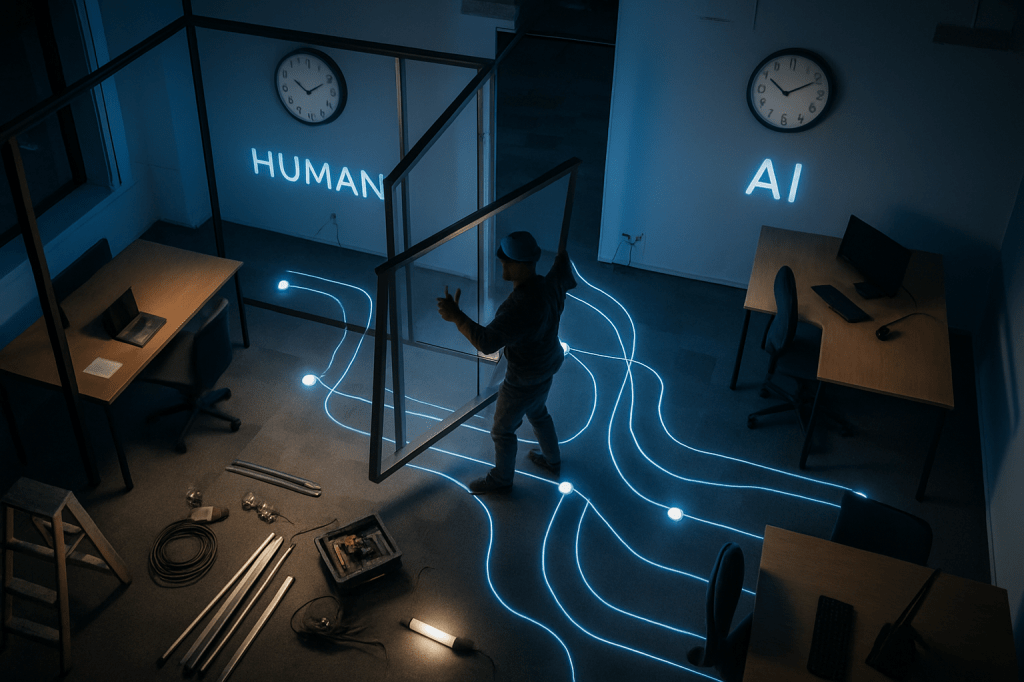
Gartner Didn’t Predict a Jobs Apocalypse. It Drew the Map for Jobs Chaos.
In Barcelona, under the stage lights that usually mint next year’s IT budgets, Gartner did something more unsettling than forecasting. It named the mess. Not collapse, not salvation—a period of jobs chaos, a phase when work itself will be torn down and rebuilt at industrial scale. The message was less prophecy than project plan: starting around 2028–2029, expect the enterprise to live inside a renovation, with walls moving weekly.
Helen Poitevin, a Distinguished VP Analyst, gave the tempo in two daily beats: roughly 150,000 roles evolving through upskilling and another 70,000 being rewritten outright. Blend that across a year and you get more than 32 million jobs reshaped, not as a headline about layoffs, but as an operating reality of redesign, task splintering, and role fusion. The firm’s point was surgical: AI will create more positions than it erases, but the count is the least interesting metric. What matters is the architecture—how tasks flow between humans and systems, and who holds accountability as the flows change.
From headcount to the floor plan of work
Gartner asked leaders to stop treating AI strategy as a tools roadmap and start treating it as work design. The centerpiece was a four-scenario map for human–AI collaboration that enterprises must plan for simultaneously. Some functions will be AI-first, tilting toward autonomy and sparse staffing. Others will keep people at the center, with AI as scaffolding. Many teams will use AI to expand their surface area and do more, while a smaller slice of frontier workers will pair with models to push boundaries in places like personalized medicine or bespoke financial engineering. In practice, that means running parallel operating models under one roof—an AI-forward micro-factory here, a human-centered service pod there, and an augmented knowledge crew connecting the two.
Gartner’s provocation—“AI-first only succeeds when it is people-first”—is not a platitude about empathy. It’s a performance claim. AI-first units only work when the surrounding system recruits human strengths intentionally: judgment, context, escalation, exception handling, and the tacit knowledge that keeps risk below the waterline. The quality of that collaboration becomes the new productivity lever. If you miss on the handoffs, you don’t get efficiency; you get rework, insurance claims, and headlines.
The two clocks already on the wall
Why did this land as the day’s defining employment story? Because Gartner put a date on it. An inflection around 2028–2029 gives boards, unions, universities, and regulators an actionable horizon. That clock starts a second one: the time required to build a skills supply chain. If 150,000 roles a day are evolving, classic corporate learning models—static courses, annual calendars—will snap under the load. You need live curricula tied to task inventories, skill taxonomies that update like code, and performance systems that reward the application of new capabilities rather than seat time. You also need a backlog: a pipeline of micro-redesigns queued and tackled the way dev teams burn down tickets.
This is not abstract. The Symposium stage is where Fortune-scale playbooks are quietly born. If CIOs carry this into budget season, we’ll see line items shift: less spend on isolated “AI pilots,” more on orchestration—workflow rewrites, data contracts, model risk controls, and change capacity in the middle management layer. The organizations that treat change management as an HR memo will trail those that treat it as an engineering discipline.
What changes inside the enterprise
Role design becomes a standing function, not an occasional reorg. Expect job families to be defined as task portfolios, versioned like software, and refreshed every quarter. Compensation will start to account for “AI leverage”—how effectively a person compounds output and reduces error with the systems around them—rather than only tenure and title. New craft roles appear: work designers who decompose and recombine tasks; prompt and workflow engineers embedded with business units; and model risk stewards who keep autonomy within guardrails. Middle managers, long cast as coordinators, become the translators who keep human judgment aligned with machine throughput. Those who can’t translate will be first to feel the chaos.
Metrics will follow. FTE counts fade in importance, replaced by collaboration yield: cycle time through mixed human–AI workflows, exception rates at handoff boundaries, and the gain from augmentation per head. Boards will ask not just “how many people” but “what proportion of work runs in each collaboration mode, and with what defect profile.” In AI-first pockets, the key question becomes whether autonomy increases resilience or simply concentrates failure.
The spillover into policy and labor
Setting a near-term hinge point forces institutions to move. Education systems will need faster loops: modular credentials mapped to task clusters, portable skills records, and partnerships that plug learners directly into live workflows. Safety nets will need to accommodate short, frequent transitions as roles are rewritten, not only long spells of unemployment. Collective bargaining will shift from negotiating headcount to negotiating redesign rights, reskilling guarantees, and visibility into where autonomy will land next. Regulators will care less about whether a model is “used” and more about how accountability is assigned when tasks migrate across the boundary.
The hard part leaders can no longer defer
Gartner’s numbers force an uncomfortable admission: most companies are not staffed to rewrite jobs at the speed implied by 220,000 roles a day evolving or redesigning. The bottleneck won’t be model capability; it will be the choreography of change. That choreography starts with a living map of tasks, a clear stance on which work should remain human-led, and the courage to run AI-first and human-first operations side by side without forcing a false uniformity. It continues with incentives that make redesign part of everyone’s job, not a quarterly initiative. And it ends—if it ends at all—with an operating rhythm where job rewrites are as routine as software updates.
There’s a quiet optimism in this, if you can hear it beneath the noise. Gartner did not offer comfort; it offered a schedule. In a world infatuated with totals—jobs gained, jobs lost—it redirected attention to the fabric of work, to the seams where human strengths and machine consistency either mesh or fray. By calling the next phase “jobs chaos,” the firm didn’t endorse disorder; it demanded stewardship. 2028 is not the cliff. It’s the hinge. The door that swings will depend on who is already holding the handle.
