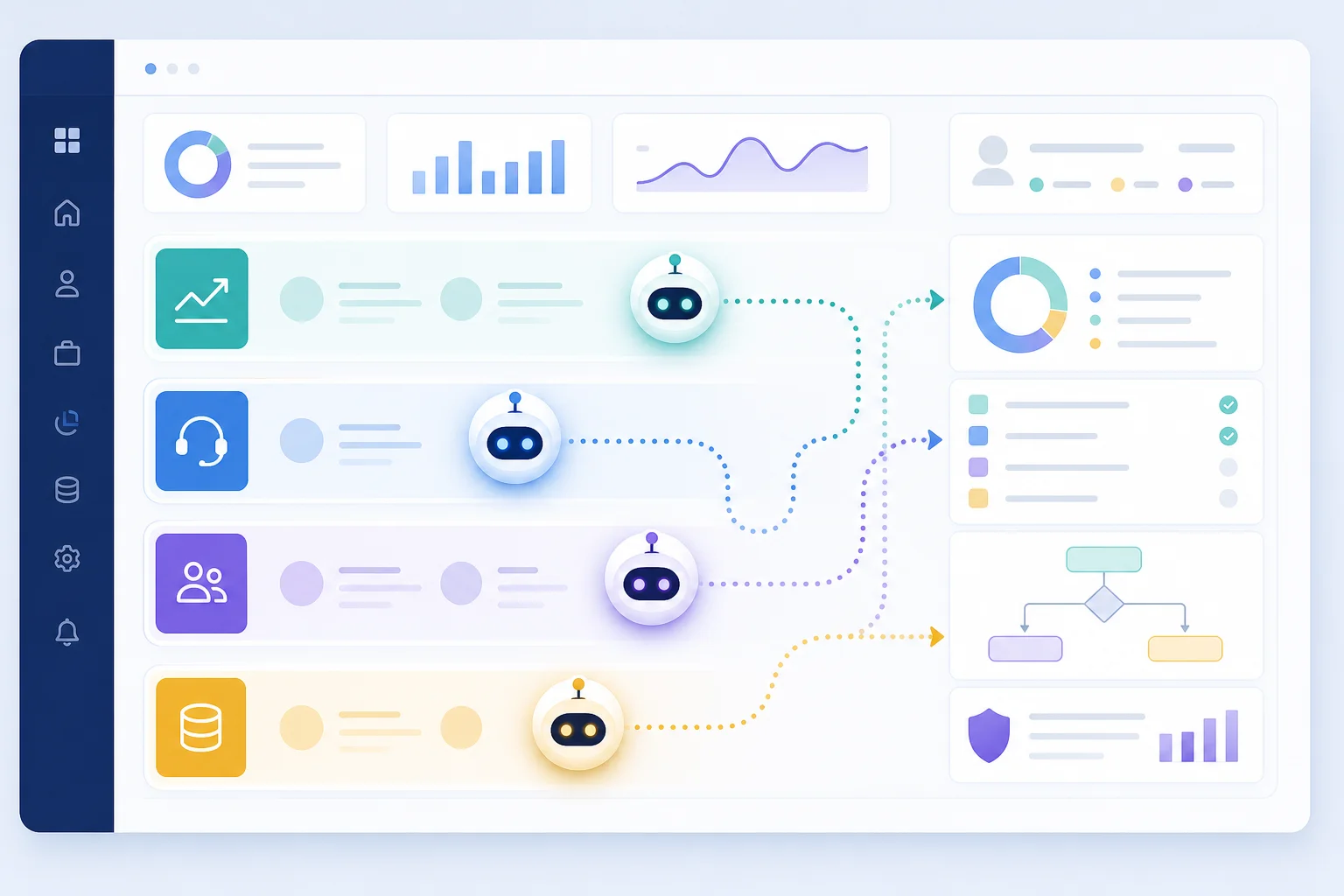
On September 11, Salesforce said it is expanding Agentforce with a new portfolio of “job-ready” AI agents built for high-value work across sales, service, commerce, employee experience, and the back office. The company said the agents can pursue goals over days and weeks, learn new skills, and coordinate with one another. Salesforce also said it has delivered 7 billion Agentic Work Units across Agentforce and Slack, including 3.2 billion in Q2.
The release names several agents and roles. Salesforce described Hunter as a sales agent that works over days and weeks, and said it is in pilot now and scheduled for general availability in November 2026. It described Paige as an IT and HR service agent and Marshall as a supply-chain agent. The release also names Casey, Piper, Carter, and Fin. Salesforce said employees can use AI Skills in Agentforce Coworker to teach it tasks once and scale that know-how across the workforce.
SiliconANGLE reported the launch as an effort to automate sales and technical support tasks and said most of the new features are generally available immediately, with the rest to launch by year-end. The article also said Agentforce Coworker was updated alongside the launch. The supplied sources do not identify whether any particular customer, department, or workforce segment has already changed as a result of these products.
What Salesforce said it is shipping
Salesforce’s announcement presents the new portfolio as a set of packaged agents for specific business functions. In the company’s framing, the agents are designed to take on categories of work rather than simply answer prompts. The named examples in the supplied sources include Hunter for sales, Paige for IT and HR service, and Marshall for supply-chain work, with the broader portfolio aimed at sales, service, commerce, employee experience, and back-office functions.
The supplied sources support the product description, but they do not state that any jobs were eliminated or that any staffing change was announced. They also do not identify any customer rollout beyond the availability details described below.
Availability and rollout details
The rollout details vary by feature, and the supplied sources keep those distinctions separate. Salesforce said Hunter is in pilot now and scheduled for general availability in November 2026. SiliconANGLE said most of the new features are generally available immediately, while the rest will launch by year-end. The supplied sources do not identify which specific features are in each availability bucket beyond those descriptions.
Salesforce also said its “AI Skills” in Agentforce Coworker allow employees to teach tasks once and scale that know-how across the workforce. SiliconANGLE reported that Agentforce Coworker was updated alongside the launch. The sources do not identify the size of any workforce using those tools, nor do they say how many customers are already using the new agents in production.
Why the company highlighted scale
Salesforce highlighted a volume metric alongside the launch: 7 billion Agentic Work Units across Agentforce and Slack, including 3.2 billion in Q2. That figure appears in the company’s announcement as a scale metric, but the supplied sources do not break down what those units represent in customer terms or how much of that activity maps to any particular function.
Based on the supplied sources, the launch is a product expansion aimed at specific business tasks, with one agent already in pilot and scheduled for November 2026 general availability. The sources do not provide evidence of a quantified employment effect or a confirmed staffing change.
What to watch next
The main thing to watch is whether the named agents remain bounded to the roles Salesforce describes or expand into broader operational use. Hunter’s November 2026 general availability is the clearest future date in the supplied material. The rest of the launch is described by SiliconANGLE as mostly immediate, with some features still coming by year-end.
Another point to watch is whether customers use Agentforce Coworker and the named agents to redesign workflows around repeatable tasks. The supplied sources do not identify any specific employer response or internal rollout, so any labor-market effect remains beyond what the evidence here directly shows.
Bottom line
Salesforce’s latest Agentforce expansion adds named AI agents for sales, service, commerce, employee experience, and back-office work. Based on the supplied sources, the launch includes Hunter in pilot with November 2026 general availability, a reported update to Agentforce Coworker, and a company claim of 7 billion Agentic Work Units across Agentforce and Slack. The evidence supports the product launch, not a confirmed staffing outcome.